What kind of spider is this?
Take a clear photo and this free spider identifier will tell you the three most likely species, how sure it is, and whether the spider is worth worrying about.
Most likely matches
AI identification can be wrong. Treat the result as a starting point, not a final answer. Compare with all spiders
How it works
-
Take a photo
Get close, in good light, with the whole spider in view. Your phone camera is fine.
-
Upload it
The photo is shrunk and stripped of location data in your browser before it’s sent.
-
Read the matches
You get the three most likely species, how confident the match is, and how to tell them apart.
Tips for a better photo
-
Use good light
Daylight or a bright lamp. Avoid flash glare on shiny spiders.
-
Shoot from above and the side
The back shows the pattern; the side shows the eyes and body shape.
-
Add something for scale
A coin or ruler next to the spider helps tell similar species apart.
-
One spider per photo
Fill most of the frame with a single spider, in sharp focus.
Spiders people find most often
-
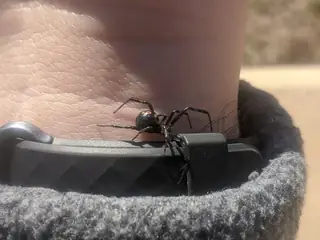 Southern black widow Latrodectus mactans Medically significant 4–13 mm
 -
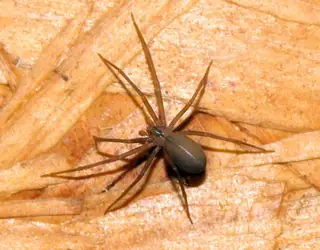 Brown recluse Loxosceles reclusa Medically significant 6–12 mm
 -
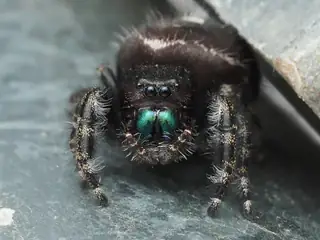 Bold jumping spider Phidippus audax Harmless 6–13 mm
 -
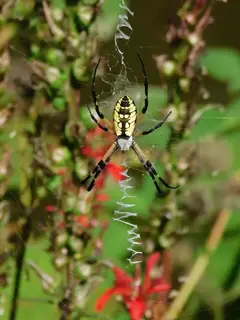 Yellow garden spider Argiope aurantia Harmless 5–28 mm
 -
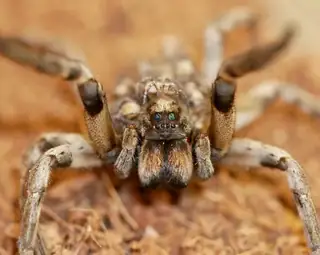 Carolina wolf spider Hogna carolinensis Mild bite 18–35 mm
 -
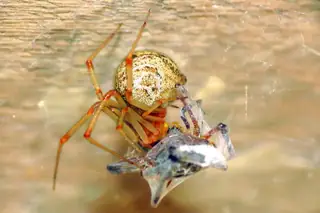 Common house spider Parasteatoda tepidariorum Harmless 4–8 mm
 -
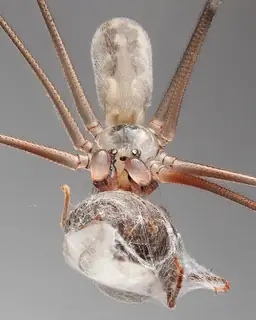 Daddy longlegs spider Pholcus phalangioides Harmless 5–10 mm
 -
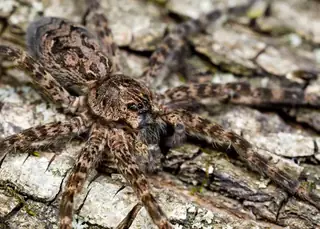 Dark fishing spider Dolomedes tenebrosus Harmless 12–26 mm
Spider identification questions
How can I identify a spider?
Look at four things: body shape, color pattern, where you found it, and the web (or lack of one). The quickest way is to take a clear photo from above and upload it here — the spider identifier compares it with 148 common species and shows the closest matches with photos you can check against.
How do I identify a brown recluse spider?
A brown recluse is plain tan to brown with a darker violin shape on the front body section, the neck of the violin pointing back toward the abdomen. It has six eyes in three pairs (most spiders have eight), long thin legs with no spines or bands, and a body about the size of a nickel or smaller. It lives mainly in the south-central and Midwestern US. Many brown spiders are mistaken for recluses, so compare the details.
How do I identify a black widow spider?
Adult female black widows are glossy black with a round abdomen and a red or orange hourglass on the underside. Northern black widows often have a broken hourglass and red spots on the back. Brown widows are tan to gray with an orange hourglass and spiky egg sacs. False widows (Steatoda) look similar but have no red hourglass.
Is this spider dangerous?
Most spiders are harmless to people. In the US, only widows and recluses are considered medically significant. Every result here shows a danger level — harmless, mild bite or medically significant — and adds safety information for the dangerous ones.
How accurate is the spider identifier?
In our tests on photos it had never seen, it named the right spider family about four times in five, and the exact species was among the top three matches about half to two-thirds of the time. It is tuned not to miss dangerous spiders: in testing, widows, recluses and funnel-webs were flagged 95% of the time. Accuracy drops with blurry or distant photos and with spiders that can only be told apart under a microscope, so always compare the reference photos.
Are my photos stored?
No. Your photo is resized and stripped of location data in your browser, sent once to the AI model for analysis, and then discarded. We keep only an anonymous fingerprint of the image and the result for seven days, so identical uploads are answered instantly.
What if it’s not a spider?
The identifier checks first whether the photo shows a spider at all. Ticks, harvestmen (daddy longlegs), mites and insects are recognized as not spiders, and you’ll see a note explaining the difference.
Can it identify a spider bite?
No. Bites can’t be identified reliably from photos, and many “spider bites” turn out to be something else. If you have a worrying bite, see a doctor or call Poison Control at 1-800-222-1222.
Which spiders does it know?
It knows 148 species: the spiders most often photographed in the United States, plus common species from the UK and Australia, including all the medically significant ones. Browse them on the types of spiders page.
Is it really free?
Yes. There’s no sign-up and no limit beyond a fair-use cap to keep the service running. The site is supported by ads.