Types of spiders with pictures
These are the spider species people photograph most often in the United States, plus common ones from the UK and Australia. Filter by what you saw — color, size, region — or scan the identification chart at the bottom.
-
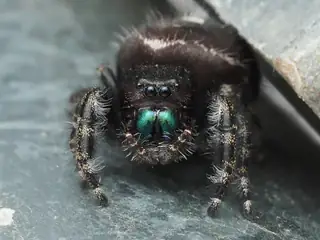
Bold jumping spider
Phidippus audaxSalticidae
Harmless
6–13 mm
This stocky black jumping spider is common around homes, fences and gardens. It hunts by sight and pounces on insects instead of building a web. You may see a white spot on its back and shiny green jaws. It is curious but not aggressive and is considered harmless to people.
How to recognize it
- Chunky, hairy black body
- Iridescent green-blue chelicerae (jaws)
- Large forward-facing front eyes
- White spot or triangle on top of abdomen
Pattern: Black, fuzzy body with a white or orange spot on the abdomen and white bars along the sides.
Habitat: Found on walls, fences, porches, gardens and sometimes indoors near windows.
Range: Across the US and southern Canada
Bites: Bites are rare and happen mainly when the spider is squeezed, with mild, short-lived local effects.
Also called: Bold jumper
Often confused with: Regal jumping spider , Johnson's jumping spider , Brilliant jumping spider
![Bold jumping spider (Phidippus audax), photo 2]()
![Bold jumping spider (Phidippus audax), photo 3]()
-
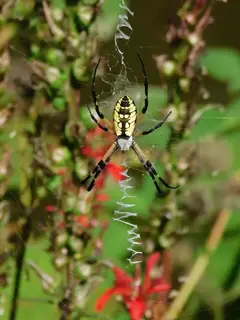
Yellow garden spider
Argiope aurantiaAraneidae
Harmless
5–28 mm
If you see a big black and yellow spider in a round web with a zigzag stripe in the middle, it is probably this one. It sits in the center waiting for insects and is gentle toward people. It is helpful in gardens and bites only if grabbed. Webs usually vanish by late fall.
How to recognize it
- Large oval abdomen with yellow and black pattern
- Legs mostly black with reddish or yellow bases
- Thick zigzag silk band in the web center
- Female much larger than the small brownish male
Pattern: Black abdomen with bold yellow markings; a large, flat web with a zigzag band in the center.
Habitat: Builds big orb webs in sunny gardens, tall grass, shrubs and along house edges; rarely indoors.
Range: Most of the US and southern Canada, into Central America
Bites: Bites are very rare, and effects are usually comparable to a mild bee sting.
Also called: Black and yellow garden spider, Writing spider
Often confused with: Banded garden spider , Wasp spider , Marbled orbweaver
![Yellow garden spider (Argiope aurantia), photo 2]()
![Yellow garden spider (Argiope aurantia), photo 3]()
-
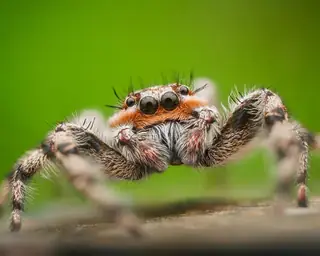
Tan jumping spider
Platycryptus undatusSalticidae
Harmless
6–14 mm
A flat, tan-and-gray jumping spider that blends in with bark and wood siding. It often rests on porch walls and fences, then pounces on insects. It is bold enough to stare back at you, but it rarely bites and is considered harmless.
How to recognize it
- Flattened, mottled tan-gray body
- Large forward-facing eyes in a face with pale hairs
- Pale center stripe on the abdomen
- Males have darker, banded legs
Pattern: Flat, mottled gray-tan body with a pale, wavy-edged band and a darker stripe on the abdomen.
Habitat: Common on tree bark, fences, siding and porches, and sometimes comes indoors.
Range: Eastern and central US and southern Canada
Bites: Bites are uncommon and generally cause only slight local irritation.
Also called: Tan jumper
Often confused with: California flattened jumping spider , Bold jumping spider , Zebra jumping spider
![Tan jumping spider (Platycryptus undatus), photo 2]()
![Tan jumping spider (Platycryptus undatus), photo 3]()
-
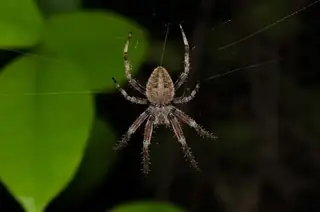
Spotted orbweaver
Neoscona cruciferaAraneidae
Harmless
6–20 mm
This common orb weaver spins a large web at dusk near porch lights and takes it down by morning. Its plump brown or orange body is marked with pale patches and dark spots. It hides during the day and is shy, rarely biting.
How to recognize it
- Plump abdomen with pale marks and black spots
- Banded, spiny legs
- Two small bumps near the front of abdomen
- Dark brown or reddish-orange color varies
Pattern: Brown to orange-ish abdomen with a pale central band, dark spots and a pair of shoulder bumps.
Habitat: Builds orb webs at night on porches, shrubs, fences and near outdoor lights, and rarely enters homes.
Range: Eastern US and southern Canada
Bites: Bites are rare and effects, if any, are mild and local.
Also called: Hentz orbweaver
Often confused with: Red-femured spotted orbweaver , Shamrock orbweaver , Arabesque orbweaver
![Spotted orbweaver (Neoscona crucifera), photo 2]()
![Spotted orbweaver (Neoscona crucifera), photo 3]()
-
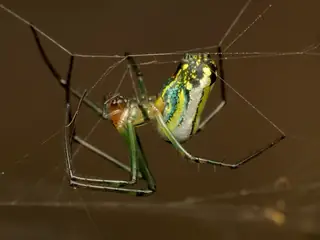
Orchard orbweaver
Leucauge venustaTetragnathidae
Harmless
4–8 mm
A small, shiny orbweaver with a silvery body, dark stripes and a touch of orange near the rear. It hangs upside down in a flat web between leaves and shrubs in gardens and woods. It is gentle, helpful for controlling small insects, and not a danger to people. Bites are extremely rare.
How to recognize it
- Shiny silvery abdomen with dark stripes
- Long, slender legs held outstretched
- Reddish-orange spot at rear of abdomen
- Web is nearly horizontal and flat
Pattern: Silver-green abdomen with black and yellow stripes and red-orange tip near the spinnerets.
Habitat: Hangs in horizontal webs in woods, shrubs and gardens, and rarely comes indoors.
Range: Eastern US and Southern Canada, into Central America
Bites: Bites to people are extremely rare and the venom is not considered harmful.
Also called: Orchard spider
Often confused with: Marbled orbweaver
![Orchard orbweaver (Leucauge venusta), photo 2]()
![Orchard orbweaver (Leucauge venusta), photo 3]()
-
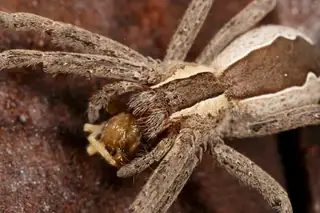
American nursery web spider
Pisaurina miraPisauridae
Harmless
9–18 mm
Long-legged and tan, this spider is often mistaken for a wolf spider. In summer the female carries a pea-sized egg sac in her jaws, then builds a small tent of silk for the babies. It hunts in grass and shrubs and is no danger to people.
How to recognize it
- Long, slender legs held forward in resting pose
- Wide dark central stripe on abdomen
- Light brown color with darker side stripes
- Often holds a round egg sac under its body
Pattern: Tan to brown body with a dark central stripe on the carapace and abdomen.
Habitat: Lives in tall grass, shrubs and woodland edges; occasionally wanders onto porches and into sheds.
Range: Eastern and central US and southern Canada
Bites: Bites are uncommon and generally produce only mild local irritation.
Also called: Nursery web spider
Often confused with: Dark fishing spider , Rabid wolf spider , Carolina wolf spider
![American nursery web spider (Pisaurina mira), photo 2]()
![American nursery web spider (Pisaurina mira), photo 3]()
-
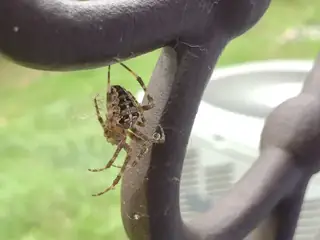
European garden spider
Araneus diadematusAraneidae
Harmless
6–18 mm
A garden favorite in Europe and northern North America, this spider has a pale cross of white dots on its round brown body. It sits in or near its orb web and drops away when disturbed. Bites are very rare and mild.
How to recognize it
- White spots arranged in a cross on abdomen
- Banded brown and tan legs
- Round, plump abdomen with shoulder bumps
- Builds a classic round orb web
Pattern: Brown or orange abdomen with white dots forming a cross on its back.
Habitat: Builds orb webs on fences, garden plants, eaves and bushes; rarely goes indoors.
Range: Europe, UK, northern US and Canada (introduced)
Bites: Bites are very rare and cause mild, short-lived pain similar to a small sting.
Also called: Cross orbweaver, Cross spider, Diadem spider
Often confused with: Marbled orbweaver , Four-spot orbweaver , Spotted orbweaver
![European garden spider (Araneus diadematus), photo 2]()
![European garden spider (Araneus diadematus), photo 3]()
-
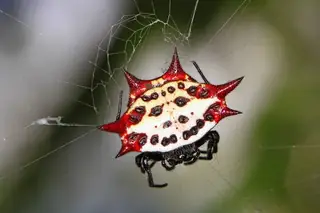
Spinybacked orbweaver
Gasteracantha cancriformisAraneidae
Harmless
2–13 mm
With its spiny, crab-like shell, this spider looks fierce but is harmless. The female is wider than she is long and often white or yellow with red spines. She hangs in a web strung between trees. Males are tiny. It rarely bites people.
How to recognize it
- Hard crab-shaped shell with six spines
- Wider than long abdomen
- Black dots on white or yellow back
- Often hangs in the middle of a web with silk tufts
Pattern: Hard, wide abdomen with six spines, usually white or yellow with black spots and red spines.
Habitat: Builds orb webs in sunny gaps between trees and shrubs; rarely comes indoors.
Range: Southern US, Caribbean and Central America
Bites: Bites are very rare, and the spider is not considered harmful.
Also called: Spiny orb weaver
Often confused with: Spined micrathena , Arrow-shaped micrathena , Christmas jewel spider
![Spinybacked orbweaver (Gasteracantha cancriformis), photo 2]()
![Spinybacked orbweaver (Gasteracantha cancriformis), photo 3]()
-
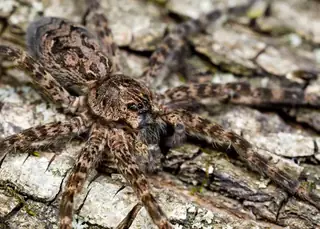
Dark fishing spider
Dolomedes tenebrosusDolomedidae
Harmless
12–26 mm
One of the biggest spiders in the East, with a leg span up to several inches. It often sits head-down on tree trunks or near water. It can move fast and give people a scare, but it bites only when handled. Bites are rarely a problem.
How to recognize it
- Large, heavy body with long banded legs
- Wavy dark chevrons on abdomen
- Pale bands on legs
- Usually found near water or tree trunks
Pattern: Gray-brown body with dark zigzag marks along the abdomen and a pale-edged carapace.
Habitat: Lives near streams, ponds, woods and wooden structures, and sometimes wanders into garages and homes.
Range: Eastern and central US and southern Canada
Bites: Bites are uncommon and generally cause only mild, local pain and swelling.
Also called: Fishing spider
Often confused with: Six-spotted fishing spider , Striped fishing spider , Carolina wolf spider
![Dark fishing spider (Dolomedes tenebrosus), photo 2]()
![Dark fishing spider (Dolomedes tenebrosus), photo 3]()
-
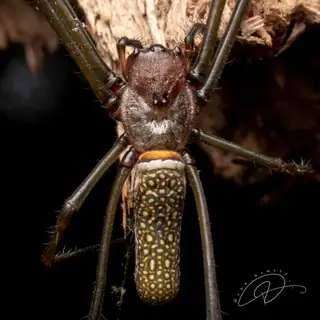
Golden silk orbweaver
Trichonephila clavipesNephilidae
Harmless
4–30 mm
A big, long-bodied spider known for enormous webs with a golden shimmer in sunlight. Females can have a body about as long as a thumb; males are tiny. It is calm and rarely bites, and the bite is generally mild.
How to recognize it
- Long, narrow, torpedo-shaped abdomen
- Fuzzy tufts on leg joints
- Huge webs with golden-tinted silk
- Female far larger than tiny male
Pattern: Long, cylindrical body with a yellow-spotted abdomen and legs with dark tufts at the joints.
Habitat: Builds huge golden webs across trails and between trees, mostly outdoors.
Range: Southern US, Caribbean, Central and South America
Bites: Bites are rare and usually feel like a mild sting with little lasting effect.
Also called: Golden silk spider, Banana spider, Calico spider
Often confused with: Joro spider , Yellow garden spider , Giant golden orb weaver
![Golden silk orbweaver (Trichonephila clavipes), photo 2]()
![Golden silk orbweaver (Trichonephila clavipes), photo 3]()
-
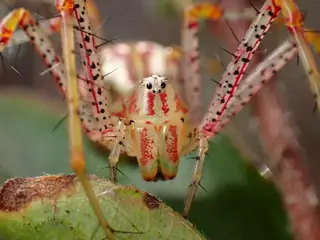
Green lynx spider
Peucetia viridansOxyopidae
Harmless
10–22 mm
A bright green spider that hunts bees, flies and caterpillars on plants and flowers. Its spiny legs help it catch prey. It does not build a web to catch food. Bites are rare and mild, and the female guards her egg sac.
How to recognize it
- Bright translucent green body
- Long, spiny legs with dark spots
- Red-orange spots on carapace and abdomen
- Sits on plants instead of in a web
Pattern: Bright green body with spines on its legs and small red-orange marks on the abdomen.
Habitat: Found on flowers, shrubs and tall grass; seldom comes indoors.
Range: Southern US, Mexico and Central America
Bites: Bites are rare, and mild pain and redness are the usual result.
Also called: Lynx spider
Often confused with: Magnolia green jumping spider , Striped lynx spider , Western lynx spider
![Green lynx spider (Peucetia viridans), photo 2]()
![Green lynx spider (Peucetia viridans), photo 3]()
-
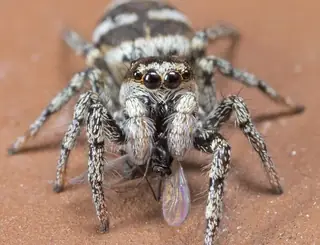
Zebra jumping spider
Salticus scenicusSalticidae
Harmless
5–8 mm
This little black-and-white spider sits on sunny walls and fences hunting flies, and it will turn to look at you with its big front eyes. It stalks its prey and jumps rather than using a web. It does not bite people unless trapped, and the venom is considered harmless.
How to recognize it
- Small flat body with black and white bands
- Large pair of forward-facing eyes
- Short legs, striped
- Jumps in short bursts on walls
Pattern: Black body with white stripes across the abdomen like a zebra.
Habitat: Common on sunny walls, fences, window frames and sheds, and sometimes inside homes.
Range: Europe and UK, North America and Asia
Bites: Bites are very rare, and effects are minor.
Also called: Zebra spider
Often confused with: Asiatic wall jumping spider , Bold jumping spider , Gray wall jumping spider
![Zebra jumping spider (Salticus scenicus), photo 2]()
![Zebra jumping spider (Salticus scenicus), photo 3]()
-
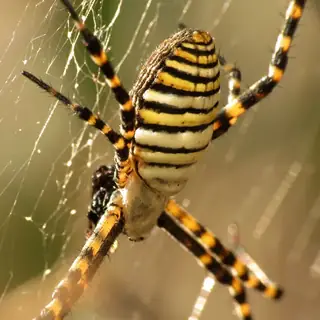
Banded garden spider
Argiope trifasciataAraneidae
Harmless
4–25 mm
A banded orb weaver with a silvery body striped yellow and black, often with a zigzag pattern in its web. It sits in sunny spots in gardens and fields, and it is usually still in the middle of its web. It rarely bites, and a bite would be mild. Harmless to people and helpful against garden pests.
How to recognize it
- Narrow dark crosswise bands on pale abdomen
- Pointed, tapered abdomen tip
- Legs banded black and pale
- Zigzag silk stabilimentum in web
Pattern: Silvery-white abdomen with narrow yellow and black bands across it and a zigzag web stripe.
Habitat: Builds orb webs in sunny open spots, gardens and fields; rarely enters homes.
Range: Worldwide in warm regions; throughout the US
Bites: Bites are very rare, with mild and brief local effects.
Also called: Banded argiope
Often confused with: Yellow garden spider , Silver garden orbweaver , Wasp spider
![Banded garden spider (Argiope trifasciata), photo 2]()
![Banded garden spider (Argiope trifasciata), photo 3]()
-
Western black widow
Latrodectus hesperusTheridiidae
Medically significant
3–16 mm
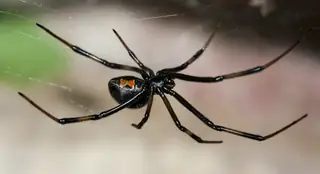
The classic western black widow is shiny black with a red hourglass beneath its round abdomen. It hides in woodpiles, sheds and garages. It is shy and bites mostly when pressed. Bites are uncommon, but they can cause serious symptoms, so seek medical care.
How to recognize it
- Glossy jet-black round abdomen
- Red hourglass underneath, sometimes two triangles
- Messy, irregular tangled web
- Males and young are smaller and have stripes
Pattern: Shiny black body with a red hourglass on the underside of the abdomen.
Habitat: Lives in dark, sheltered spots such as woodpiles, sheds, garages and meter boxes, occasionally indoors.
Range: Western US, southwest Canada and Mexico
Bites: Bites are uncommon, but the venom can cause muscle cramps and other body-wide symptoms, so a suspected bite warrants medical attention.
Also called: Black widow
Often confused with: Southern black widow , Northern black widow , False black widow , Brown widow
![Western black widow (Latrodectus hesperus), photo 2]()
![Western black widow (Latrodectus hesperus), photo 3]()
-
Rabid wolf spider
Rabidosa rabidaLycosidae
Harmless
12–22 mm
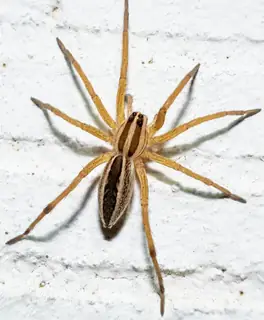
Despite the scary name, this large wolf spider is not dangerous. It hunts on the ground at night, and females carry their egg sacs on their bodies. It can look alarming and runs fast when disturbed, but it bites only if handled or trapped. Bites are uncommon, and effects are usually mild.
How to recognize it
- Pale stripe down the center of the carapace
- Dark spots in a row along the abdomen
- Dark stripe under the legs and belly
- Large, powerful, hairy legs
Pattern: Brown body with a light central stripe and dark bars on the underside of the abdomen.
Habitat: Lives on the ground in grass, leaf litter, woodland edges and sometimes enters garages.
Range: Eastern and central US
Bites: Bites are uncommon and generally produce only mild local pain.
Also called: Wolf spider
Often confused with: Dotted wolf spider , Carolina wolf spider , Drumming sword wolf spider
![Rabid wolf spider (Rabidosa rabida), photo 2]()
![Rabid wolf spider (Rabidosa rabida), photo 3]()
-
Triangulate cobweb spider
Steatoda triangulosaTheridiidae
Harmless
3–7 mm
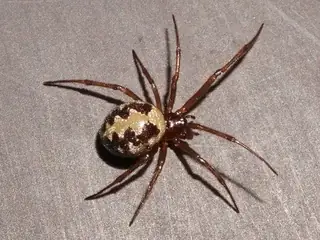
A tiny, tan or brown house spider with a neat row of pale triangles on its back. It lives in basements, corners and closets, catching small insects in tangled webs. Bites are very rare, and it is considered harmless to people.
How to recognize it
- Row of pale triangles on the back
- Small, round, shiny abdomen
- Pale banded legs
- Messy cobweb in corners
Pattern: Round, glossy abdomen with a row of pale triangles along the top.
Habitat: Builds tangled webs in corners, closets, basements and window frames indoors.
Range: Worldwide in homes; throughout the US
Bites: Bites are very rare; this species has no recorded adverse reactions in humans in extension fact sheets.
Also called: Triangulate combfoot, Cobweb spider
Often confused with: Common house spider , Rabbit hutch spider , False black widow
![Triangulate cobweb spider (Steatoda triangulosa), photo 2]()
![Triangulate cobweb spider (Steatoda triangulosa), photo 3]()
-
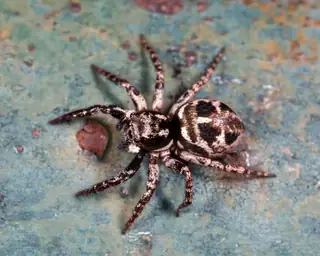
Twin-flagged jumping spider
Anasaitis canosusSalticidae
Harmless
3–5 mm
This tiny jumping spider lives on walls, fences and tree trunks in the Southeast. Males wave a pair of dark, flag-like front legs in courtship dances to impress females. It hunts small insects by jumping on them and does not build a web to catch food. It is far too small to harm people.
How to recognize it
- Tiny black body with white bands
- Males wave flag-like front legs
- Large eyes at the front
- Found on walls and trees
Pattern: Small dark body with white scale patches and, in males, two flag-like front legs.
Habitat: Seen on trees, fences, walls, siding and outdoor furniture, and sometimes inside.
Range: Southeastern US and Caribbean
Bites: Bites are essentially unknown and the spider is too small to affect people.
Also called: Twin-flagged jumper
Often confused with: Common Hentz jumping spider , Gray wall jumping spider , Zebra jumping spider
![Twin-flagged jumping spider (Anasaitis canosus), photo 2]()
![Twin-flagged jumping spider (Anasaitis canosus), photo 3]()
-
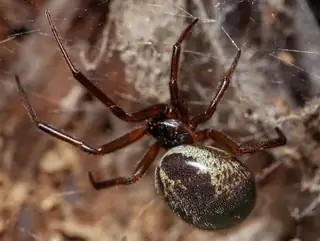
Noble false widow
Steatoda nobilisTheridiidae
Mild bite
7–14 mm
A glossy brown spider with a pale skull-like mark. It is often called a false widow, though it is not a true widow. It lives around buildings and bites are rare, but sometimes cause pain and swelling. A few severe cases are reported.
How to recognize it
- Pale marks on front of abdomen, often skull-like
- Glossy dark brown body
- Reddish brown legs
- Rounded body that is brown rather than jet black
Pattern: Dark brown to black body with a pale skull-like mark on the front of the abdomen.
Habitat: Common in buildings, fences, window frames, sheds and walls.
Range: Madeira and Canary Islands, UK and Europe, introduced to US
Bites: Bites may cause pain, redness and swelling; rare cases involve longer-lasting symptoms and may need medical care.
Also called: False widow
Often confused with: False black widow , Western black widow , Common house spider , Boreal combfoot
![Noble false widow (Steatoda nobilis), photo 2]()
![Noble false widow (Steatoda nobilis), photo 3]()
-
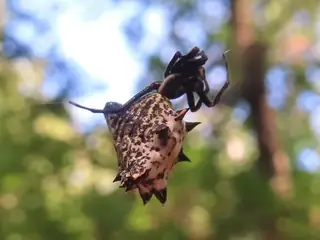
Spined micrathena
Micrathena gracilisAraneidae
Harmless
3–10 mm
This spiny little orb weaver has a hard abdomen with several spikes, which makes it look more dangerous than it is. It builds delicate, tidy webs along trails and in woods, so people often walk into them by accident. It is harmless to people and gentle, and bites are practically unknown.
How to recognize it
- Hard shell abdomen with ten spines
- Pale yellow and white with black spots
- Smaller, brownish males
- Tiny orb webs in forests
Pattern: Hard, white and black abdomen with ten spines, some larger on the rear.
Habitat: Builds small webs in woods, shrubs and along trails, rarely entering homes.
Range: Eastern US and southern Canada
Bites: Bites are very rare and venom is not considered harmful.
Also called: Spiny orbweaver
Often confused with: Arrow-shaped micrathena , Spinybacked orbweaver , White micrathena
![Spined micrathena (Micrathena gracilis), photo 2]()
![Spined micrathena (Micrathena gracilis), photo 3]()
-
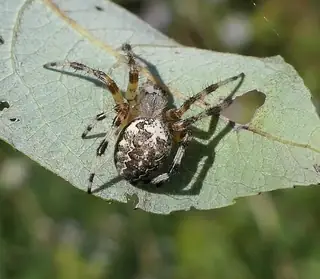
Marbled orbweaver
Araneus marmoreusAraneidae
Harmless
5–14 mm
This round, orange orb weaver looks a bit like a tiny pumpkin, though colors vary from yellow to reddish. It often hides in a curled leaf near its delicate web and waits for prey to arrive. It is shy and eats insects. It is harmless to people, and bites are very rare.
How to recognize it
- Round bright orange or yellow abdomen
- Dark marbling or blotches
- Banded legs
- Often hides in a leaf near the web
Pattern: Round orange or yellow abdomen with dark marbled markings.
Habitat: Found in meadows, woodlands, gardens and sometimes buildings.
Range: Northern US, Canada and Europe
Bites: Bites are rare and the venom is not considered harmful to people.
Also called: Marbled orb weaver
Often confused with: European garden spider , Shamrock orbweaver , Four-spot orbweaver
![Marbled orbweaver (Araneus marmoreus), photo 2]()
![Marbled orbweaver (Araneus marmoreus), photo 3]()
-
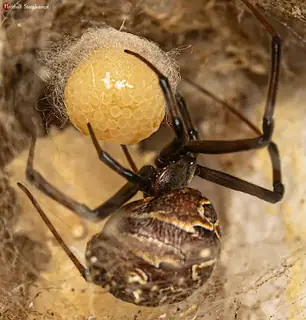
Brown widow
Latrodectus geometricusTheridiidae
Medically significant
4–13 mm
The brown widow is mottled tan and brown with an orange hourglass under its round abdomen. It likes outdoor spaces like mailboxes, eaves and patio furniture. Bites are uncommon and often milder than black widow bites, but they can still cause serious symptoms, so get medical advice if you suspect one.
How to recognize it
- Orange hourglass underneath
- Mottled brown abdomen
- Spiky egg sacs
- Banded legs
Pattern: Mottled tan to brown body with a yellow-orange or orange hourglass under the abdomen.
Habitat: Found around homes, mailboxes, eaves, garages and patio furniture, rarely indoors.
Range: Worldwide warm regions; southern US
Bites: Bites are uncommon and usually milder than black widow bites, but symptoms after a bite still warrant medical attention.
Also called: Gray widow
Often confused with: Southern black widow , Western black widow , Noble false widow , Common house spider
![Brown widow (Latrodectus geometricus), photo 2]()
![Brown widow (Latrodectus geometricus), photo 3]()
-
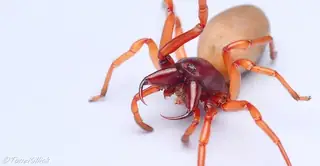
Woodlouse spider
Dysdera crocataDysderidae
Harmless
9–15 mm
This spider hunts woodlice, also called pillbugs. It has a deep orange-red head and legs, a pale abdomen and big, forward-pointing fangs that look scary. It hides under rocks and in damp basements and may bite if handled. It is not considered dangerous, and bites are uncommon and mild.
How to recognize it
- Orange-red head and legs
- Pale tan abdomen
- Large, forward-pointing fangs
- Only six eyes in a tight cluster
Pattern: Dark reddish-orange head and legs with a pale tan to gray abdomen.
Habitat: Hides under rocks, logs, mulch and plant pots, and can enter basements.
Range: Europe and UK; introduced worldwide, throughout the US
Bites: Bites are uncommon and usually cause only brief, minor pain or mild local itching.
Also called: Sowbug hunter, Pillbug hunter
Often confused with: Tube-dwelling spider , Brown recluse , Southern house spider
![Woodlouse spider (Dysdera crocata), photo 2]()
![Woodlouse spider (Dysdera crocata), photo 3]()
-
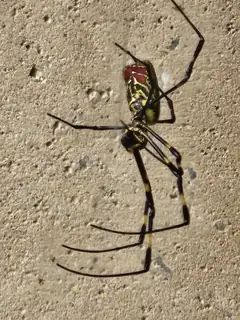
Joro spider
Trichonephila clavataNephilidae
Harmless
6–25 mm
The Joro spider is a large, colorful spider from East Asia that now lives in the Southeast US and is spreading north. Its yellow and blue-black body and wide golden web can alarm people, but it is shy and tends to leave people alone. Bites are rare and mild.
How to recognize it
- Yellow and black body with dark gray bands
- Large, long legs with black and yellow banding
- Red marks on underside
- Tough, golden webs
Pattern: Yellow-and-black banded legs and a yellow abdomen with a blue-black pattern and red markings below.
Habitat: Builds giant webs on porches, trees, power lines and fences outdoors.
Range: East Asia; introduced to the southeastern US
Bites: Bites are rare, usually only when the spider is gripped, and cause effects comparable to a mosquito bite.
Often confused with: Golden silk orbweaver , Yellow garden spider , Giant golden orb weaver
![Joro spider (Trichonephila clavata), photo 2]()
![Joro spider (Trichonephila clavata), photo 3]()
-
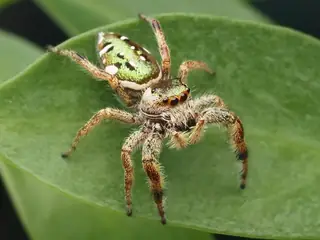
Golden jumping spider
Paraphidippus aurantiusSalticidae
Harmless
6–12 mm
A bright jumping spider with golden hairs and a hint of green shine on its jaws. It hunts on shrubs, trees and fences by leaping on insects, using sharp eyesight instead of a web. It is shy and curious rather than aggressive, and it is considered harmless to people, with rare bites.
How to recognize it
- Hairy brown body with golden or orange hairs
- Pale spots on abdomen
- Iridescent green jaws
- Large front eyes
Pattern: Reddish-brown body with golden hairs and a pale or green iridescent shine in places.
Habitat: Lives on shrubs, trees, fences and gardens, sometimes near homes.
Range: Eastern and southern US, Mexico and Central America
Bites: Bites are rare and cause only minor local irritation.
Also called: Emerald jumping spider
Often confused with: Bold jumping spider , Regal jumping spider , Putnam's jumping spider
![Golden jumping spider (Paraphidippus aurantius), photo 2]()
![Golden jumping spider (Paraphidippus aurantius), photo 3]()
-
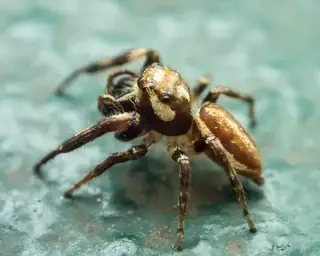
Bronze jumping spider
Eris militarisSalticidae
Harmless
5–9 mm
This small jumping spider has a metallic bronze sheen and a white band across its abdomen. It hunts on plants, fences and leaves, jumping on insects with great accuracy and using excellent vision. Males wave their legs in courtship dances. It is shy, harmless to people and rarely bites.
How to recognize it
- Bronze iridescent head area
- White spot or band on abdomen
- Compact, stocky body
- Males have a more vivid pattern
Pattern: Dark body with a metallic bronze sheen, a white spot or band on the abdomen and pale legs.
Habitat: Found on shrubs, grass, fences and tree bark.
Range: Eastern and central US, Canada
Bites: Bites are very rare and cause little effect.
Also called: Bronze jumper
Often confused with: Bold jumping spider , Dimorphic jumping spider , Peppered jumping spider
![Bronze jumping spider (Eris militaris), photo 2]()
![Bronze jumping spider (Eris militaris), photo 3]()
-
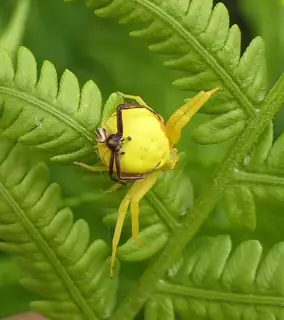
Goldenrod crab spider
Misumena vatiaThomisidae
Harmless
2.5–11 mm
This flower-sitting spider is a patient ambusher. Females are white or yellow and can slowly shift color to match the blossom they sit on. They hold their front legs wide like a crab and wait for bees and flies. They don't spin webs, and they are harmless to people.
How to recognize it
- Crab-like sideways stance with front two leg pairs held wide
- Females are white or yellow and can change color
- Pale body with no webbing or hair tufts
- Males are tiny with dark brown front legs
Pattern: Females are plain white or yellow, sometimes with red side stripes; males are small, dark and brown-striped.
Habitat: Waits on flowers like goldenrod and daisies in meadows and gardens; rarely comes indoors.
Range: North America, Europe and northern Asia
Bites: Bites are very rare and considered harmless to people.
Also called: Flower crab spider
Often confused with: American green crab spider , White-banded crab spider , Green crab spider , Northern crab spider
![Goldenrod crab spider (Misumena vatia), photo 2]()
![Goldenrod crab spider (Misumena vatia), photo 3]()
-
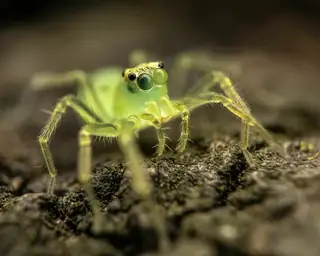
Magnolia green jumping spider
Lyssomanes viridisSalticidae
Harmless
4–8 mm
This tiny, almost see-through green jumping spider is a nice find on leaves in the humid Southeast. It blends in with foliage and hunts small insects without a web. It is shy and delicate, and it poses no danger to people or pets. Seeing one usually means a healthy garden.
How to recognize it
- Pale translucent green body and legs
- Large, wide-set front eyes with a bluish or green glow
- Long, slender front legs held forward
- Small, delicate build compared to other jumpers
Pattern: Translucent pale green body with long legs and a faint pale abdomen.
Habitat: Lives on the leaves of shrubs and trees such as magnolia in humid woods; seldom enters homes.
Range: Southeastern US from the Carolinas to Texas
Bites: Bites are very unlikely; this small, gentle spider is harmless to people.
Also called: Green jumping spider
Often confused with: Green lynx spider , American green crab spider , Golden jumping spider , Common Hentz jumping spider
![Magnolia green jumping spider (Lyssomanes viridis), photo 2]()
![Magnolia green jumping spider (Lyssomanes viridis), photo 3]()
-
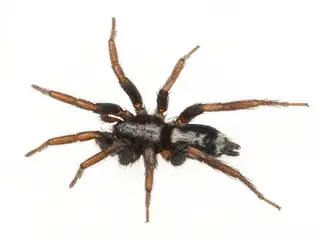
Eastern parson spider
Herpyllus ecclesiasticusGnaphosidae
Harmless
6–10 mm
The parson spider is a dark ground hunter with a striking white mark across its back that looks like a clergyman's collar. It wanders at night, sometimes straying indoors. It does not build a web to catch food, and it is not aggressive. Bites are rare, and it eats other household pests.
How to recognize it
- White chevron or band across the middle of the abdomen
- Dark, glossy and slightly velvety body
- Uniform dark legs, no webbing seen
- Smooth, flat-looking build with elongated body
Pattern: Dark brown to black body with a bold white or pale band across the abdomen and a pale spot above the spinnerets.
Habitat: Hunts at night on the ground, under rocks and bark; commonly wanders into houses.
Range: Eastern US and southeastern Canada
Bites: Bites are rare and generally cause only minor local irritation.
Also called: Parson spider
Often confused with: Broad-faced sac spider , Southern house spider , Woodlouse spider
![Eastern parson spider (Herpyllus ecclesiasticus), photo 2]()
![Eastern parson spider (Herpyllus ecclesiasticus), photo 3]()
-
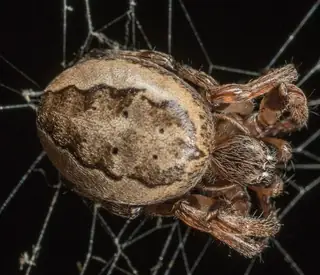
Furrow orbweaver
Larinioides cornutusAraneidae
Harmless
5–14 mm
This sturdy orb weaver likes to build big webs on docks, porches and fences, especially near water. By day it hides in a crevice, then comes out to repair its web at dusk. It looks scary but is shy, and a bite is rare and minor.
How to recognize it
- Leaf-like pattern with dark scalloped edges on abdomen
- Banded brown and tan legs
- Rounded, plump abdomen with small shoulder humps
- Builds big orb web near water or lights
Pattern: Mottled gray-brown abdomen with a pale, scalloped leaf-like folium and dark banded legs.
Habitat: Builds orb webs on bridges, fences, docks and building eaves near water, often near lights.
Range: North America, Europe and northern Asia
Bites: Bites are very rare; the venom is not a concern for people.
Also called: Furrow spider
Often confused with: Bridge orbweaver , European garden spider , Spotted orbweaver , Shamrock orbweaver
![Furrow orbweaver (Larinioides cornutus), photo 2]()
![Furrow orbweaver (Larinioides cornutus), photo 3]()
-
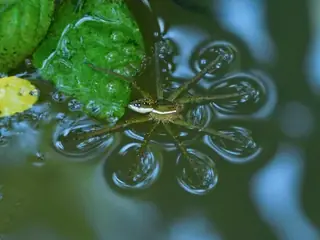
Six-spotted fishing spider
Dolomedes tritonDolomedidae
Harmless
9–17 mm
This big, water-loving hunter can run across a pond's surface and even dive to escape. It is often found resting on docks and lake edges. It looks intimidating because of its size, but it is shy and prefers to flee. A bite is rare and not harmful.
How to recognize it
- Pale white or cream stripe along each side of the body
- Six small black spots on the underside
- Large body with long, spiny legs
- Often seen resting on or near water
Pattern: Brown to gray body with a pale stripe along each side and six black spots on the underside of the body.
Habitat: Lives at ponds, streams and marshes, sitting on the shoreline or floating plants; occasionally wanders into nearby buildings.
Range: Northern and eastern US, Canada, and parts of the West
Bites: A bite is rare and may be mildly painful but is not dangerous to healthy people.
Also called: Fishing spider
Often confused with: Dark fishing spider , Banded fishing spider , Striped fishing spider , American nursery web spider
![Six-spotted fishing spider (Dolomedes triton), photo 2]()
![Six-spotted fishing spider (Dolomedes triton), photo 3]()
-
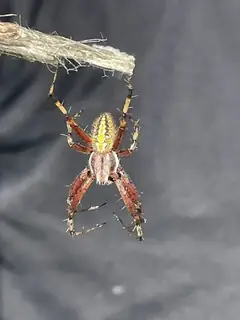
Western spotted orbweaver
Neoscona oaxacensisAraneidae
Harmless
6–14 mm
A common night-time web builder around Southwest homes, this orb weaver spins a large wheel-shaped web at dusk and often takes it down in the morning. It is brown and speckled, so it blends in. It is not aggressive and its bite is rare and mild.
How to recognize it
- Sharp, white-edged dark spots on the abdomen
- Rounded abdomen with small shoulder humps
- Brown banded legs
- Often sits head-down at night in an orb web
Pattern: Tan to gray abdomen with a darker central stripe or pattern and pairs of dark spots along the sides.
Habitat: Builds orb webs at night on shrubs, fences and buildings; hides in a retreat by day and sometimes appears around porches.
Range: Southwestern and western US south to Central America
Bites: Bites are rare and the spider is not considered dangerous.
Also called: Spotted orbweaver
Often confused with: Spotted orbweaver , Arabesque orbweaver , European garden spider , Red-femured spotted orbweaver
![Western spotted orbweaver (Neoscona oaxacensis), photo 2]()
![Western spotted orbweaver (Neoscona oaxacensis), photo 3]()
-
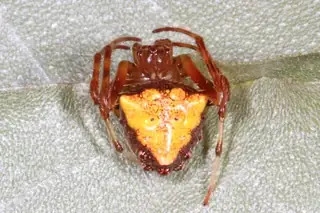
Arrowhead orbweaver
Verrucosa arenataAraneidae
Harmless
3–9 mm
The arrowhead orbweaver is a tiny spider with a distinctive triangular back that looks like a little arrowhead. It sits quietly in its small web among shrubs and tall grass. It is not interested in people, and its bite is rare and harmless.
How to recognize it
- Triangular, arrowhead-shaped abdomen with a point at the back
- Glossy white to yellow with dark lines
- Small, compact build
- Sits head-up at center of small orb web
Pattern: Shiny pale to yellowish abdomen shaped like a triangle or arrowhead with dark markings.
Habitat: Spins small orb webs in shrubs, tall grass and woodland edges; rarely found indoors.
Range: Eastern and southern US, Mexico and Central America
Bites: Bites are extremely rare and not dangerous to people.
Also called: Arrowhead spider
Often confused with: Spined micrathena , Spinybacked orbweaver , Tuft-legged orbweaver , Six-spotted orbweaver
![Arrowhead orbweaver (Verrucosa arenata), photo 2]()
![Arrowhead orbweaver (Verrucosa arenata), photo 3]()
-
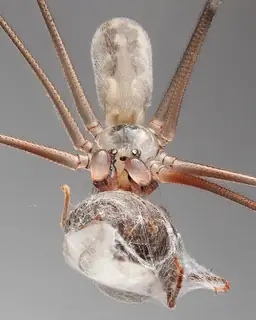
Daddy longlegs spider
Pholcus phalangioidesPholcidae
Harmless
5–10 mm
This is the common cellar spider that hangs in messy webs in basements, ceilings and corners. It has very long, thin legs and a small body. It is harmless to people and even eats other spiders. If it is disturbed, it vibrates rapidly in its web.
How to recognize it
- Extremely long, thin legs
- Small, elongated cylindrical body
- Hangs upside down in a messy web
- Dark patch on the middle of the front body
Pattern: Pale tan to gray, cylindrical body with a dark marking on the head area.
Habitat: Hangs upside down in loose webs in corners of basements, ceilings, garages and houses.
Range: Worldwide; introduced to US
Bites: Bites are practically unheard of and not harmful to people.
Also called: Cellar spider, Skull spider
Often confused with: Marbled cellar spider , South American toothed hacklemesh weaver , Green meshweaver
![Daddy longlegs spider (Pholcus phalangioides), photo 2]()
![Daddy longlegs spider (Pholcus phalangioides), photo 3]()
-
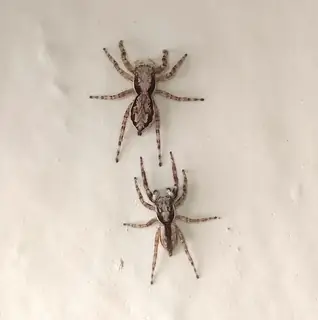
Gray wall jumping spider
Menemerus bivittatusSalticidae
Harmless
5–9 mm
This flat, gray jumping spider spends sunny days on walls and fences hunting small flies. It is bold but friendly in the sense that it just watches you with its big eyes. It is harmless to people. It sometimes shows up on windows and indoors.
How to recognize it
- Flat, silvery-gray, striped body
- Two pale stripes along the sides of the head area
- Short legs with soft gray hair
- Large forward-facing eyes
Pattern: Flat, gray body with a pale stripe down each side and a lighter central band.
Habitat: Lives on sunny walls, fences and buildings, sometimes entering homes.
Range: Warm regions worldwide; introduced to southern US
Bites: Bites are very rare and not dangerous to people.
Also called: Gray wall jumper
Often confused with: Half-edged wall jumping spider , Pantropical jumping spider , Zebra jumping spider , Tan jumping spider
![Gray wall jumping spider (Menemerus bivittatus), photo 2]()
![Gray wall jumping spider (Menemerus bivittatus), photo 3]()
-
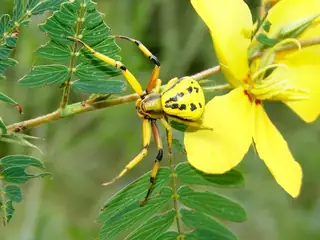
White-banded crab spider
Misumenoides formosipesThomisidae
Harmless
3–12 mm
This chunky crab spider waits patiently on yellow and white flowers to ambush visiting bees and flies. It can tint its body pale yellow or white to match the blossom. It spins no web to catch food, and it is harmless to people. You will rarely find one indoors.
How to recognize it
- Pale body with a white band across the front of the head
- Chunky, crab-like body
- Front legs longer and bulkier than back legs
- Often tinged yellow, greenish or tan
Pattern: Pale yellow or white abdomen with a distinct white band on the front of the head and body in females.
Habitat: Waits on flowers like goldenrod and sunflowers in fields and gardens; rarely comes indoors.
Range: Southern Canada through the US to Central America
Bites: Bites are very rare and not dangerous to people.
Also called: Whitebanded crab spider
Often confused with: Goldenrod crab spider , American green crab spider , Northern crab spider , Black-banded crab spider
![White-banded crab spider (Misumenoides formosipes), photo 2]()
![White-banded crab spider (Misumenoides formosipes), photo 3]()
-
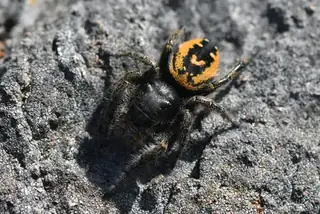
Johnson's jumping spider
Phidippus johnsoniSalticidae
Harmless
5–13 mm
This bold western jumping spider is easy to spot: males wear a bright red stripe, and both sexes have a green shine on the jaws. It hunts by day and pounces on insects instead of using a web. It may wander indoors, but bites are very rare and mild.
How to recognize it
- Bright red-orange back on adult males
- Black body with a white band on the abdomen of females
- Iridescent green jaws
- Fuzzy hairs and large front eyes
Pattern: Black body with a bright red-orange abdomen stripe in males; females are black with white-edged markings.
Habitat: Found on walls, logs, rocks and fences; may wander into homes.
Range: Western US and southwestern Canada
Bites: Bites are rare and cause little more than minor local irritation.
Also called: Red-backed jumping spider
Often confused with: Bold jumping spider , Brilliant jumping spider , Regal jumping spider , Whitman's jumping spider
![Johnson's jumping spider (Phidippus johnsoni), photo 2]()
![Johnson's jumping spider (Phidippus johnsoni), photo 3]()
-
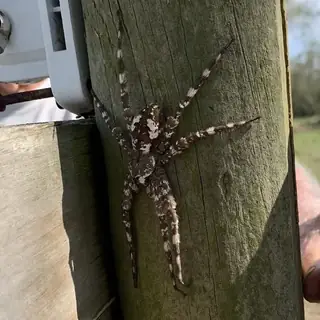
White-banded fishing spider
Dolomedes albineusDolomedidae
Harmless
9–18 mm
A big fishing spider with a striking white stripe on each side, found in swamps and ponds across the Southeast. It can walk on water and hunt small fish and tadpoles. It looks intimidating, but it is shy and prefers to run away.
How to recognize it
- Wide white stripe along each side of the body
- Large body with long, spiny legs
- Mottled gray-brown top
- Lives near water, floating on the surface
Pattern: Gray-brown body with a bold white band down each side of the body.
Habitat: Lives on shrubs and trees near swamps, ponds and slow streams; seldom comes indoors.
Range: Southeastern US
Bites: Bites are rare and not considered dangerous to people.
Also called: Whitebanded fishing spider
Often confused with: Six-spotted fishing spider , Dark fishing spider , Banded fishing spider , Striped fishing spider
![White-banded fishing spider (Dolomedes albineus), photo 2]()
![White-banded fishing spider (Dolomedes albineus), photo 3]()
-
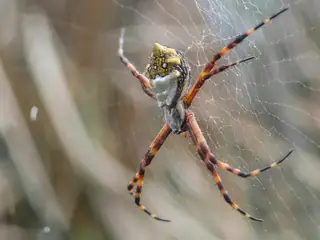
Silver garden orbweaver
Argiope argentataAraneidae
Harmless
3–15 mm
This silvery garden spider hangs head-down in a big sunny web decorated with a white zigzag band in the middle. It looks dramatic but is gentle and wants nothing to do with you. It is harmless to people, and it eats plenty of flying insects around the yard.
How to recognize it
- Shiny silver cephalothorax
- Scalloped abdomen with silver and dark banding
- Bold zigzag stabilimentum (white web pattern)
- Legs often held in a pair-wise X
Pattern: Silvery body with lighter bands, black and yellowish markings and scalloped edges on the abdomen.
Habitat: Builds large orb webs in open sunny places, on shrubs, cacti and fences; rarely comes indoors.
Range: Southern and southwestern US, Central and South America
Bites: Bites are very rare and not considered dangerous to people.
Also called: Silver argiope
Often confused with: Yellow garden spider , Banded garden spider , Hawaiian garden spider , Spinybacked orbweaver
![Silver garden orbweaver (Argiope argentata), photo 2]()
![Silver garden orbweaver (Argiope argentata), photo 3]()
-
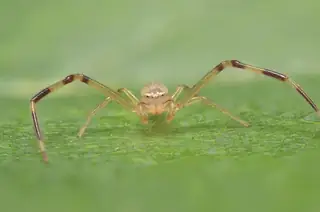
American green crab spider
Misumessus oblongusThomisidae
Harmless
3–8 mm
A leaf-green ambusher common in gardens, meadows and woodland edges, this crab spider sits motionless on stems and snatches small insects that wander close. It does not spin a web to catch food, which helps it stay hidden. It is harmless to people and shy.
How to recognize it
- Entirely bright green body and legs
- Crab-like sideways stance
- Long front legs held out
- Slender, elongated abdomen
Pattern: Bright green to pale green body, often with a pale stripe down the sides and sometimes small dark dots.
Habitat: Hunts on green leaves, tall grass and shrubs; rarely comes indoors.
Range: US and Canada east of the Rockies, plus parts of the West
Bites: Bites are very rare and not dangerous to people.
Also called: Green crab spider
Often confused with: Green lynx spider , Goldenrod crab spider , Magnolia green jumping spider , White-banded crab spider
![American green crab spider (Misumessus oblongus), photo 2]()
![American green crab spider (Misumessus oblongus), photo 3]()
-
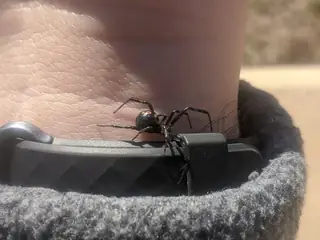
Southern black widow
Latrodectus mactansTheridiidae
Medically significant
4–13 mm
The southern black widow is the classic shiny black spider with a red hourglass underneath. It hides in tangled webs in quiet, dark places like woodpiles and garages. Bites are uncommon, since it is shy, but they can be serious and need medical attention. Wear gloves when moving clutter.
How to recognize it
- Glossy jet black round abdomen
- Complete red hourglass on the underside
- Often a red spot near the spinnerets
- Long thin legs and a messy, irregular web
Pattern: Shiny black body in females with a red hourglass on the underside; males are small with pale markings.
Habitat: Builds tangled webs in woodpiles, sheds, garages, meter boxes and undisturbed corners; occasionally found indoors.
Range: Southeastern and central US, from the Atlantic coast to Texas
Bites: Bites are uncommon, but the venom can cause serious muscle pain and cramping, so symptoms after a bite warrant medical attention.
Also called: Black widow
Often confused with: Western black widow , Northern black widow , False black widow , Triangulate cobweb spider
![Southern black widow (Latrodectus mactans), photo 2]()
![Southern black widow (Latrodectus mactans), photo 3]()
-
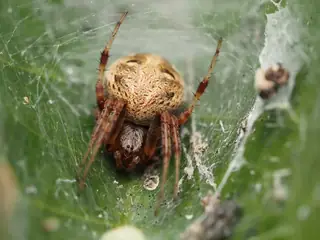
Arabesque orbweaver
Neoscona arabescaAraneidae
Harmless
4–10 mm
This nocturnal orb weaver spins a round web every evening, often on a porch, fence or between shrubs, and usually takes it down by morning. By day it hides in a crevice. It is harmless to people, rarely bites, and does a good job catching night-flying insects.
How to recognize it
- Dark, scalloped folium pattern on the abdomen
- Banded gray and brown legs
- Tiny black dots near the front of the abdomen
- Smaller, slimmer than other Neoscona
Pattern: Gray-brown abdomen with a pattern of dark wavy lines and light patches and pairs of small dark spots.
Habitat: Spins orb webs at night between shrubs, on fences and under eaves; sometimes seen near lights.
Range: Eastern, southern and central US
Bites: Bites are very rare and the spider is not harmful to people.
Also called: Arabesque orb weaver
Often confused with: Spotted orbweaver , Western spotted orbweaver , Red-femured spotted orbweaver , European garden spider
![Arabesque orbweaver (Neoscona arabesca), photo 2]()
![Arabesque orbweaver (Neoscona arabesca), photo 3]()
-
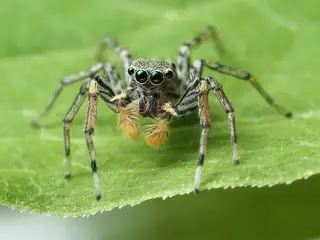
Dimorphic jumping spider
Maevia inclemensSalticidae
Harmless
4–8 mm
The males of this jumping spider come in two looks, one tufted and black and white, one gray and plain, so it can look like two species. It is a tiny hunter on tree trunks and fences, and it is harmless to people.
How to recognize it
- Males: black with white head tufts and striped legs
- Females: mottled gray-brown with a pale stripe
- Black V-shaped markings in females
- Large front eyes
Pattern: Males are black with white tufts and stripes; females are mottled gray and brown with a pale stripe.
Habitat: Lives on tree trunks, fences, walls and shrubs; seldom comes indoors.
Range: Eastern US and southern Canada to Texas
Bites: Bites are very rare and not dangerous to people.
Also called: Bold jumper
Often confused with: Bold jumping spider , Brilliant jumping spider , White-jawed jumping spider , Zebra jumping spider
![Dimorphic jumping spider (Maevia inclemens), photo 2]()
![Dimorphic jumping spider (Maevia inclemens), photo 3]()
-
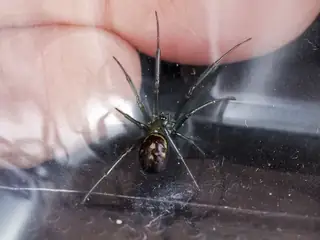
False black widow
Steatoda grossaTheridiidae
Mild bite
4–10 mm
Often mistaken for a black widow, this false widow is plump and dark brown to black but lacks the red hourglass. It lives in garages, basements and quiet corners. It is shy, and a bite is uncommon, usually causing local pain and a bit of swelling.
How to recognize it
- Glossy dark brown to black round abdomen
- No red hourglass on the underside
- Reddish-brown legs and head area
- Sometimes faint pale marks near the front of abdomen
Pattern: Plump, shiny dark brown to purplish-black abdomen, sometimes with faint pale markings, and no hourglass.
Habitat: Lives in dark corners of basements, garages, closets and sheds, and commonly comes indoors.
Range: Worldwide; common across the US and Europe
Bites: Bites are uncommon and usually cause local pain, sometimes with brief malaise, that resolves within hours to a few days.
Also called: Cupboard spider
Often confused with: Southern black widow , Noble false widow , Triangulate cobweb spider , Common house spider
![False black widow (Steatoda grossa), photo 2]()
![False black widow (Steatoda grossa), photo 3]()
-
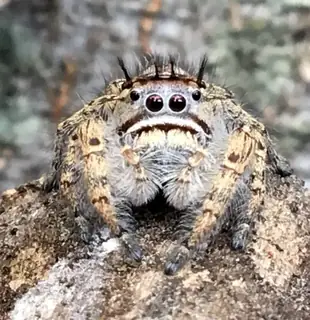
Putnam's jumping spider
Phidippus putnamiSalticidae
Harmless
4–10 mm
A little jumping spider in black, orange and white, Putnam's jumper hunts in daylight on bark and fences. It is curious and may turn its big eyes to look at you. It leaps on small insects instead of building a web. It is harmless, and a bite is very rare and minor.
How to recognize it
- Dark body with white hair on the sides
- Orange or tan patches on the back
- Iridescent green-blue jaws
- Fuzzy and compact with large front eyes
Pattern: Dark body with orange-tan markings on abdomen and a pale white stripe on each side.
Habitat: Found on tree trunks, fences, rocks and in leaf litter; may wander into buildings.
Range: Eastern US and southern Canada
Bites: Bites are rare and minor.
Also called: Putnam's jumper
Often confused with: Bold jumping spider , Brilliant jumping spider , Canopy jumping spider , Grayish jumping spider
![Putnam's jumping spider (Phidippus putnami), photo 2]()
![Putnam's jumping spider (Phidippus putnami), photo 3]()
-
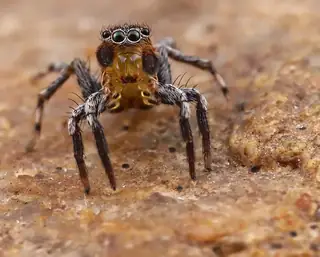
Flea jumping spider
Naphrys pulexSalticidae
Harmless
2.5–5 mm
This is one of the smallest jumping spiders, no bigger than a grain of rice, and it looks a lot like a tiny flea when it hops. You can find it on tree bark, rocks and fences. It hunts by sight, not with a web, and it is harmless to people.
How to recognize it
- Very small, flea-sized flat body
- Mottled black, gray and white pattern
- Pale stripe down the middle of the abdomen
- Short legs and large forward eyes
Pattern: Tiny, black and gray mottled body with a pale stripe on the abdomen and faint bands on the legs.
Habitat: Lives on tree bark, rocks and fences; seldom enters homes.
Range: Southern Canada through the US
Bites: Bites are essentially unheard of and the spider is harmless.
Also called: Flea jumper
Often confused with: Zebra jumping spider , Asiatic wall jumping spider , Tan jumping spider , Peppered jumping spider
![Flea jumping spider (Naphrys pulex), photo 2]()
![Flea jumping spider (Naphrys pulex), photo 3]()
-
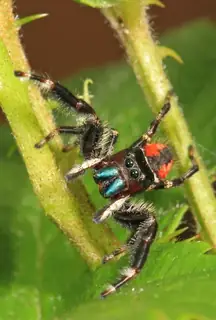
Brilliant jumping spider
Phidippus clarusSalticidae
Harmless
5–13 mm
A colorful meadow jumper, the male is bright red-orange while the female is more drab gray and brown. It leaps on insects and watches you with big front eyes. You will find it on weeds and fences in sunny fields. It is harmless, and a bite is rare and minor.
How to recognize it
- Males: bright red-orange abdomen
- Females: gray-brown with pale center stripe
- Bold white band at the front of the head
- Iridescent green jaws
Pattern: Males have a red-orange abdomen with a black stripe; females are gray to brown with a pale stripe.
Habitat: Lives in fields, meadows and weedy edges, on plants and fences; rarely indoors.
Range: Eastern US and southern Canada
Bites: Bites are rare and cause only minor irritation.
Also called: Brilliant jumper
Often confused with: Bold jumping spider , Johnson's jumping spider , Grayish jumping spider , Putnam's jumping spider
![Brilliant jumping spider (Phidippus clarus), photo 2]()
![Brilliant jumping spider (Phidippus clarus), photo 3]()
-
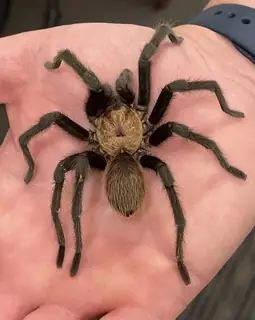
Texas brown tarantula
Aphonopelma hentziTheraphosidae
Mild bite
25–50 mm
A large, hairy brown tarantula that lives in burrows across the south-central US. In fall, wandering males can alarm people on roads. They are docile, and bites are rare and similar to a bee sting. Their hairs may irritate eyes and skin.
How to recognize it
- Large, hairy brown body
- Thick, hairy legs held low to the ground
- Dark abdomen with reddish-brown hairs
- No obvious markings or stripes
Pattern: Uniformly brown, hairy body with darker legs; males have a darker, reddish-brown back.
Habitat: Digs burrows in prairies and hillsides; males wander in late summer, sometimes onto roads and yards.
Range: Texas, Oklahoma and neighboring states
Bites: Bites are rare and usually feel like a bee sting; the abdominal hairs can also irritate skin and eyes.
Also called: Oklahoma brown tarantula
Often confused with: Desert blonde tarantula , Desert tarantula , Carolina wolf spider
![Texas brown tarantula (Aphonopelma hentzi), photo 2]()
![Texas brown tarantula (Aphonopelma hentzi), photo 3]()
-
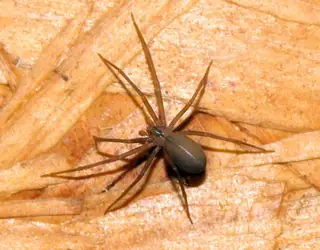
Brown recluse
Loxosceles reclusaSicariidae
Medically significant
6–12 mm
The brown recluse has a violin-shaped mark and only six eyes, which helps tell it from other brown spiders. It hides in dry, quiet places and bites mostly when pressed against skin. Bites are uncommon, but some cause wounds that need medical attention, so shake out stored clothing and shoes.
How to recognize it
- Dark violin shape on the front body, neck pointing back
- Six eyes arranged in three pairs
- Even tan-brown color with no spines on legs
- No stripes or bands on legs or abdomen
Pattern: Uniform tan to dark brown with a darker violin-shaped mark on the head area and no markings on the abdomen or legs.
Habitat: Hides in dry, dark spots like closets, boxes, attics and garages, and does come indoors.
Range: Central and southeastern US, from Nebraska to Georgia and Texas
Bites: Bites are uncommon but can cause a skin wound that is slow to heal, so symptoms after a bite warrant medical attention.
Also called: Fiddleback spider
Often confused with: Desert recluse , Chilean recluse , Southern house spider , Daddy longlegs spider
![Brown recluse (Loxosceles reclusa), photo 2]()
![Brown recluse (Loxosceles reclusa), photo 3]()
-
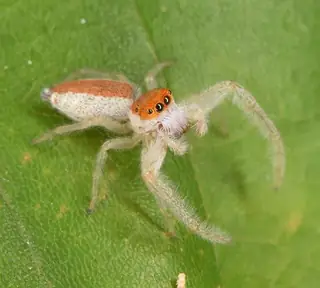
White-jawed jumping spider
Hentzia mitrataSalticidae
Harmless
3–7 mm
A small, slim jumping spider found in grass, shrubs and on fences, the male has bright white jaws that make it easy to recognize. It scampers and hops after tiny insects instead of spinning a web. It is shy, rarely bites, and is harmless to people and pets.
How to recognize it
- Males: bright white jaws
- Pale stripe down center of abdomen
- Gray-brown striped body
- Small, slim body with large eyes
Pattern: Gray to brown body with a pale stripe down the center and a light band around the abdomen; males have white jaws.
Habitat: Common on shrubs, grass, fences and trees; rarely indoors.
Range: Eastern and central US and southern Canada
Bites: Bites are rare and cause no more than mild irritation.
Also called: Whitejawed jumper
Often confused with: Common Hentz jumping spider , Dimorphic jumping spider , Peppered jumping spider , Flea jumping spider
![White-jawed jumping spider (Hentzia mitrata), photo 2]()
![White-jawed jumping spider (Hentzia mitrata), photo 3]()
-
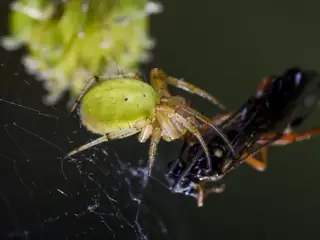
Six-spotted orbweaver
Araniella displicataAraneidae
Harmless
3–8 mm
A small, pale green orb weaver with six tiny black dots on its back, it builds its web on shrubs, tall plants and tree branches. It is easy to overlook in the greenery. It is shy and not aggressive, and it is harmless to people. Bites are very rare.
How to recognize it
- Pale green abdomen with a light central stripe
- Six small dark spots in three pairs
- Smaller, slim body
- Reddish legs with fine dark spines
Pattern: Pale green to yellowish abdomen with a thin white stripe and six small black spots in pairs.
Habitat: Builds small orb webs on trees, shrubs and tall plants in woods and gardens; rarely comes indoors.
Range: Northern North America, Europe and Asia
Bites: Bites are very rare and not dangerous to people.
Also called: Sixspotted orbweaver
Often confused with: Marbled orbweaver , Tuft-legged orbweaver , Arrowhead orbweaver , Conical trashline orbweaver
![Six-spotted orbweaver (Araniella displicata), photo 2]()
![Six-spotted orbweaver (Araniella displicata), photo 3]()
-
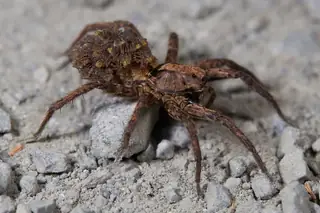
Koch's wolf spider
Alopecosa kochiLycosidae
Harmless
7–12 mm
If you spot a brown, fast-running spider in a dry field, this could be it. Koch's wolf spider hunts on the ground instead of building a web, and females carry their egg sacs around. It is shy, quick to flee, and not a threat to people.
How to recognize it
- Pale median stripe on the carapace
- Stocky, hairy brown build
- Large eyes in typical wolf spider arrangement
- Often shows a lighter abdominal midline patch
Pattern: Brown body with a pale central stripe on the carapace and a darker, mottled abdomen.
Habitat: Dry grassland, sandy fields and open ground; sometimes wanders into outbuildings but rarely lives indoors.
Range: Northern US, Canada and Eurasia (Holarctic)
Bites: Bites are rare and the venom is not a concern for people; any reaction is typically brief and local, like a minor sting.
Also called: Wolf spider
Often confused with: Rabid wolf spider , Carolina wolf spider , Dotted wolf spider
![Koch's wolf spider (Alopecosa kochi), photo 2]()
![Koch's wolf spider (Alopecosa kochi), photo 3]()
-
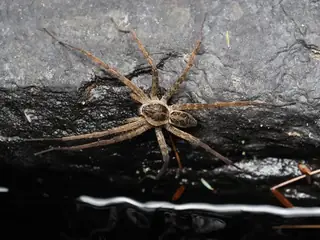
Striped fishing spider
Dolomedes scriptusDolomedidae
Harmless
10–20 mm
This large, long-legged spider lives near ponds and streams and can even walk on water to hunt insects and small fish. It has pale side stripes and may startle you by dashing for cover. It is not aggressive and bites only if handled roughly.
How to recognize it
- Pale lateral stripes on carapace and abdomen
- Long banded legs with spines
- Large body with eight eyes in two rows
- Stripes often cream, sometimes thin or broken
Pattern: Brown to gray body with pale stripes along the sides of the carapace and abdomen.
Habitat: Wooded streams, ponds and wet areas; sometimes found on porches or sheds near water, rarely inside homes.
Range: Eastern US and southern Canada
Bites: Bites are rare and the venom is not a concern for people; any reaction is typically brief and local, like a minor sting.
Also called: Fishing spider
Often confused with: Banded fishing spider , Dark fishing spider , Six-spotted fishing spider , American nursery web spider
![Striped fishing spider (Dolomedes scriptus), photo 2]()
![Striped fishing spider (Dolomedes scriptus), photo 3]()
-
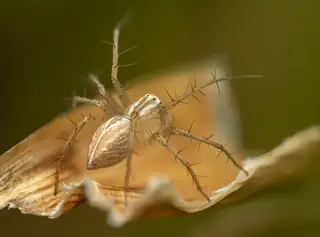
Striped lynx spider
Oxyopes salticusOxyopidae
Harmless
5–8 mm
A small, spiny-legged spider that stalks insects on garden plants and crops instead of spinning a web. It is a welcome pest controller, often seen on sunny leaves. It is quick and shy, and bites on people are rarely a concern.
How to recognize it
- Long spiny legs with dark spots
- Dark stripes on pale tan carapace
- Slim, tapered abdomen
- Small pointed, hexagon-shaped eye pattern
Pattern: Pale tan body with dark stripes on the carapace and bold dark markings on the abdomen.
Habitat: Grassy fields, gardens and crops, resting on foliage; usually stays outdoors.
Range: Most of the US, south into Central America
Bites: Bites are rare and the venom is not a concern for people; any reaction is typically brief and local, like a minor sting.
Also called: Lynx spider
Often confused with: Green lynx spider , Western lynx spider , Zebra jumping spider
![Striped lynx spider (Oxyopes salticus), photo 2]()
![Striped lynx spider (Oxyopes salticus), photo 3]()
-
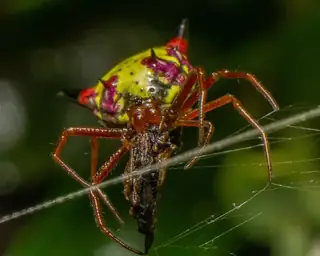
Arrow-shaped micrathena
Micrathena sagittataAraneidae
Harmless
6–9 mm
Shaped like a tiny arrowhead, this colorful spider hangs in the middle of a neat round web in shady woods. Yellow, red and black, it looks fierce but is harmless. Females are the ones you notice; males are much smaller and plain.
How to recognize it
- Flat triangular abdomen like an arrowhead
- Yellow with black and red markings
- Short red spines along the rear edge
- Black legs
Pattern: Triangular yellow abdomen with red and black spots and three pairs of small red spines.
Habitat: Woodland edges and shrubs where it builds a round web; seldom enters buildings.
Range: Eastern US
Bites: Bites are rare and the venom is not a concern for people; any reaction is typically brief and local, like a minor sting.
Also called: Arrow-shaped orbweaver, Arrowhead spider
Often confused with: Spined micrathena , White micrathena , Spinybacked orbweaver
![Arrow-shaped micrathena (Micrathena sagittata), photo 2]()
![Arrow-shaped micrathena (Micrathena sagittata), photo 3]()
-
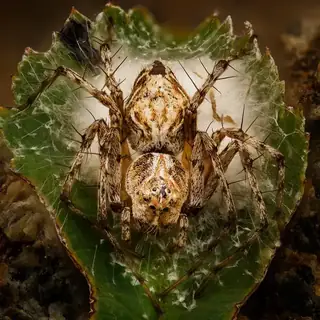
Western lynx spider
Oxyopes scalarisOxyopidae
Harmless
5–10 mm
Active on shrubs and grasses in warm weather, this lynx spider chases insects across plants and does not spin a catch web. Its spiny legs and pale striping help you spot it. It is shy and its bite is not a concern.
How to recognize it
- Long spiny legs with dark spots
- Dark stripes on the carapace
- Tapering abdomen with pale central band
- Hexagon-shaped eye arrangement
Pattern: Pale gray-tan body with dark lengthwise stripes and a tapered abdomen with faint chevrons.
Habitat: Shrubs, grasses and conifers in open or wooded areas; usually stays outdoors.
Range: Western North America
Bites: Bites are rare and the venom is not a concern for people; any reaction is typically brief and local, like a minor sting.
Also called: Lynx spider
Often confused with: Striped lynx spider , Green lynx spider
![Western lynx spider (Oxyopes scalaris), photo 2]()
![Western lynx spider (Oxyopes scalaris), photo 3]()
-
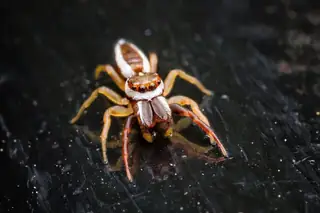
Common Hentz jumping spider
Hentzia palmarumSalticidae
Harmless
4–7 mm
A small, quick jumping spider with a neatly striped look, often seen on fences, walls and leaves. It tilts its head to inspect you with big eyes. It helps by eating pests and is not dangerous to people. Look for it on sunny railings and leaves, where it often pauses to stare back.
How to recognize it
- Slim, tapered gray-brown body
- Dark and light lengthwise abdominal stripes
- Forward-facing large eyes
- Males have darker, elongated front legs
Pattern: Gray-brown body with two dark stripes on the abdomen edged in white, and a pale band on the carapace.
Habitat: Fields, trees, fences and house walls; commonly found on exterior walls and sometimes indoors.
Range: Eastern and southern US, south to Central America
Bites: Bites are rare and the venom is not a concern for people; any reaction is typically brief and local, like a minor sting.
Also called: Hentz jumper
Often confused with: White-jawed jumping spider , Fencepost jumping spider , Zebra jumping spider , Gray wall jumping spider
![Common Hentz jumping spider (Hentzia palmarum), photo 2]()
![Common Hentz jumping spider (Hentzia palmarum), photo 3]()
-
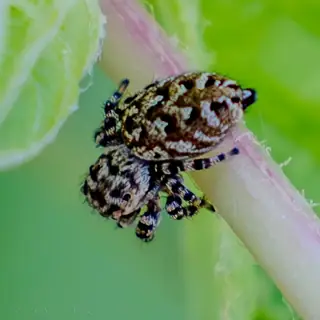
Peppered jumping spider
Pelegrina galatheaSalticidae
Harmless
4–7 mm
Small and speckled like it was sprinkled with pepper, this jumping spider hunts on leaves and weeds in sunny spots. It is quick and curious but timid. People almost never get bitten, and it is harmless to us. Gardeners often find it on leaves and stems, where it stalks small flies and other tiny prey.
How to recognize it
- Peppery mottled gray-brown coloring
- Pale central abdominal stripe
- Small compact jumping spider
- Males have pale scale patches on the face
Pattern: Gray-brown peppered body with a pale or white stripe down the middle of the abdomen and a brown carapace.
Habitat: Meadows, shrubs and forest edges, often on foliage; rarely comes indoors.
Range: Most of the US and southern Canada
Bites: Bites are rare and the venom is not a concern for people; any reaction is typically brief and local, like a minor sting.
Also called: Jumping spider
Often confused with: Brilliant jumping spider , Putnam's jumping spider , White-jawed jumping spider , Flea jumping spider
![Peppered jumping spider (Pelegrina galathea), photo 2]()
![Peppered jumping spider (Pelegrina galathea), photo 3]()
-
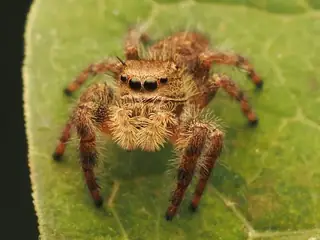
Grayish jumping spider
Phidippus princepsSalticidae
Harmless
8–14 mm
A chunky gray jumping spider seen on logs, fences and walls. It watches you with big front eyes and may leap away. It can look intimidating because of its size, but it is a shy hunter and a bite would be rare and minor.
How to recognize it
- Stocky, hairy gray-black body
- Pale spots or bands on abdomen
- Large front eyes
- Iridescent green-blue jaws (chelicerae)
Pattern: Gray, hairy body with a dark abdomen marked by pale spots or bands; males may be mostly black.
Habitat: Woodland edges, fences, trees and buildings; sometimes wanders indoors.
Range: Eastern and central US, southern Canada
Bites: Bites are rare and the venom is not a concern for people; any reaction is typically brief and local, like a minor sting.
Also called: Jumping spider
Often confused with: Bold jumping spider , Putnam's jumping spider , Tan jumping spider , Brilliant jumping spider
![Grayish jumping spider (Phidippus princeps), photo 2]()
![Grayish jumping spider (Phidippus princeps), photo 3]()
-
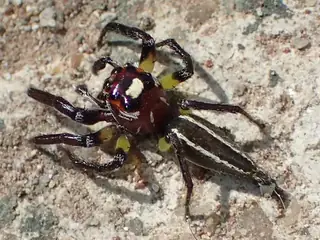
Sylvan jumping spider
Colonus sylvanusSalticidae
Harmless
5–9 mm
This bark-colored jumper blends in against tree trunks and old logs, then pounces on small insects. It rarely troubles people and is not dangerous. If you see a flat, gray-brown spider hopping on bark, this could be it. It is most active on warm days, often darting around woodpiles and outdoor walls.
How to recognize it
- Flat, mottled gray-brown body
- Pale zigzag marks on abdomen
- Males have bold front legs
- Often rests flat against bark
Pattern: Mottled brown and gray body with a pale, jagged band or chevron markings on the abdomen.
Habitat: Tree trunks, logs, rocks and wooden fences; occasionally on house walls.
Range: Eastern US
Bites: Bites are rare and the venom is not a concern for people; any reaction is typically brief and local, like a minor sting.
Also called: Jumping spider
Often confused with: Tan jumping spider , California flattened jumping spider , Fencepost jumping spider , White-jawed jumping spider
![Sylvan jumping spider (Colonus sylvanus), photo 2]()
![Sylvan jumping spider (Colonus sylvanus), photo 3]()
-
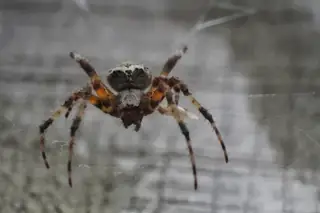
Red-femured spotted orbweaver
Neoscona domiciliorumAraneidae
Harmless
7–14 mm
At dusk it builds a large round web, often near porch lights or between shrubs, then hides during the day. Look for reddish upper legs. It is a calm orbweaver that rarely bites and poses no real danger. Its sticky web is usually gone or tucked away by morning, so many people only notice the spider itself.
How to recognize it
- Reddish-orange thigh segments on legs
- Mottled gray-brown, folium-patterned abdomen
- Banded legs
- Rounded abdomen with dark spots
Pattern: Gray-brown abdomen with a pale leaf-like pattern and dark spots, with reddish upper legs.
Habitat: Shrubs, fences and building eaves where it spins a round web at night; often near homes.
Range: Eastern and southeastern US
Bites: Bites are rare and the venom is not a concern for people; any reaction is typically brief and local, like a minor sting.
Also called: Spotted orbweaver
Often confused with: Spotted orbweaver , Arabesque orbweaver , European garden spider , Furrow orbweaver
![Red-femured spotted orbweaver (Neoscona domiciliorum), photo 2]()
![Red-femured spotted orbweaver (Neoscona domiciliorum), photo 3]()
-
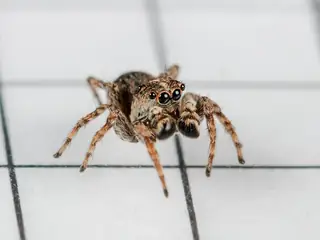
Asiatic wall jumping spider
Attulus fascigerSalticidae
Harmless
3–5 mm
A tiny introduced jumper that lives on walls, window frames and fences near buildings. It is quick, curious and easy to miss. It eats small flies and is not a danger to people. Its web-free hunting style means you will see it hopping about rather than waiting in a web, especially on warm days.
How to recognize it
- Very small brown jumping spider
- Pale stripes on the carapace
- Two pale bands on abdomen
- Often seen on walls and fences
Pattern: Small brown body with pale stripes on the carapace and darker chevron markings on the abdomen.
Habitat: Walls, fences and buildings in urban areas; sometimes enters homes.
Range: Native to Asia; introduced to eastern US
Bites: Bites are rare and the venom is not a concern for people; any reaction is typically brief and local, like a minor sting.
Also called: Wall jumping spider
Often confused with: Zebra jumping spider , Fencepost jumping spider , Common Hentz jumping spider , Flea jumping spider
![Asiatic wall jumping spider (Attulus fasciger), photo 2]()
![Asiatic wall jumping spider (Attulus fasciger), photo 3]()
-
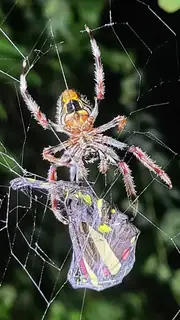
Tropical orbweaver
Eriophora ravillaAraneidae
Harmless
10–22 mm
A big brownish orbweaver that spins a wide round web after dark across paths and between shrubs, then hides by day. It is calm and non-aggressive, and its bite is not dangerous. Because it hides by day, you often meet it face first when walking into its web at night, which is startling but harmless.
How to recognize it
- Bumpy shoulders on a stout abdomen
- Mottled brown-gray folium pattern
- Banded legs
- Rounded body, heavier than most orbweavers
Pattern: Brown to gray abdomen with a darker, scalloped folium pattern and two shoulder humps.
Habitat: Shrubs, trees and porches where it builds large webs at night; may be found near lights.
Range: Southern US south through the Caribbean and Central America
Bites: Bites are rare and the venom is not a concern for people; any reaction is typically brief and local, like a minor sting.
Also called: Orbweaver
Often confused with: Spotted orbweaver , Giant lichen orbweaver , Shamrock orbweaver , Furrow orbweaver
![Tropical orbweaver (Eriophora ravilla), photo 2]()
![Tropical orbweaver (Eriophora ravilla), photo 3]()
-
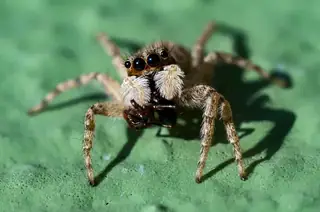
Half-edged wall jumping spider
Menemerus semilimbatusSalticidae
Harmless
5–9 mm
A flat, silvery-gray jumping spider that sunbathes on walls and fences. It often lives close to people and eats flies and other small pests. It is harmless and rarely bites. Its flattened shape lets it slip into tight cracks, so you may see it dart behind shutters or trim when approached.
How to recognize it
- Flat, gray-black body with pale edging
- Pale margin around carapace
- Shimmering silvery hairs
- Large front eyes
Pattern: Flat gray body with a broad white-edged band along the abdomen and black markings.
Habitat: Sunny walls, fences and buildings; commonly found around homes in warm areas.
Range: Mediterranean region; introduced to Florida and Gulf region
Bites: Bites are rare and the venom is not a concern for people; any reaction is typically brief and local, like a minor sting.
Also called: Wall jumping spider
Often confused with: Gray wall jumping spider , Pantropical jumping spider , Zebra jumping spider , Common Hentz jumping spider
![Half-edged wall jumping spider (Menemerus semilimbatus), photo 2]()
![Half-edged wall jumping spider (Menemerus semilimbatus), photo 3]()
-
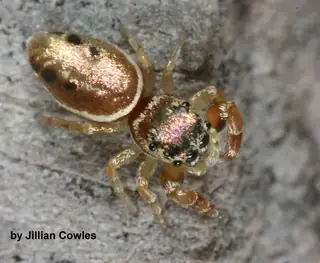
Buttonhook leafbeetle jumping spider
Sassacus vitisSalticidae
Harmless
3–5 mm
This tiny jumper looks like a shiny leaf beetle, which may help it avoid predators. It lives on plants, hunting small insects. It is far too small and mild to be a concern to people. Under sunlight its scales can flash orange, green or bronze, so look closely, because a quick photo helps you spot it.
How to recognize it
- Beetle-like shiny, rounded body
- Iridescent scales in orange, green or bronze
- Very small size
- Compact, stout legs
Pattern: Small, shiny brown-orange body that resembles a leaf beetle with patches of iridescent scales.
Habitat: Shrubs, trees and tall plants in meadows and forest edges; rarely indoors.
Range: Eastern and southern US
Bites: Bites are rare and the venom is not a concern for people; any reaction is typically brief and local, like a minor sting.
Also called: Leaf beetle mimic jumping spider
Often confused with: Peppered jumping spider , Common Hentz jumping spider , Flea jumping spider
![Buttonhook leafbeetle jumping spider (Sassacus vitis), photo 2]()
![Buttonhook leafbeetle jumping spider (Sassacus vitis), photo 3]()
-
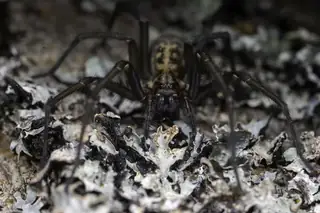
Giant house spider
Eratigena duellicaAgelenidae
Harmless
9–18 mm
Large, speedy and often startling when found in a bathtub or basement. Males wander indoors in autumn looking for mates. Despite the size, it is not dangerous, and the old claims about its bite have not held up. You usually see them in basements, garages and sheds, running along the floor and seeking a quiet corner.
How to recognize it
- Long, hairy brown legs
- Dark carapace stripes
- Chevron marks along the abdomen
- Large, fast body
Pattern: Brown body with pale, V-shaped or chevron markings on the abdomen and a dark stripe on the carapace.
Habitat: Basements, garages, sheds and crawl spaces; often found indoors in the fall.
Range: Native to Europe; introduced to northwest US and Canada
Bites: Bites are rare and not considered a concern for people; any reaction is typically brief and local.
Also called: House spider
Often confused with: Giant house spider , Barn funnel weaver , Labyrinth spider , Daddy longlegs spider
![Giant house spider (Eratigena duellica), photo 2]()
![Giant house spider (Eratigena duellica), photo 3]()
-
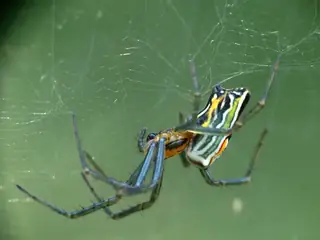
Basilica orbweaver
Mecynogea lemniscataAraneidae
Harmless
7–12 mm
It builds a cone-shaped web that looks like a cathedral dome, with a string of egg sacs hanging nearby. The spider rests under the dome and is quite shy. It is harmless to people and ignores them. The odd web and egg sac chain make it easy to recognize, even when the spider itself hides from view.
How to recognize it
- Hunched, knobby abdomen
- Pale wavy markings
- Web shaped like a dome with egg-sac chain
- Brown legs, usually tucked in
Pattern: Brown, humped abdomen with a pale, wavy-edged pattern, often with whitish patches.
Habitat: Shrubs and low vegetation, hanging beneath a domed web; outdoors only.
Range: Southern US south through the Caribbean and Central America
Bites: Bites are rare and the venom is not a concern for people; any reaction is typically brief and local, like a minor sting.
Also called: Basilica spider
Often confused with: Humped trashline orbweaver , Tropical orbweaver , Tuft-legged orbweaver
![Basilica orbweaver (Mecynogea lemniscata), photo 2]()
![Basilica orbweaver (Mecynogea lemniscata), photo 3]()
-
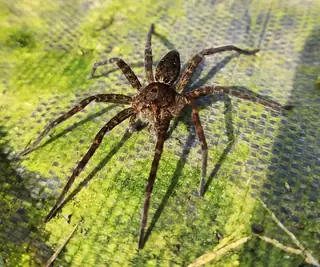
Banded fishing spider
Dolomedes vittatusDolomedidae
Harmless
8–16 mm
A long-legged water-side spider that perches on lily pads and plants, ready to dive or skate across the water. Pale side stripes help identify it. It is non-aggressive and a bite would be rare. People often meet it near docks or garden ponds, where it waits at the water's edge, motionless, for prey.
How to recognize it
- Pale lateral stripes
- Banded legs
- Large, long-legged build
- Often a white line near eyes
Pattern: Dark brown body with a pale stripe along each side and light banding across the abdomen.
Habitat: Swamps, ponds and slow streams, often on vegetation; rarely enters homes.
Range: Southeastern US
Bites: Bites are rare and the venom is not a concern for people; any reaction is typically brief and local, like a minor sting.
Also called: Fishing spider
Often confused with: Six-spotted fishing spider , Striped fishing spider , Dark fishing spider , American nursery web spider
![Banded fishing spider (Dolomedes vittatus), photo 2]()
![Banded fishing spider (Dolomedes vittatus), photo 3]()
-
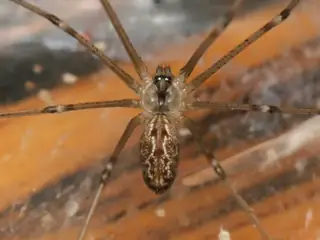
Marbled cellar spider
Holocnemus plucheiPholcidae
Harmless
5–8 mm
The tangled web in your garage or basement corner probably belongs to this skinny, long-legged spider. It hangs upside down and shakes when disturbed. It is a helpful hunter of other spiders and bugs and is not a danger to people.
How to recognize it
- Very long thin legs
- Oval, elongated abdomen with dark marks
- Bands on leg joints
- Tan with a darker stripe
Pattern: Pale tan body with a dark, marbled stripe on the underside and dark marks on the abdomen.
Habitat: Corners of ceilings, garages, basements and under eaves; frequently comes indoors.
Range: Native to the Mediterranean; widely introduced including western US
Bites: Bites are rare and the venom is not a concern for people; any reaction is typically brief and local, like a minor sting.
Also called: Daddy longlegs spider, Cellar spider
Often confused with: Daddy longlegs spider , South American toothed hacklemesh weaver , Woodlouse spider
![Marbled cellar spider (Holocnemus pluchei), photo 2]()
![Marbled cellar spider (Holocnemus pluchei), photo 3]()
-
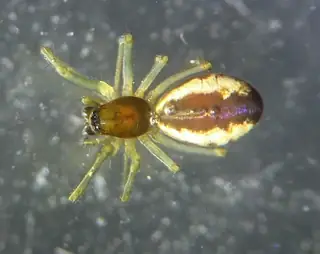
Bowl-and-doily spider
Frontinella pyramitelaLinyphiidae
Harmless
3–5 mm
The bowl-and-doily is a tiny sheet-weaver recognized by its two-part web: a bowl above and a doily below. It hangs beneath the bowl. It is much too small to bite people, and it is entirely harmless. You will mostly see its web, glittering with dew on bushes in late summer and fall.
How to recognize it
- Tiny, with tan-and-black body
- Rounded, shiny abdomen with darker pattern
- Hangs upside down under a bowl-shaped web
- Web is bowl above, flat doily below
Pattern: Black and orange-brown body with a pale, silvery abdomen with dark markings.
Habitat: Shrubs, bushes and low branches; builds webs outdoors, very rarely in buildings.
Range: Eastern and central North America
Bites: Bites are rare and the venom is not a concern for people; any reaction is typically brief and local, like a minor sting.
Also called: Bowl and doily spider
Often confused with: Filmy dome spider , Common house spider
![Bowl-and-doily spider (Frontinella pyramitela), photo 2]()
![Bowl-and-doily spider (Frontinella pyramitela), photo 3]()
-
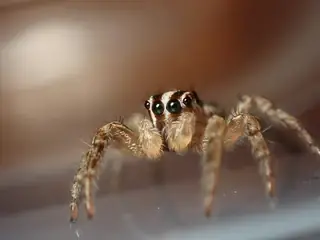
Pantropical jumping spider
Plexippus paykulliSalticidae
Harmless
8–12 mm
A common wall-dwelling jumper in warm areas, it patrols windows and porches hunting flies and small insects. It tracks you with big eyes and leaps away. It is harmless to people. It is common in warm cities, gardens and homes, and it often lives on outdoor walls near porch lights at night.
How to recognize it
- Striped carapace with pale border
- Banded abdomen with chevrons
- Slender legs, brownish
- Strong jumping stance and big front eyes
Pattern: Brown body with white or cream stripes on the carapace and a pale, banded abdomen.
Habitat: Walls, fences and houses; often found indoors and on outdoor walls.
Range: Warm regions worldwide; introduced to southern US
Bites: Bites are rare and the venom is not a concern for people; any reaction is typically brief and local, like a minor sting.
Also called: Paykull's jumping spider
Often confused with: Gray wall jumping spider , Half-edged wall jumping spider , Bold jumping spider , Common Hentz jumping spider
![Pantropical jumping spider (Plexippus paykulli), photo 2]()
![Pantropical jumping spider (Plexippus paykulli), photo 3]()
-
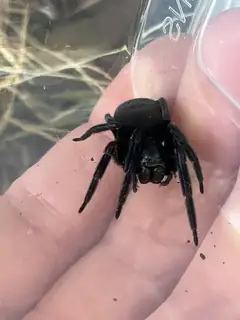
Black house spider
Badumna insignisDesidae
Mild bite
10–18 mm
The black house spider is a dark, stocky spider that builds untidy, funnel-shaped webs around windows and walls. It is common near homes in Australia. It is timid and only bites if it is handled, and a bite can be painful.
How to recognize it
- Dark, chunky body
- Hairy-looking, thick legs
- Messy, funnel-shaped lacy web
- Often in corners and windows
Pattern: Dark brown to black body with a gray-ish pattern on the abdomen.
Habitat: Builds webs in window corners, bark and brickwork and often lives near houses.
Range: Australia; introduced to other countries
Bites: Bites are uncommon and can cause pain and swelling; skin ulceration is unlikely.
Also called: Window spider
Often confused with: Grey house spider , Black lace weaver , Giant house spider
![Black house spider (Badumna insignis), photo 2]()
![Black house spider (Badumna insignis), photo 3]()
-
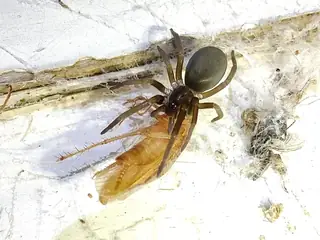
Southern house spider
Kukulcania hibernalisFilistatidae
Harmless
8–15 mm
These shy, fuzzy spiders hide in cracks and make a fluffy bluish web around window frames and fences. Males often wander indoors and look scary but are timid. They rarely bite and are not dangerous. It is often confused with brown recluses or black widows, but the fuzzy look and lacy web help tell it apart.
How to recognize it
- Fuzzy, dark brown-black body
- Males have long, slender, pale legs
- Lacy, bluish web at crevices
- Flattened body
Pattern: Females are dark brown to black and fuzzy; males are lighter brown with long legs.
Habitat: Window frames, siding, crevices and sheds; commonly around and in homes.
Range: Southern US south into Mexico
Bites: Bites are rare and cause only minor, short-lived local effects; the spider is often mistaken for a brown recluse.
Also called: Gray house spider, Crevice spider
Often confused with: Brown recluse , False black widow , Southern black widow , Woodlouse spider
![Southern house spider (Kukulcania hibernalis), photo 2]()
![Southern house spider (Kukulcania hibernalis), photo 3]()
-
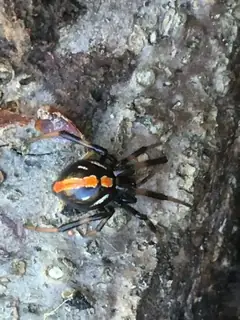
Northern black widow
Latrodectus variolusTheridiidae
Medically significant
8–13 mm
This shiny black spider with red marks hangs upside down in a messy web near the ground. It is shy and bites mainly when pressed against skin. A bite is uncommon but can cause strong symptoms. If you suspect a bite, contact a doctor or poison control; avoid reaching into wood piles without gloves.
How to recognize it
- Shiny black, round abdomen
- Row of red spots down the back
- Broken or split red hourglass underneath
Pattern: Glossy black body with a row of red spots down the back and a broken red hourglass underneath.
Habitat: Wood piles, stumps, rock walls and sheds; sometimes in outbuildings and rarely inside homes.
Range: Eastern US and southern Canada
Bites: Bites are uncommon, but the venom can cause strong muscle pain and other body-wide symptoms that warrant medical attention.
Also called: Black widow, Black widow spider
Often confused with: Southern black widow , Western black widow , False black widow , Noble false widow
![Northern black widow (Latrodectus variolus), photo 2]()
![Northern black widow (Latrodectus variolus), photo 3]()
-
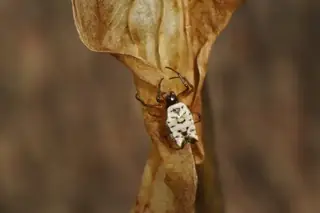
White micrathena
Micrathena mitrataAraneidae
Harmless
5–9 mm
A small white spiny orbweaver commonly found in shady woods, hanging in a neat round web. Its bright body and spines can look alarming, but it is harmless to people. Walking into its web on a woodland trail is more annoying than dangerous, and the spider simply scurries off.
How to recognize it
- White hard-looking abdomen with black dots
- Small spines on abdomen edges
- Black legs
- Hangs in the center of a round web
Pattern: Glossy white abdomen with small black dots and short spines at the sides and rear.
Habitat: Woodland and shrub areas with shady, damp spots; stays outdoors.
Range: Eastern US
Bites: Bites are rare and the venom is not a concern for people; any reaction is typically brief and local, like a minor sting.
Also called: White orbweaver
Often confused with: Spined micrathena , Arrow-shaped micrathena , Spinybacked orbweaver
![White micrathena (Micrathena mitrata), photo 2]()
![White micrathena (Micrathena mitrata), photo 3]()
-
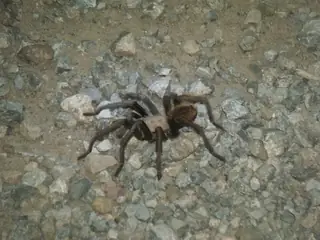
Desert blonde tarantula
Aphonopelma chalcodesTheraphosidae
Mild bite
35–55 mm
This big, fuzzy desert tarantula lives in burrows. In late summer, males roam looking for mates and are often seen on roads or in yards. It is docile and bites only if seriously provoked. It may also flick itchy hairs from its abdomen when scared, so observe from a distance and never pick one up.
How to recognize it
- Blonde to tan carapace and legs
- Darker brown to black abdomen
- Very hairy, thick legs
- Large, stocky body
Pattern: Pale tan, hairy carapace and legs with a darker, brown abdomen.
Habitat: Desert scrub, burrows in soil; wandering males may enter buildings in late summer and fall.
Range: Southwestern US (Arizona) and northwestern Mexico
Bites: Bites are rare and, like a bee or wasp sting, can be painful; no records of serious harm to people, but the hairs can irritate skin.
Also called: Arizona blonde tarantula, Tarantula
Often confused with: Texas brown tarantula , Desert tarantula
![Desert blonde tarantula (Aphonopelma chalcodes), photo 2]()
![Desert blonde tarantula (Aphonopelma chalcodes), photo 3]()
-
Shoreline wolf spider
Arctosa littoralisLycosidae
Harmless
8–16 mm
This sand-colored wolf spider hides in burrows on beaches and dunes, then runs out at night to hunt. It blends beautifully with sand. It is shy and not dangerous to people. Look for scattered burrows in sandy ground near water, where the spider may be seen at dusk, hunting small prey.
How to recognize it
- Sandy tan-gray color
- Hairy stocky build
- Pale carapace stripe
- Eyes in typical wolf spider arrangement
Pattern: Sand-colored mottled body that blends with beach sand, with faint markings on the abdomen.
Habitat: Sandy beaches, dunes and lake shores, in burrows; rarely enters buildings.
Range: Eastern US coasts and Great Lakes shores
Bites: Bites are rare and the venom is not a concern for people; any reaction is typically brief and local, like a minor sting.
Also called: Beach wolf spider, Wolf spider
Often confused with: Carolina wolf spider , Rabid wolf spider , Koch's wolf spider
![Shoreline wolf spider (Arctosa littoralis), photo 2]()
![Shoreline wolf spider (Arctosa littoralis), photo 3]()
-
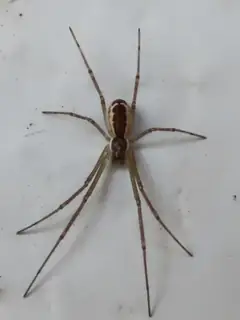
Filmy dome spider
Neriene radiataLinyphiidae
Harmless
4–6 mm
This small spider spins a neat dome of silk in shrubs and woodland edges, then hangs upside down underneath to wait for tiny insects. It is shy and almost never bites. Seeing one in your yard is normal and helpful, since it quietly eats gnats and other small bugs.
How to recognize it
- Builds a domed sheet web with a flat sheet beneath
- Hangs upside down beneath the dome
- Small slim body with long thin legs
- Abdomen is oval with lighter sides and dark patches
Pattern: Pale to brown body with darker markings on the abdomen, often with white sides.
Habitat: Found in woods, shrubs and gardens; rarely comes indoors.
Range: Eastern US and Canada
Bites: Bites are rare and the venom is not considered harmful to people.
Often confused with: Bowl-and-doily spider , Shamrock orbweaver
![Filmy dome spider (Neriene radiata), photo 2]()
![Filmy dome spider (Neriene radiata), photo 3]()
-
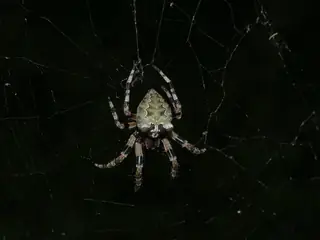
Giant lichen orbweaver
Araneus bicentenariusAraneidae
Harmless
10–20 mm
Giant lichen orbweavers are big, bumpy spiders colored like tree bark. By day they rest flat on a trunk or wall, and at night they build a wide circular web. They look intimidating, but they are calm, slow to bite, and no threat to people or pets.
How to recognize it
- Large rounded abdomen with two bumps near the front
- Mottled gray-brown pattern that blends with bark
- Banded, spiny legs
- Hides by day against tree trunks or fences
Pattern: Mottled gray and brown abdomen with a lichen-like camouflage pattern and knobby shoulders.
Habitat: Lives on trees, fences and buildings and builds large orb webs at night; occasionally found on porches.
Range: Eastern US and southern Canada
Bites: Bites are rare and the venom is not considered harmful to people.
Often confused with: Marbled orbweaver , European garden spider , Tropical orbweaver
![Giant lichen orbweaver (Araneus bicentenarius), photo 2]()
![Giant lichen orbweaver (Araneus bicentenarius), photo 3]()
-
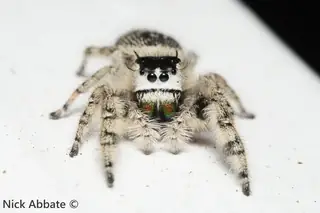
Canopy jumping spider
Phidippus otiosusSalticidae
Harmless
8–15 mm
The canopy jumping spider is a chunky, furry hunter that leaps on its prey instead of using a web. It often sits on tree trunks, fences and sunny walls. It is curious but not aggressive, and a bite is very unlikely unless it is pinched.
How to recognize it
- Stocky, fuzzy black body
- Large front eyes typical of jumping spiders
- Pale spots or stripe on top of the abdomen
- Iridescent greenish jaws on adults
Pattern: Black, hairy body with a pale or white patch and a dark triangle or spots on the abdomen.
Habitat: Lives in trees, shrubs and on house walls; sometimes wanders indoors.
Range: Southeastern US
Bites: Bites are rare and cause only brief mild pain, like a small sting.
Often confused with: Bold jumping spider , Regal jumping spider , Brilliant jumping spider
![Canopy jumping spider (Phidippus otiosus), photo 2]()
![Canopy jumping spider (Phidippus otiosus), photo 3]()
-
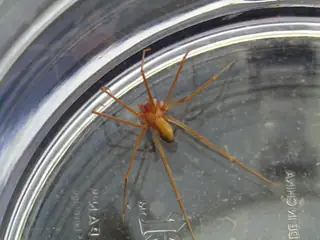
Mediterranean recluse
Loxosceles rufescensSicariidae
Medically significant
6–10 mm
The Mediterranean recluse is a plain brown spider with a violin-shaped mark and six eyes. In the US it turns up in a few cities, often in buildings. It is shy and rarely bites, but a bite should be evaluated by a medical professional.
How to recognize it
- Violin-shaped mark on the front of the body
- Six eyes in three pairs
- Plain legs without bands
- Uniform tan to reddish brown body
Pattern: Uniform tan to brown with a faint darker violin mark on the head.
Habitat: Lives in dark, humid, sheltered spots such as basements, steam tunnels and crawl spaces; commonly found indoors.
Range: Native to the Mediterranean; scattered populations in the US
Bites: Bites are uncommon, and while reactions are generally milder than from the brown recluse, they warrant medical attention.
Also called: Rufous recluse, Violin spider
Often confused with: Brown recluse , Chilean recluse , Southern house spider
![Mediterranean recluse (Loxosceles rufescens), photo 2]()
![Mediterranean recluse (Loxosceles rufescens), photo 3]()
-
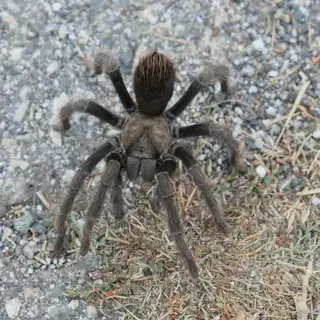
Desert tarantula
Aphonopelma iodiusTheraphosidae
Mild bite
30–40 mm
Desert tarantulas are huge, hairy and a little scary, but they are gentle. Most days they stay in burrows. In fall, males wander looking for mates, which is when people see them. Bites are rare and feel like a bee sting. Just let them walk away.
How to recognize it
- Very large and hairy with thick legs
- Dark brown to black overall
- Abdomen often reddish or lighter than body
- Two short spinnerets visible at rear
Pattern: Uniformly dark brown to blackish and hairy, with a slightly lighter, reddish-tinged abdomen.
Habitat: Lives in burrows in dry soil and rocky hillsides; males roam in fall and may wander near homes.
Range: Southwestern US (Great Basin, Nevada, Utah, California, Arizona)
Bites: Bites are rare and can be painful like a bee sting; the venom is not considered dangerous to healthy people, and the hairs can irritate skin.
Also called: Great Basin tarantula
Often confused with: Desert blonde tarantula , Texas brown tarantula
![Desert tarantula (Aphonopelma iodius), photo 2]()
![Desert tarantula (Aphonopelma iodius), photo 3]()
-
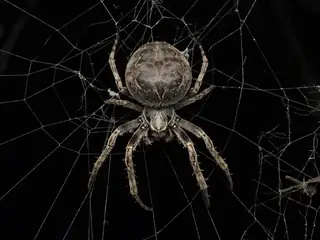
Bridge orbweaver
Larinioides sclopetariusAraneidae
Harmless
7–14 mm
Bridge orbweavers love lights and water, so you will see their webs on bridges, docks, railings and porch lights, sometimes packed close together. They hide in a crevice by day. They are timid and bite only if squeezed. Their webs can be messy, but they eat plenty of insects.
How to recognize it
- Gray-brown abdomen with a pale central band
- Dark scalloped edge along the abdomen
- Banded brown legs
- Often found in groups near water and lights
Pattern: Gray and brown mottled abdomen with a darker, scalloped leaf-shaped band down the middle.
Habitat: Builds orb webs on bridges, docks, railings and buildings near water; may rest in corners but rarely enters homes.
Range: Northern US, Canada and Europe
Bites: Bites are rare and the venom is not considered harmful to people.
Also called: Gray cross spider
Often confused with: Furrow orbweaver , European garden spider , Silver-sided sector spider
![Bridge orbweaver (Larinioides sclopetarius), photo 2]()
![Bridge orbweaver (Larinioides sclopetarius), photo 3]()
-
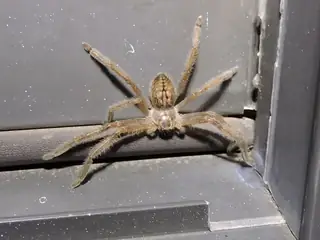
Giant crab spider
Olios giganteusSparassidae
Mild bite
15–25 mm
This big, long-legged spider is a wandering hunter that never builds a web. It is pale tan and looks a bit like a crab. It sometimes shows up on walls at night. It is calm, runs rather than fights, and bites only if it is trapped.
How to recognize it
- Very long legs held out crab-like to the side
- Flat, tan to golden body
- Large eyes in two rows
- Fast-moving, sideways-scuttling posture
Pattern: Pale tan to golden body with fine dark spots and faint stripes on the legs.
Habitat: Lives under bark, rocks and debris in desert areas, and sometimes wanders into houses.
Range: Southwestern US and northern Mexico
Bites: The bite is reported to be painful, but this spider is not considered dangerous to people.
Also called: Desert huntsman
Often confused with: Social huntsman spider , Cane spider , Grey huntsman spider
![Giant crab spider (Olios giganteus), photo 2]()
![Giant crab spider (Olios giganteus), photo 3]()
-
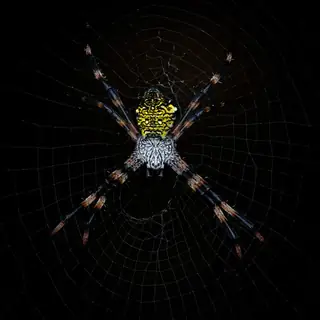
Hawaiian garden spider
Argiope appensaAraneidae
Harmless
10–25 mm
Seen all over Hawaii, this showy spider sits in the middle of its large round web, often with a zigzag stripe of white silk. Females are big and bright yellow and black. They look dramatic, but they are shy and bite only if grabbed.
How to recognize it
- Bright yellow and black banded abdomen
- Silvery front section
- Long legs with dark and light bands
- Web with a zigzag white silk pattern in the center
Pattern: Yellow and black abdomen with bold bands and silvery body, large female with stripes on the legs.
Habitat: Sits in the center of big orb webs in gardens, forest edges and bushes; rarely goes indoors.
Range: Hawaii, Southeast Asia and the Pacific islands
Bites: Bites are rare and the venom is not considered harmful to people.
Often confused with: Yellow garden spider , Banded garden spider
![Hawaiian garden spider (Argiope appensa), photo 2]()
![Hawaiian garden spider (Argiope appensa), photo 3]()
-
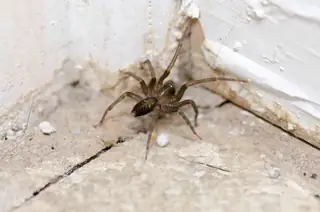
South American toothed hacklemesh weaver
Metaltella simoniDesidae
Harmless
5–10 mm
This brown spider came originally from South America and now lives in parts of California. It builds ragged, lacy webs in rock crevices, wall cracks and around foundations, and sometimes wanders inside homes. It looks plain and a little dull, and it is not considered dangerous to people or pets.
How to recognize it
- Plain brown, medium-sized body
- Messy, lacy web with tubular retreat
- Faint pale marks on the abdomen
- Spiny, robust legs
Pattern: Dull brown body with a faint chevron pattern on a gray-brown abdomen.
Habitat: Lives in rock crevices, leaf litter and building cracks, and does sometimes enter homes.
Range: California; native to South America
Bites: Bites are rare and the venom is not considered harmful to people.
Often confused with: Grey house spider , Black lace weaver , Southern house spider
![South American toothed hacklemesh weaver (Metaltella simoni), photo 2]()
![South American toothed hacklemesh weaver (Metaltella simoni), photo 3]()
-
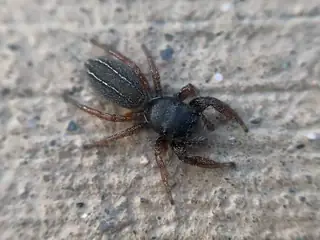
Ribbon jumping spider
Metacyrba taeniolaSalticidae
Harmless
4–7 mm
This flat, dark jumping spider hides beneath loose tree bark and in cracks of old wood. It has pale ribbon-like stripes along its sides, which give it its name. It is small and shy, and it would much rather dart away than bite, so there is nothing to worry about.
How to recognize it
- Flat, dark body with white edge stripes
- Long, front legs and big front eyes
- Small, wide-bodied jumper
- Tends to hide under bark
Pattern: Dark flattened body with a pale stripe or ribbon along each side of the abdomen.
Habitat: Lives under loose tree bark and on tree trunks and sometimes porch walls.
Range: Southeastern US
Bites: Bites are rare and cause no more than a brief mild sting.
Often confused with: Tan jumping spider , Fencepost jumping spider , California flattened jumping spider
![Ribbon jumping spider (Metacyrba taeniola), photo 2]()
![Ribbon jumping spider (Metacyrba taeniola), photo 3]()
-
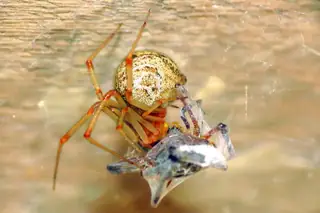
Common house spider
Parasteatoda tepidariorumTheridiidae
Harmless
4–8 mm
If you find a messy tangle of webs in a corner, it likely belongs to this spider. It is one of the most common house spiders in the US. It is brown or tan, with a round body. It rarely bites and helps control flies and mosquitoes.
How to recognize it
- Round, bulbous abdomen with mottled markings
- Long, thin banded legs
- Messy, tangled web with no pattern
- Female carries pear-shaped egg sacs
Pattern: Round tan to brown abdomen with a mottled gray pattern and dark chevron marks.
Habitat: Spins messy webs in corners, basements, garages and windowsills; common indoors.
Range: Worldwide; common throughout the US
Bites: Bites are very rare and usually cause only minor local irritation.
Also called: American house spider
Often confused with: Triangulate cobweb spider , Southern black widow , Candy-striped spider , False black widow
![Common house spider (Parasteatoda tepidariorum), photo 2]()
![Common house spider (Parasteatoda tepidariorum), photo 3]()
-
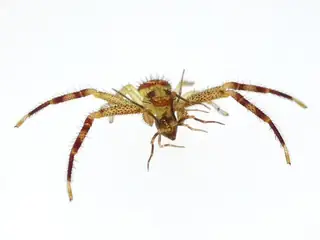
Northern crab spider
Mecaphesa asperataThomisidae
Harmless
3–8 mm
Northern crab spiders do not build webs. They sit on flowers and leaves, front legs held wide, waiting for bees and flies to land close. Their pale bodies blend in well. They are small, calm and no concern to people.
How to recognize it
- Crab-like body with front legs held out
- First two leg pairs longer and thicker
- Pale body, often with reddish or brown streaks
- Sits still on flowers
Pattern: Cream to pale yellow body with brown marks and a dark band on the sides, abdomen sometimes spotted.
Habitat: Waits on flowers, leaves and shrubs to ambush insects; rarely enters homes.
Range: Most of the US and Canada
Bites: Bites are rare and the venom is not considered harmful to people.
Often confused with: Goldenrod crab spider , American green crab spider , White-banded crab spider , Green crab spider
![Northern crab spider (Mecaphesa asperata), photo 2]()
![Northern crab spider (Mecaphesa asperata), photo 3]()
-
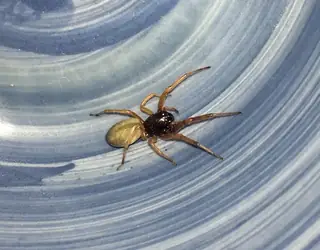
Broad-faced sac spider
Trachelas tranquillusTrachelidae
Harmless
4–7 mm
The broad-faced sac spider is a small night hunter with a dark reddish head area and a pale abdomen. It rests in a silk pouch under bark or stones and sometimes inside homes. It rarely bites, and the bite is usually minor.
How to recognize it
- Dark reddish-brown front part with a lighter abdomen
- Wide, broad front of the head
- Stocky, short-legged body
- Resembles a sac spider but darker
Pattern: Reddish-brown front section with a paler tan to gray abdomen.
Habitat: Lives under bark, in leaf litter and in silk retreats, and does sometimes enter homes.
Range: Eastern US and Canada
Bites: Bites are rare; reports describe only minor local pain.
Often confused with: Yellow sac spider , Eastern parson spider , Sylvan jumping spider
![Broad-faced sac spider (Trachelas tranquillus), photo 2]()
![Broad-faced sac spider (Trachelas tranquillus), photo 3]()
-
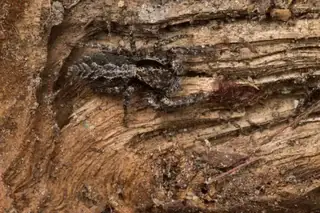
California flattened jumping spider
Platycryptus californicusSalticidae
Harmless
7–14 mm
This flat jumping spider is gray-brown and blends in with wood, fences and house walls. It hunts by sight, then leaps on prey. It is curious and may follow your hand, but it bites rarely and the bite is minor.
How to recognize it
- Flat wide body held close to surfaces
- Mottled gray and brown, bark-like pattern
- Large front eyes
- Males have hairy white and black bands
Pattern: Flat gray-brown body with mottled bark-like pattern, males darker with white stripes.
Habitat: Found on fences, tree trunks and walls; can enter houses.
Range: Southern and western US to Mexico
Bites: Bites are rare and cause only brief mild pain.
Also called: Flat jumping spider
Often confused with: Tan jumping spider , Bold jumping spider , Ribbon jumping spider
![California flattened jumping spider (Platycryptus californicus), photo 2]()
![California flattened jumping spider (Platycryptus californicus), photo 3]()
-
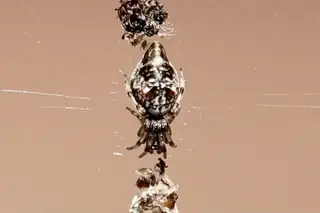
Humped trashline orbweaver
Cyclosa turbinataAraneidae
Harmless
4–7 mm
The humped trashline orbweaver decorates its web with a vertical line of egg sacs, dead insects and bits of debris, then sits in the line, looking like part of the junk. It is very small, calm and harmless, and finding one in your garden means the web is doing its job.
How to recognize it
- Cone-shaped hump on the back of the abdomen
- Mottled brown and gray body
- Lines up on its web next to a trash line
- Small body with short legs
Pattern: Brown and gray abdomen with a hump near the rear, resembling a bit of debris.
Habitat: Lives in shrubs, bushes and woods, sitting in a vertical line of debris; rarely goes indoors.
Range: Southeastern and eastern US
Bites: Bites are rare and the venom is not considered harmful to people.
Also called: Trashline spider
Often confused with: Conical trashline orbweaver , Basilica orbweaver , Spined micrathena
![Humped trashline orbweaver (Cyclosa turbinata), photo 2]()
![Humped trashline orbweaver (Cyclosa turbinata), photo 3]()
-
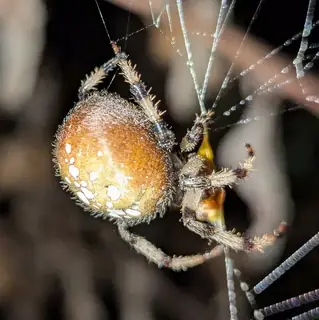
Shamrock orbweaver
Araneus trifoliumAraneidae
Harmless
9–20 mm
The shamrock orbweaver is a plump, round spider that can be white, tan, orange or even purple. Its back has a pale leaf-like pattern. It builds big webs in fall gardens. It rarely bites, and bites are no more than a pinch.
How to recognize it
- Large rounded abdomen
- Leaf or shamrock-like markings on top
- Color varies from cream to orange to purple-brown
- Stout, spiny legs with dark bands
Pattern: Round, plump abdomen that ranges from pale to orange-brown, with a pale leaf-shaped or clover-like pattern.
Habitat: Builds orb webs in shrubs, fields and gardens, and hides in leaves by day; seldom enters homes.
Range: Eastern US and southern Canada
Bites: Bites are rare and the venom is not considered harmful to people.
Also called: Shamrock spider
Often confused with: Marbled orbweaver , European garden spider , Spotted orbweaver
![Shamrock orbweaver (Araneus trifolium), photo 2]()
![Shamrock orbweaver (Araneus trifolium), photo 3]()
-
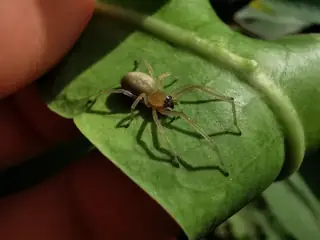
Yellow sac spider
Cheiracanthium inclusumCheiracanthiidae
Mild bite
5–10 mm
A small pale yellow spider that hides in silk tubes in corners, on walls or ceilings, or in plants. It hunts at night and sometimes bites if it gets pressed against skin in bedding or clothing. The bite stings and may swell a little, but it usually heals without trouble.
How to recognize it
- Pale yellow or cream body
- Dark fangs and mouthparts
- Long front legs
- Dark brown tips on the face
Pattern: Pale yellow to tan body with a dark brown area at the front of the head and fangs.
Habitat: Lives in leaf litter, shrubs and building corners, and can come indoors in fall.
Range: Southern and central US to Central America
Bites: Bites are uncommon and cause pain, redness and mild swelling; they are not considered dangerous to healthy adults.
Also called: Agrarian sac spider
Often confused with: Eastern parson spider , Broad-faced sac spider , Daddy longlegs spider
![Yellow sac spider (Cheiracanthium inclusum), photo 2]()
![Yellow sac spider (Cheiracanthium inclusum), photo 3]()
-
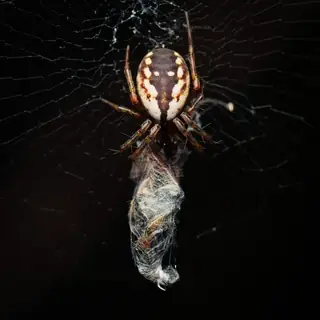
Tuft-legged orbweaver
Mangora placidaAraneidae
Harmless
3–5 mm
This tiny orbweaver weaves a tight, neat web among leaves, low plants and shrubs. It is pale tan with thin dark stripes along its body. Because it is so small, a bite is almost unheard of, and it poses no risk to people, so you can safely leave it alone.
How to recognize it
- Slim pale body with dark side lines
- Fine dark stripes on the abdomen
- Small, long-legged body
- Orb web with many tightly spaced threads
Pattern: Pale tan body with two dark lines along the sides and a central stripe on the abdomen.
Habitat: Builds small, tight webs in leaves and bushes; occasionally on porches.
Range: Eastern US
Bites: Bites are rare and the venom is not considered harmful to people.
Often confused with: Lined orbweaver , Cricket-bat orbweaver , Six-spotted orbweaver
![Tuft-legged orbweaver (Mangora placida), photo 2]()
![Tuft-legged orbweaver (Mangora placida), photo 3]()
-
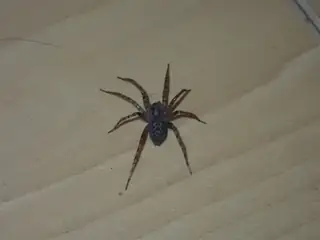
Barn funnel weaver
Tegenaria domesticaAgelenidae
Harmless
6–11 mm
The barn funnel weaver is a brown, fast-running spider that spins flat sheets of web with a funnel hideout in corners of basements, sheds and garages. It is a common house spider and is not dangerous. It rarely bites and just wants to hide.
How to recognize it
- Brown body with chevron pattern
- Two dark stripes on the front section
- Long, hairy back spinnerets
- Flat, funnel-shaped sheet web
Pattern: Brown body with a pale gray chevron pattern on the abdomen and two dark stripes on the front.
Habitat: Builds funnel webs in basements, garages, barns and window corners and is common indoors.
Range: Worldwide; common in the northern US and Europe
Bites: Bites are rare, and symptoms are usually minor.
Also called: Domestic house spider
Often confused with: Giant house spider , Giant house spider , Labyrinth spider
![Barn funnel weaver (Tegenaria domestica), photo 2]()
![Barn funnel weaver (Tegenaria domestica), photo 3]()
-
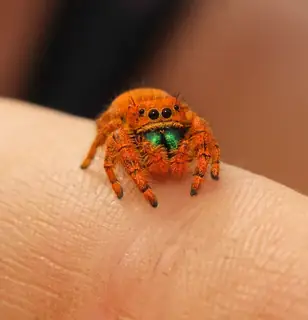
Apache jumping spider
Phidippus apacheanusSalticidae
Harmless
6–13 mm
This colorful jumping spider has a bright orange-red abdomen, black legs and shimmering jaws, and it lives mostly in the dry Southwest. It hunts bugs by sight and leaps on them. It is bold and curious but gentle, and a bite is rare and mild if it ever happens.
How to recognize it
- Orange-red abdomen with black center stripe
- Black front section with fuzzy legs
- Large front eyes
- Iridescent jaws on adults
Pattern: Black body with a bright orange or red abdomen marked by a black stripe or spots.
Habitat: Lives in deserts, grasslands and gardens and may wander into homes.
Range: Southwestern US and Mexico
Bites: Bites are rare and cause only mild local pain.
Often confused with: Johnson's jumping spider , Brilliant jumping spider , Bold jumping spider
![Apache jumping spider (Phidippus apacheanus), photo 2]()
![Apache jumping spider (Phidippus apacheanus), photo 3]()
-
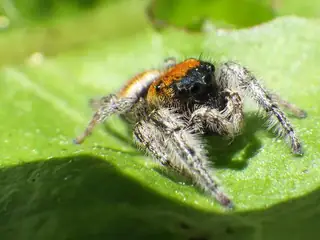
Whitman's jumping spider
Phidippus whitmaniSalticidae
Harmless
6–12 mm
Whitman's jumping spider is a small, black, fuzzy jumper with pale spots on its back and shimmering jaws. It hunts by sight on plants, trees and sunny walls rather than using a web. It is curious but not aggressive, and a bite is rare and usually no worse than a tiny pinch.
How to recognize it
- Black fuzzy body
- White-ringed abdomen spots
- Orange or red marks on the back
- Iridescent green jaws
Pattern: Black body with white or orange spots on the abdomen and a pale stripe along the sides.
Habitat: Hunts on foliage, trees and house walls; occasionally goes indoors.
Range: Northern US and Canada
Bites: Bites are rare and cause only mild brief pain.
Often confused with: Bold jumping spider , Putnam's jumping spider , Brilliant jumping spider
![Whitman's jumping spider (Phidippus whitmani), photo 2]()
![Whitman's jumping spider (Phidippus whitmani), photo 3]()
-
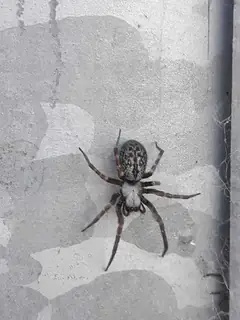
Grey house spider
Badumna longinquaDesidae
Mild bite
6–11 mm
The grey house spider spins lacy webs with a funnel on walls, fences and window frames. Brought in from Australia, it now lives in California. It is shy, but a bite can sting and swell a bit. It is not considered dangerous.
How to recognize it
- Gray-brown body with pale mottled pattern
- Banded legs
- Brownish front section
- Messy, lacy web with funnel retreat
Pattern: Gray to dark brown body with a mottled pale pattern on the abdomen.
Habitat: Builds lacy webs on walls, fences and window frames and sometimes goes into buildings.
Range: Native to Australia; introduced to California, NZ and other places
Bites: Bites from Badumna house spiders are uncommon and can be painful with local swelling, but are not considered dangerous.
Also called: Brown house spider
Often confused with: Black house spider , South American toothed hacklemesh weaver , Barn funnel weaver
![Grey house spider (Badumna longinqua), photo 2]()
![Grey house spider (Badumna longinqua), photo 3]()
-
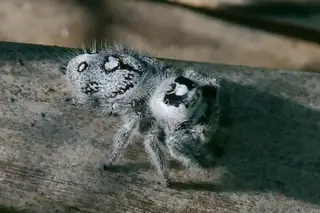
Regal jumping spider
Phidippus regiusSalticidae
Harmless
8–18 mm
The regal jumping spider is one of the largest jumpers in the country. Males are black and fuzzy with white bars, and females are grayer, both with shimmering green jaws. They are curious and quite tolerant of people, and they rarely bite, so they make a friendly neighbor on walls and fences.
How to recognize it
- Large and bulky for a jumping spider
- Metallic green to blue jaws
- White spots and stripes on abdomen
- Males are black with white bars
Pattern: Black fuzzy body with white spots on the abdomen; females gray, males black with white bands.
Habitat: Found on fences, walls and in trees; occasionally enters buildings.
Range: Southeastern US and Caribbean
Bites: Bites are rare and cause a mild sting at most.
Often confused with: Bold jumping spider , Canopy jumping spider , Grayish jumping spider
![Regal jumping spider (Phidippus regius), photo 2]()
![Regal jumping spider (Phidippus regius), photo 3]()
-
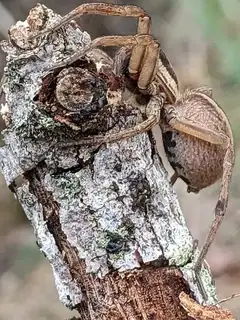
Dotted wolf spider
Rabidosa punctulataLycosidae
Harmless
10–20 mm
This brown wolf spider runs across lawns, leaf litter and open fields, hunting at night instead of building a web. Females carry their round egg sac behind them. It looks scary because of its size and hairy legs, but it is shy and bites only when it is pinned or trapped.
How to recognize it
- Pale cream band down the middle
- Row of dark dots on the underside of the abdomen
- Brown, hairy, long-legged body
- Large eyes in three rows
Pattern: Brown with a pale central stripe and dark dotted marks along the abdomen.
Habitat: Hunts on the ground in grass and leaf litter; sometimes enters buildings.
Range: Eastern and central US
Bites: Bites are rare and cause only mild local pain.
Often confused with: Rabid wolf spider , Carolina wolf spider , Drumming sword wolf spider
![Dotted wolf spider (Rabidosa punctulata), photo 2]()
![Dotted wolf spider (Rabidosa punctulata), photo 3]()
-
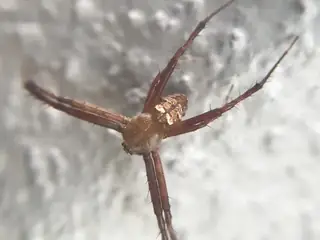
Heptagonal orbweaver
Gea heptagonAraneidae
Harmless
3–7 mm
The heptagonal orbweaver is a tiny spider with a pattern shaped like a seven-sided figure on its back. It spins a small round web in tall grasses and shrubs, often at dusk. It is very small, easy to overlook and completely harmless to people, so there is no reason to worry.
How to recognize it
- Seven-sided or polygonal shape of the abdomen
- Small, flat body
- Pale spots in rows
- Long front legs
Pattern: Brown to tan abdomen with pale spots and a seven-sided pattern.
Habitat: Builds orb webs in tall grasses, shrubs and bushes; rarely goes indoors.
Range: Southern US and Central America
Bites: Bites are rare and the venom is not considered harmful to people.
Often confused with: Arrowhead orbweaver , Lined orbweaver , Conical trashline orbweaver
![Heptagonal orbweaver (Gea heptagon), photo 2]()
![Heptagonal orbweaver (Gea heptagon), photo 3]()
-
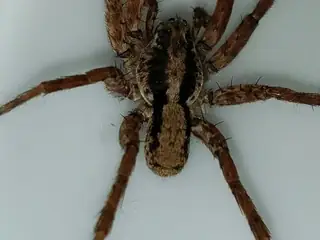
Drumming sword wolf spider
Gladicosa gulosaLycosidae
Harmless
10–16 mm
The drumming sword wolf spider hunts on the ground in forests, leaf litter and gardens. Males drum on dry leaves to attract mates. It is brown with pale stripes and fairly slim. It is shy and bites only if it feels trapped, and the bite is usually minor and local.
How to recognize it
- Brown body with pale stripe
- Dark stripes on the sides of the head
- Leaves a drumming sound
- Long thin legs
Pattern: Brown with a pale central stripe and dark side markings on the abdomen.
Habitat: Hunts on the ground in leaf litter and wooded areas; may enter homes.
Range: Eastern and central US
Bites: Bites are rare and cause only mild local pain.
Also called: Wolf spider
Often confused with: Dotted wolf spider , Carolina wolf spider , Rabid wolf spider
![Drumming sword wolf spider (Gladicosa gulosa), photo 2]()
![Drumming sword wolf spider (Gladicosa gulosa), photo 3]()
-
Black-banded crab spider
Synema parvulumThomisidae
Harmless
3–6 mm
This small crab spider has a bold black and orange pattern, sometimes with white bands. It does not spin a web but waits on flowers and leaves to ambush flies and bees. It is calm, tiny and not dangerous to people, so it is safe to admire from a distance.
How to recognize it
- Black abdomen with orange or red markings
- White or yellow bands
- Crab-like body with powerful front legs
- Dark legs with pale rings
Pattern: Black body with bright orange or red marks and white banding on the abdomen.
Habitat: Waits on flowers and foliage to ambush insects; rarely enters homes.
Range: Most of the US and southern Canada
Bites: Bites are rare and the venom is not considered harmful to people.
Also called: Elegant crab spider
Often confused with: Goldenrod crab spider , Northern crab spider , Green crab spider
![Black-banded crab spider (Synema parvulum), photo 2]()
![Black-banded crab spider (Synema parvulum), photo 3]()
-
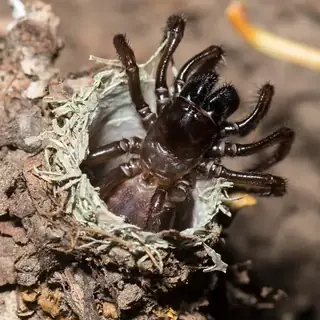
California turret spider
Atypoides riversiAntrodiaetidae
Harmless
10–20 mm
A stocky, shiny dark brown spider that lives in a silk-lined burrow in California hillsides, sometimes topped with a little silk turret. It looks tarantula-like but is much smaller. It stays hidden in its tunnel and ambushes passing insects, so you will rarely meet one in your house.
How to recognize it
- Large, shiny, dome-shaped carapace with a deep front-heavy look
- Stout, heavy-bodied with short, thick legs
- Large forward-pointing fangs visible from the front
- Seen at the mouth of a silk-lined burrow, sometimes with a short silk turret
Pattern: Glossy dark brown to black carapace with a plain, slightly paler to dark abdomen.
Habitat: Digs silk-lined burrows in banks and wooded slopes, sometimes with a short turret; rarely enters homes.
Range: Coastal and Sierra foothill California
Bites: Bites are very rare, as this shy burrower seldom leaves its tunnel, and are not considered dangerous.
Also called: Turret spider
Often confused with: Desert blonde tarantula , Southern house spider
![California turret spider (Atypoides riversi), photo 2]()
![California turret spider (Atypoides riversi), photo 3]()
-
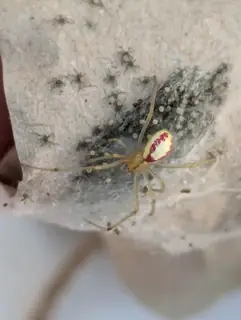
Candy-striped spider
Enoplognatha ovataTheridiidae
Harmless
4–6 mm
A tiny, round, colorful spider that sits on garden plants and fence tops. Some are plain cream, while others wear red stripes that give it the candy-striped name. It is a harmless relative of cobweb spiders and mostly minds its own business, catching small bugs in a messy web among leaves.
How to recognize it
- Globular, shiny abdomen in cream, yellow or white
- Red stripes or red spots on the back in some forms
- Pale legs, often with slightly darker tips
- Very small, usually under 6 mm
Pattern: Rounded cream, yellow or white abdomen, often with a red stripe or red spots along the top and sides.
Habitat: Lives on low plants, hedges, fences and garden foliage in a loose web; rarely goes indoors.
Range: Europe; introduced to northern US and Canada
Bites: Bites are very rare and, if they happen, produce only mild local irritation.
Also called: Common candy-striped spider
Often confused with: Boreal combfoot , Common house spider , Goldenrod crab spider
![Candy-striped spider (Enoplognatha ovata), photo 2]()
![Candy-striped spider (Enoplognatha ovata), photo 3]()
-
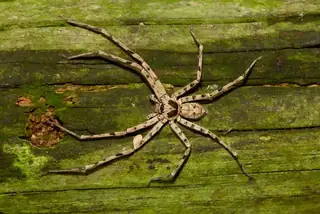
Cane spider
Heteropoda venatoriaSparassidae
Mild bite
12–20 mm
A big, flat, long-legged brown spider that often wanders into homes in warm places like Florida and Hawaii. It runs fast and may startle you, but it hunts cockroaches and other pests and prefers to flee. A bite is rare and mostly just briefly painful, usually when the spider is handled.
How to recognize it
- Large, flat body with long legs held crab-like
- Brown to tan with mottled dark markings
- Two rows of four eyes, with a pale face band
- Legs sprawl sideways and look hairy
- Dark patches on each side of the front of the carapace
Pattern: Flattened tan to brown body with dark mottling and a pale band across the face.
Habitat: Found under bark, in palm fronds, sheds and houses in warm climates, and does come indoors.
Range: Tropics worldwide; established in Florida, Gulf Coast, Hawaii and southern states
Bites: Bites are uncommon and usually cause brief local pain; the species is not considered dangerous to healthy adults.
Also called: Pantropical huntsman spider, Banana spider, Huntsman spider
Often confused with: Giant crab spider , Social huntsman spider , Grey huntsman spider , Dark fishing spider
![Cane spider (Heteropoda venatoria), photo 2]()
![Cane spider (Heteropoda venatoria), photo 3]()
-
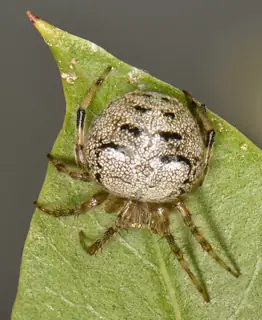
Butterfly orbweaver
Araneus pegniaAraneidae
Harmless
5–8 mm
A small orbweaver with a pale, butterfly-shaped pattern on its back. You might find its web in low shrubs or grassy edges on the eastern side of the country. It is shy, usually hides during the day, and is not a threat to people or pets.
How to recognize it
- Butterfly-shaped dark outline on a pale back
- Small, with a rounded abdomen
- Pale yellow or whitish shoulders
- Brown cephalothorax and banded legs
Pattern: Abdomen shows a pale butterfly-shaped or leaf-like pattern, outlined in dark brown, with white and yellow patches.
Habitat: Builds small orb webs in shrubs, tall grass and woodland edges, often at night; seldom enters homes.
Range: Eastern US and southern Canada
Bites: Bites are very rare and not considered harmful.
Also called: Butterfly orb weaver
Often confused with: Shamrock orbweaver , Tuft-legged orbweaver , Six-spotted orbweaver
![Butterfly orbweaver (Araneus pegnia), photo 2]()
![Butterfly orbweaver (Araneus pegnia), photo 3]()
-
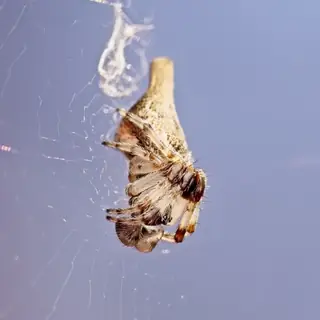
Conical trashline orbweaver
Cyclosa conicaAraneidae
Harmless
4–7 mm
A tiny, bark-colored orbweaver that hangs in the middle of a web decorated with a vertical line of leftover prey and debris. It looks like part of the trash line. It is easy to miss, shy, and no concern to people.
How to recognize it
- Abdomen tapers to a pointed, conical hump at the rear
- Mottled bark-like gray-brown coloring
- Camouflaged among a line of debris in its web
- Small and pale-legged
Pattern: Mottled brown and gray abdomen with a cone-shaped tip and pale patches.
Habitat: Hangs in orb webs in trees and shrubs, decorating the web with a line of debris; rarely comes inside.
Range: Across the US and Canada; also found in Europe and Asia
Bites: Bites are extremely rare and not dangerous to people.
Also called: Trashline orbweaver
Often confused with: Humped trashline orbweaver , Shamrock orbweaver , Tuft-legged orbweaver
![Conical trashline orbweaver (Cyclosa conica), photo 2]()
![Conical trashline orbweaver (Cyclosa conica), photo 3]()
-
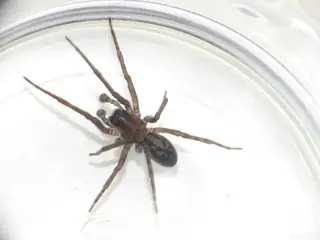
Black lace weaver
Amaurobius feroxAmaurobiidae
Harmless
8–15 mm
A dark, shiny, stocky spider that builds a bluish, lacy web around cracks in walls and window frames. It is often confused with false widows, but it is much less harmful. It hides in its retreat and rarely bites, even when disturbed.
How to recognize it
- Dark, glossy brown-black body
- Rounded abdomen and stout, hairy legs
- Bluish-looking lacy web in crevices
- Females much larger than males
Pattern: Glossy dark brown to black body, often with faint pale marks on the abdomen.
Habitat: Lives in crevices in walls, window frames, bark and under logs; often noticed around houses and may come indoors.
Range: UK and Europe; introduced to northeastern US and Canada
Bites: Bites are rare and mild, sometimes causing minor local pain.
Also called: Black laceweaver
Often confused with: Lace-weaver spider , Noble false widow , Grey house spider
![Black lace weaver (Amaurobius ferox), photo 2]()
![Black lace weaver (Amaurobius ferox), photo 3]()
-
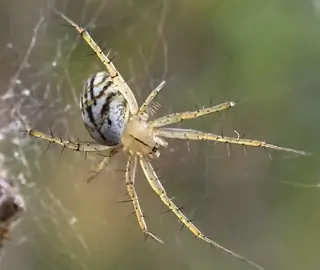
Lined orbweaver
Mangora gibberosaAraneidae
Harmless
3–6 mm
A small pale orbweaver marked with thin dark lines along its back. It spins a neat flat web in grass or low brush and sits tight in the center. It is very small, shy, and not a bite risk to people.
How to recognize it
- Pale cream body with thin dark lengthwise stripes
- Tiny, slender abdomen
- Pale legs with slight dark tips
Pattern: Pale creamy abdomen with fine dark lines running lengthwise.
Habitat: Builds small orb webs in grass, shrubs and woodland edges; rarely comes indoors.
Range: Eastern US and Mexico
Bites: Bites are very rare and not considered harmful.
Often confused with: Tuft-legged orbweaver , Six-spotted orbweaver , Butterfly orbweaver
![Lined orbweaver (Mangora gibberosa), photo 2]()
![Lined orbweaver (Mangora gibberosa), photo 3]()
-
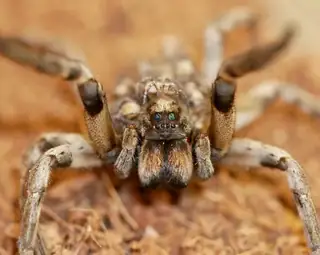
Carolina wolf spider
Hogna carolinensisLycosidae
Mild bite
18–35 mm
The Carolina wolf spider is the largest wolf spider in the US. It is brown, hairy and sturdy, and it hunts at night instead of waiting in a web. Females carry their egg sac and later their babies on their backs. It bites only if handled or trapped.
How to recognize it
- Large, hairy, robust body, the biggest US wolf spider
- Dark brown carapace with a paler stripe down the middle
- Dark underside, often black on the belly
- Two large eyes on top of a row of four small eyes
Pattern: Brown to gray body with a pale central band on the carapace and dark mottled abdomen.
Habitat: Digs burrows in open ground, fields and yards; sometimes wanders indoors.
Range: Eastern and central US, from Florida to Illinois and Texas
Bites: Bites are uncommon and can be painful, about like a bee sting, with brief redness or swelling; they are not considered dangerous.
Also called: Giant wolf spider, Wolf spider
Often confused with: Rabid wolf spider , Drumming sword wolf spider , Dark fishing spider , Dotted wolf spider
![Carolina wolf spider (Hogna carolinensis), photo 2]()
![Carolina wolf spider (Hogna carolinensis), photo 3]()
-
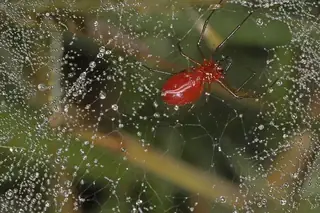
Black-tailed red sheetweaver
Florinda coccineaLinyphiidae
Harmless
2–4 mm
A tiny sheetweaver that stands out for its red front and shiny black rear. It lives in leaf litter or low shrubs and builds a small, flat web. It is too small to hurt people, so its bright color is the only reason it gets noticed.
How to recognize it
- Bright orange-red carapace and legs
- Glossy black abdomen
- Tiny, under 4 mm long
Pattern: Orange-red front section with a shiny black abdomen.
Habitat: Builds small sheet webs in leaf litter and low shrubs in woodlands; seldom enters homes.
Range: Eastern US
Bites: Bites are essentially unknown and not harmful.
Often confused with: Bowl-and-doily spider , Filmy dome spider
![Black-tailed red sheetweaver (Florinda coccinea), photo 2]()
![Black-tailed red sheetweaver (Florinda coccinea), photo 3]()
-
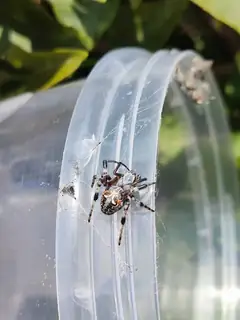
Labyrinth orbweaver
Metepeira labyrintheaAraneidae
Harmless
4–8 mm
A small brown orbweaver that spins a round web with a messy tangle of silk above it, where it hides during the day. Several neighbors often share the same tangle in conifers and shrubs. It is quiet and shy, and it is no threat to people or pets.
How to recognize it
- Brown mottled body with a darker central stripe
- Rounded abdomen, shorter than it is wide
- Brown banded legs
- Sits under a messy retreat above the web
Pattern: Brownish abdomen with a pale central band, often with a dark leaf-like pattern.
Habitat: Builds orb webs with a tangled retreat in conifers and shrubs; sometimes seen on buildings and fences.
Range: Eastern US and Canada
Bites: Bites are very rare and not considered harmful.
Also called: Labyrinth orb weaver
Often confused with: Shamrock orbweaver , Furrow orbweaver , Butterfly orbweaver
![Labyrinth orbweaver (Metepeira labyrinthea), photo 2]()
![Labyrinth orbweaver (Metepeira labyrinthea), photo 3]()
-
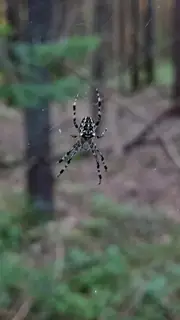
Nordmann's orbweaver
Araneus nordmanniAraneidae
Harmless
6–12 mm
A small, mottled brown orbweaver that lives in cool northern conifer forests. It has a pale leaf-like pattern down its back and looks much like several other orbweavers. It stays in or near its web, rarely meets people, and is not a danger to anyone.
How to recognize it
- Leaf-like pale folium on the back
- Mottled brown, tan and cream coloring
- Rounded oval abdomen with white spots
- Brown banded legs
Pattern: Reddish-brown to tan abdomen with a pale central leaf-shaped folium and white spots.
Habitat: Builds orb webs in conifers and shrubs in cool forests; occasionally on buildings.
Range: Northern Eurasia and northern North America including Canada and Alaska
Bites: Bites are rare and not harmful to people.
Often confused with: European garden spider , Marbled orbweaver , Shamrock orbweaver
![Nordmann's orbweaver (Araneus nordmanni), photo 2]()
![Nordmann's orbweaver (Araneus nordmanni), photo 3]()
-
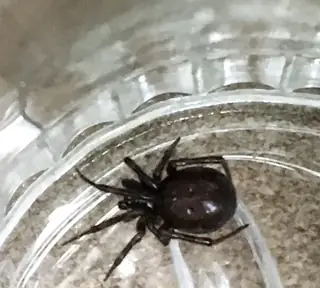
Boreal combfoot
Steatoda borealisTheridiidae
Harmless
4–8 mm
A small round dark spider and member of the false widow group. It is often mistaken for a black widow, but it lacks the red hourglass and is much smaller. It is shy, usually found under rocks and wood, and rarely bites.
How to recognize it
- Round, glossy dark abdomen
- Reddish-brown legs
- Spiky comb-like hairs on the rear legs
- Looks like a small, dull black widow
Pattern: Glossy dark brown abdomen, sometimes with a faint pale band or marks.
Habitat: Lives in leaf litter, under rocks and logs, and sometimes around buildings.
Range: Northern US and Canada
Bites: Bites are very rare and usually cause only minor local pain; related false widows are not considered dangerous to healthy adults.
Also called: Northern false widow
Often confused with: False black widow , Common house spider , Northern black widow , Southern black widow
![Boreal combfoot (Steatoda borealis), photo 2]()
![Boreal combfoot (Steatoda borealis), photo 3]()
-
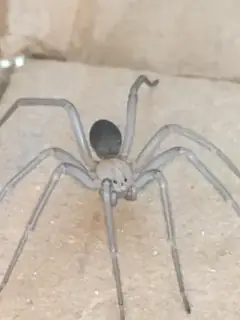
Chilean recluse
Loxosceles laetaSicariidae
Medically significant
8–15 mm
The Chilean recluse is a large, plain brown spider with a violin mark on its head. It hides in closets and basements. It is introduced to a few places in the US. It rarely bites, but bites can be serious and should be seen by a doctor.
How to recognize it
- Violin-shaped mark on the head
- Six eyes in pairs
- Long thin legs without banding
- Plain brown abdomen
Pattern: Uniform tan to reddish-brown body with a dark violin mark on the head region.
Habitat: Prefers dark, quiet places like closets, basements and storage boxes, and lives inside buildings.
Range: Native to South America; local populations in the US (e.g. Los Angeles)
Bites: Bites are uncommon, but venom can cause skin damage and rarely body-wide effects, so medical attention is warranted.
Also called: South American recluse
Often confused with: Brown recluse , Mediterranean recluse , Desert recluse
![Chilean recluse (Loxosceles laeta), photo 2]()
![Chilean recluse (Loxosceles laeta), photo 3]()
-
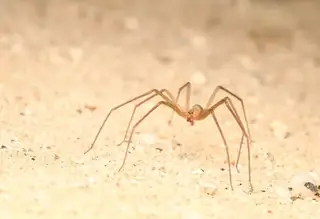
Desert recluse
Loxosceles desertaSicariidae
Medically significant
6–12 mm
The desert recluse is a pale brown spider from the dry southwestern US. It has six eyes and a violin-shaped mark on its head, and no markings on its legs. It is shy and hides, but bites can cause skin lesions and should be checked by a doctor.
How to recognize it
- Dark violin mark on the head region
- Six eyes in three pairs
- Plain, unbanded legs
- Uniform tan to brown abdomen
Pattern: Uniform tan to brown body with a dark violin-shaped mark on the front of the body.
Habitat: Lives in dry desert rocks, burrows and sheds, and sometimes enters buildings in desert areas.
Range: Southwestern US deserts (California, Arizona, Nevada, Utah)
Bites: Bites are uncommon, but recluse bites can cause skin damage that is slow to heal and warrant medical attention.
Also called: Desert violin spider
Often confused with: Brown recluse , Chilean recluse , Southern house spider
![Desert recluse (Loxosceles deserta), photo 2]()
![Desert recluse (Loxosceles deserta), photo 3]()
-
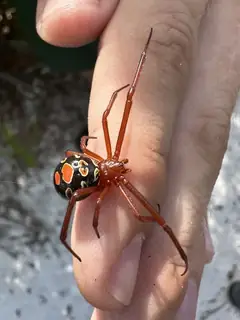
Red widow
Latrodectus bishopiTheridiidae
Medically significant
8–13 mm
The red widow is a Florida spider that lives in palmetto scrub. It has an orange-red head and legs with a dark body marked by red spots. It is shy and found outdoors rather than in houses. As with other widows, a bite deserves medical attention.
How to recognize it
- Orange-red head and legs
- Black abdomen with red spots
- Round glossy abdomen typical of widow spiders
- Found only in Florida
Pattern: Black to dark body with a red or orange head and legs, and red spots on a dark abdomen.
Habitat: Lives in palmetto scrub and sand pine habitat; rarely enters homes.
Range: Central and southern Florida
Bites: Bites are uncommon, but widow bites can cause pain and spreading symptoms that warrant medical attention.
Also called: Red widow spider
Often confused with: Southern black widow , Northern black widow , Brown widow
![Red widow (Latrodectus bishopi), photo 2]()
![Red widow (Latrodectus bishopi), photo 3]()
-
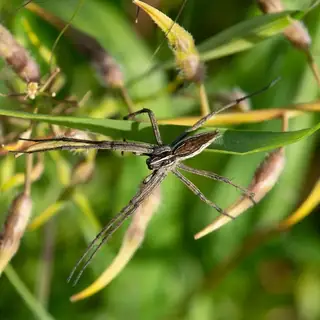
European nursery web spider
Pisaura mirabilisPisauridae
Harmless
10–15 mm
A long-legged, pale brown hunter of grassy meadows in Europe. Females famously carry a round egg sac in their jaws and later build a nursery web to guard their spiderlings. It is shy and quick to run, and it poses no real risk to people.
How to recognize it
- Long slender legs held out front
- Pale brown body with a pale central stripe
- Oval abdomen tapering to a point
- Carries a pale egg sac in its jaws
Pattern: Pale brown body with a pale central band edged with dark stripes on the carapace.
Habitat: Hunts in grass, meadows and low vegetation; rarely goes indoors.
Range: UK and Europe, east across Asia
Bites: Bites are very rare and not dangerous to people.
Also called: Nursery web spider
Often confused with: American nursery web spider , Banded fishing spider , Rabid wolf spider
![European nursery web spider (Pisaura mirabilis), photo 2]()
![European nursery web spider (Pisaura mirabilis), photo 3]()
-
Walnut orbweaver
Nuctenea umbraticaAraneidae
Harmless
10–14 mm
A flat, dark orbweaver that squeezes into cracks in fences, bark and walls during the day, which is why it is hard to spot. At night it comes out to spin its web. It is harmless to people, bites only if squashed, and is common across Europe.
How to recognize it
- Very flat, wide body that hides in cracks
- Mottled brown and gray with a dark leaf marking
- Wide abdomen with pale edges
- Short, strong legs
Pattern: Flat, dark gray-brown abdomen with a paler central leaf-like pattern.
Habitat: Hides in cracks in fences, bark and walls by day, then builds an orb web at night; occasionally enters sheds.
Range: UK and Europe, across Asia
Bites: Bites are rare and not dangerous.
Also called: Walnut orb weaver
Often confused with: Furrow orbweaver , European garden spider , Silver-sided sector spider
![Walnut orbweaver (Nuctenea umbratica), photo 2]()
![Walnut orbweaver (Nuctenea umbratica), photo 3]()
-
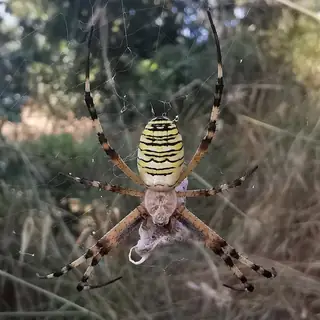
Wasp spider
Argiope bruennichiAraneidae
Harmless
5–18 mm
A striking yellow and black spider that spins large orb webs in tall grass and sunny meadows. Its wasp-like stripes give it a fierce look, and a zigzag band of silk often sits in the middle of the web. It is quiet and calm, and bites are rare.
How to recognize it
- Bold yellow and black stripes across the abdomen
- Silvery-white carapace
- Long legs often paired in an X
- Zigzag stabilimentum band in the web
Pattern: Yellow and black stripes across the abdomen, like a wasp, with a silvery front.
Habitat: Builds orb webs in tall grass and sunny meadows; rarely comes indoors.
Range: Europe, Asia and North Africa; spreading north
Bites: Bites are rare and cause mild local pain at most.
Also called: European garden spider
Often confused with: Banded garden spider , Yellow garden spider , St Andrew's cross spider
![Wasp spider (Argiope bruennichi), photo 2]()
![Wasp spider (Argiope bruennichi), photo 3]()
-
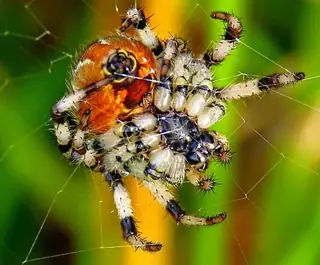
Four-spot orbweaver
Araneus quadratusAraneidae
Harmless
10–20 mm
A big, plump orbweaver whose round abdomen carries four white spots arranged in a square. Its color can be green, orange or brown. It sits in meadows and tall grass, hiding in a leaf shelter by its web. It is calm, shy and no danger to people.
How to recognize it
- Four pale spots in a square on the abdomen
- Very round, plump abdomen
- Color varies from green to orange or brown
- Banded legs
Pattern: Large rounded abdomen, green, orange or brown, with four white spots forming a square.
Habitat: Builds large orb webs in meadows, heath and tall grass; rarely enters homes.
Range: UK and Europe, across Asia
Bites: Bites are rare and cause only mild local effects.
Also called: Four-spotted orbweaver
Often confused with: European garden spider , Marbled orbweaver , Shamrock orbweaver
![Four-spot orbweaver (Araneus quadratus), photo 2]()
![Four-spot orbweaver (Araneus quadratus), photo 3]()
-
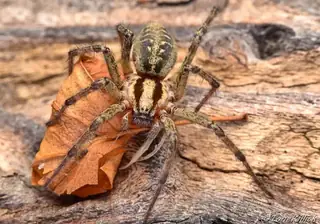
Labyrinth spider
Agelena labyrinthicaAgelenidae
Harmless
8–14 mm
A brown funnel-web spider that builds a flat sheet of silk in grass or shrubs with a tube at one end. It is fast and dashes back into the tube when disturbed. It is harmless, rarely bites, and is easy to spot on dewy mornings when the web shows up.
How to recognize it
- Two dark stripes down the carapace
- Brown abdomen with pale chevron marks
- Long spinnerets at the rear
- Funnel-shaped retreat on a sheet web
Pattern: Brown body with a pale central stripe and dark chevron-like markings on the abdomen.
Habitat: Builds sheet webs with a funnel tube in tall grass and low shrubs; seldom enters homes.
Range: UK, Europe and Asia
Bites: Bites are very rare and not dangerous to people.
Also called: Funnel weaver
Often confused with: Barn funnel weaver , Giant house spider
![Labyrinth spider (Agelena labyrinthica), photo 2]()
![Labyrinth spider (Agelena labyrinthica), photo 3]()
-
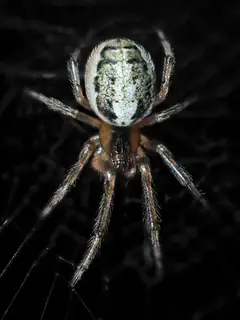
Silver-sided sector spider
Zygiella x-notataPhonognathidae
Harmless
4–8 mm
A small orbweaver often found on window frames and fence panels, with a round web that has a wedge-shaped gap missing. A single silk line leads to a hidden retreat in the gap. It is harmless, very common around houses, and rarely bothers anyone indoors or outdoors.
How to recognize it
- Orb web with a clear wedge-shaped gap
- Silvery sides with a dark leaf pattern
- Pale reddish-brown legs
- Sits in a retreat at the edge of its web
Pattern: Silvery abdomen with a dark scalloped leaf-like pattern and a pale border.
Habitat: Builds webs on window frames, fences and walls; common around houses, sometimes indoors.
Range: UK, Europe and worldwide
Bites: Bites are very rare and not dangerous.
Also called: Missing sector orbweaver
Often confused with: Bridge orbweaver , European garden spider
![Silver-sided sector spider (Zygiella x-notata), photo 2]()
![Silver-sided sector spider (Zygiella x-notata), photo 3]()
-
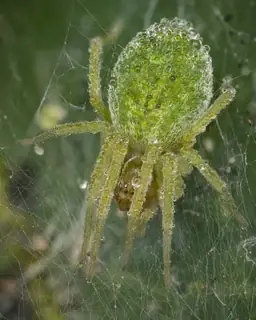
Green meshweaver
Nigma walckenaeriDictynidae
Harmless
3–5 mm
A tiny spider with a bright green rear and a shiny brown front. It lives on the leaves of hedges and shrubs and builds a small, flat web there. It is too small to hurt anyone, and it sometimes gets carried indoors on cut plants or flowers without any trouble.
How to recognize it
- Bright green abdomen
- Brown, shiny front body
- Tiny, under 5 mm
- Pale legs
Pattern: Bright green abdomen with a dark brown front section and sometimes silvery patches.
Habitat: Lives on leaves of shrubs and hedges in a small web; can come inside on cut plants.
Range: UK, Europe and Asia
Bites: Bites are extremely rare and not harmful.
Also called: Green leaf spider
Often confused with: Green crab spider , Green lynx spider
![Green meshweaver (Nigma walckenaeri), photo 2]()
![Green meshweaver (Nigma walckenaeri), photo 3]()
-
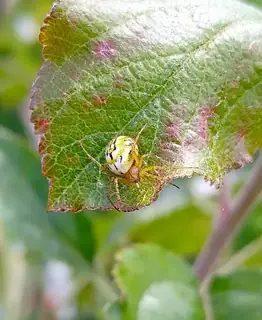
Cricket-bat orbweaver
Mangora acalyphaAraneidae
Harmless
3–5 mm
A tiny orbweaver with a dark mark on its pale back that looks a bit like a cricket bat. It lives in grass, heath and low shrubs across Europe. It builds a neat round web, stays small and shy, and is harmless to people and pets alike.
How to recognize it
- Pale cream abdomen
- Dark cricket-bat shaped mark on the back
- Thin pale legs
- Tiny size
Pattern: Pale cream abdomen with a dark stripe shaped like a cricket bat.
Habitat: Builds orb webs in grass, heath and low shrubs; rarely enters homes.
Range: UK, Europe and Asia
Bites: Bites are very rare and not considered harmful.
Also called: Cricket-bat orb weaver
Often confused with: Lined orbweaver , Tuft-legged orbweaver
![Cricket-bat orbweaver (Mangora acalypha), photo 2]()
![Cricket-bat orbweaver (Mangora acalypha), photo 3]()
-
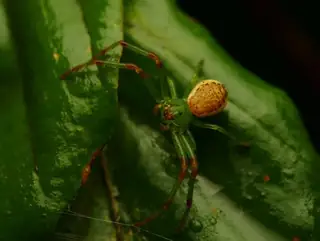
Green crab spider
Diaea dorsataThomisidae
Harmless
4–6 mm
A small green crab spider that waits on tree leaves and shrub branches for passing prey. Its front legs are held out wide like a crab, and it has a brown patch on its green back. It is quiet, rarely comes indoors, and is harmless to people and pets.
How to recognize it
- Green body with a brown patch on the back
- Front legs held out crab-like
- Long front legs and shorter hind legs
- Brown carapace
Pattern: Green abdomen with a dark brown central patch and brown front legs.
Habitat: Sits on trees, shrubs and leaves; rarely comes indoors.
Range: UK and Europe, across Asia
Bites: Bites are rare and not dangerous.
Also called: Eurasian green crab spider
Often confused with: Goldenrod crab spider , Green lynx spider , American green crab spider
![Green crab spider (Diaea dorsata), photo 2]()
![Green crab spider (Diaea dorsata), photo 3]()
-
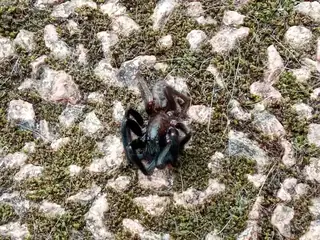
Tube-dwelling spider
Segestria florentinaSegestriidae
Mild bite
10–22 mm
A dark spider with shiny green fangs that lives in a silk tube in walls, rocks and old stonework. Thin silk lines fan out from the entrance and warn the spider when prey walks by. It is shy, seldom leaves its tube, and bites only if handled roughly.
How to recognize it
- Metallic green fangs
- Dark, glossy body
- Radiating silk threads around its tube
- Legs pointed forward
Pattern: Dark, glossy body with a greenish-metallic sheen on the large fangs.
Habitat: Lives in tubes in walls, rocks and old stonework; may enter buildings.
Range: UK, Europe and parts of the US
Bites: Bites are uncommon, but this spider can pierce skin and the bite is reported to be painful, though not considered dangerous.
Also called: Green-fanged tube web spider
Often confused with: Woodlouse spider , Southern house spider
![Tube-dwelling spider (Segestria florentina), photo 2]()
![Tube-dwelling spider (Segestria florentina), photo 3]()
-
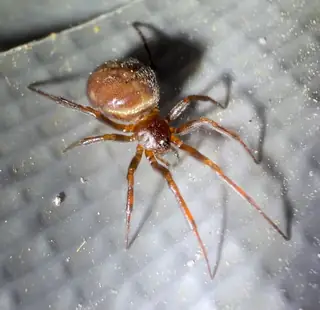
Rabbit hutch spider
Steatoda bipunctataTheridiidae
Harmless
3–8 mm
A small, rounded brown spider that lives in sheds, fences, dark corners and old hutches. It resembles a false widow but is smaller and much gentler. It builds a messy web, stays hidden in daytime, and rarely bites, so it is no cause for alarm around a home.
How to recognize it
- Round, shiny brown abdomen
- Pale or white mottled markings
- Comb-like bristles on rear legs
- Rusty-brown legs
Pattern: Glossy dark brown abdomen with a pale marking of mottled spots or bands.
Habitat: Lives in dark corners, sheds, fences and outbuildings; sometimes inside.
Range: UK and Europe; introduced to US
Bites: Bites are very rare and generally minor; false widow bites are not considered dangerous to healthy adults.
Also called: False widow
Often confused with: Noble false widow , False black widow , Common house spider
![Rabbit hutch spider (Steatoda bipunctata), photo 2]()
![Rabbit hutch spider (Steatoda bipunctata), photo 3]()
-
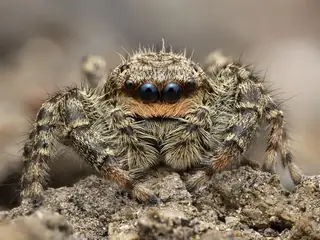
Fencepost jumping spider
Marpissa muscosaSalticidae
Harmless
5–10 mm
A flat, gray-brown jumping spider that sits on fenceposts, tree bark and old wooden walls, blending in well. It has large front eyes and pounces on small insects instead of building a web. It moves quickly, stays shy, and is harmless to people and pets.
How to recognize it
- Flat, gray-brown body
- Large front eyes
- Pale hairs and white stripes
- Banded legs
Pattern: Gray-brown flattened body with white and dark stripes on the abdomen.
Habitat: Found on fences, tree bark and walls; sometimes inside.
Range: UK, Europe, Asia and North America
Bites: Bites are rare and mild.
Also called: Jumping spider
Often confused with: Tan jumping spider , Zebra jumping spider
![Fencepost jumping spider (Marpissa muscosa), photo 2]()
![Fencepost jumping spider (Marpissa muscosa), photo 3]()
-
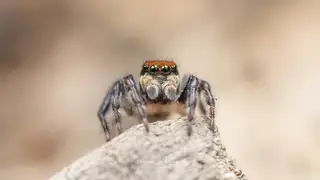
White banded house jumper
Maratus griseusSalticidae
Harmless
2–5 mm
A tiny Australian jumping spider with a pale band across its gray-brown back. It lives on the ground, rocks and walls, and sometimes wanders into houses. It uses sharp eyesight to jump on small prey, and it is far too small to hurt people or pets.
How to recognize it
- White band across the abdomen
- Tiny gray-brown body
- Large front eyes
- Pale legs
Pattern: Gray-brown body with a white band across the abdomen.
Habitat: Found on the ground, rocks and walls; may come into houses.
Range: Australia
Bites: Bites are essentially unknown.
Also called: Peacock spider
Often confused with: Flying peacock spider , Zebra jumping spider
![White banded house jumper (Maratus griseus), photo 2]()
![White banded house jumper (Maratus griseus), photo 3]()
-
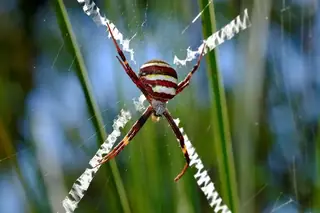
St Andrew's cross spider
Argiope keyserlingiAraneidae
Harmless
4–15 mm
This Australian garden spider is easy to spot because it sits in the middle of its web with its eight legs bunched into four pairs, making a big X. Bright silvery and yellow bands decorate its body. It is shy, rarely bites, and is a helpful pest catcher.
How to recognize it
- Legs held together in pairs to form an X shape
- Silver-white cephalothorax and banded abdomen
- Zigzag white silk bands in the center of the web
- Females much larger than slim males
Pattern: Silvery abdomen with yellow, white and black bands, with legs held in pairs forming an X.
Habitat: Builds orb webs in gardens, bushes and forest edges; rarely comes indoors.
Range: Eastern and northern Australia
Bites: Bites are rare and usually cause only brief local pain or redness.
Also called: Saint Andrew's cross spider
Often confused with: Wasp spider , Banded garden spider , Yellow garden spider
![St Andrew's cross spider (Argiope keyserlingi), photo 2]()
![St Andrew's cross spider (Argiope keyserlingi), photo 3]()
-
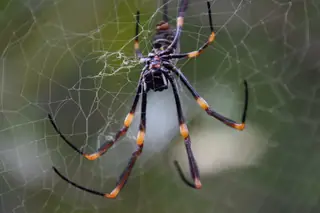
Tiger orbweaver
Trichonephila plumipesNephilidae
Harmless
7–25 mm
If you spot a big gray-brown spider with tufted legs hanging in a huge web outside, it may be this one. Females are impressive but timid, and prefer to hide or drop away rather than bite. They are common in coastal gardens and help control flies and mosquitoes.
How to recognize it
- Long narrow body with silvery or yellowish spots
- Leg joints with thick tufts of dark hair
- Large golden-tinted web, often in open spaces
- Females far bigger than tiny males
Pattern: Elongated gray-brown abdomen with pale silvery spots and dark-banded legs.
Habitat: Strings large orb webs between trees, shrubs and fences in gardens and bushland; stays outdoors.
Range: Eastern Australia, New Guinea and Pacific islands
Bites: Bites are very rare and cause at most mild local pain.
Also called: Tiger spider, Northern golden orbweaver
Often confused with: Australian golden orb weaver , Golden silk orbweaver , Giant golden orb weaver
![Tiger orbweaver (Trichonephila plumipes), photo 2]()
![Tiger orbweaver (Trichonephila plumipes), photo 3]()
-
Australian golden orb weaver
Trichonephila edulisNephilidae
Harmless
7–30 mm
This large Australian orb weaver spins strong, golden-tinted webs that can span a path or a doorway. The female looks big and fearsome with her long body and tufted legs, but she is gentle. People mostly just bump into her web by accident.
How to recognize it
- Very long, cylindrical, often gray or tan abdomen
- Dark legs with tufts of bristles near the joints
- Strong golden-yellow silk in a large web
- Tiny male often sits on the female's web
Pattern: Long cylindrical body, silvery gray to brown with pale flecks, and banded legs.
Habitat: Builds huge webs across paths and gardens in forests and suburbs; does not live indoors.
Range: Eastern and southern Australia
Bites: Bites are uncommon and generally cause brief, mild local pain.
Also called: Golden orb-weaver, Giant wood spider
Often confused with: Tiger orbweaver , Golden silk orbweaver , Giant golden orb weaver
![Australian golden orb weaver (Trichonephila edulis), photo 2]()
![Australian golden orb weaver (Trichonephila edulis), photo 3]()
-
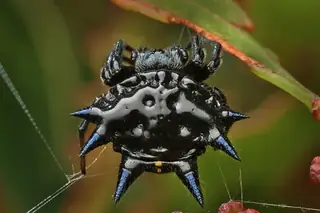
Christmas jewel spider
Austracantha minaxAraneidae
Harmless
5–10 mm
A tiny spider with a spiny, brightly colored shell that looks like a little jewel or a holiday ornament. It builds its web in bushes and often lives close to many neighbors. It is not dangerous and is not interested in biting people.
How to recognize it
- Hard wide abdomen with six spines around edge
- Bright white, yellow or orange with black spots
- Small, with black legs and head
- Often found in big clusters of webs
Pattern: Hard, spiny abdomen colored white, yellow, orange or red with black spots and six spines.
Habitat: Webs in shrubs, grass and open bushland, often in groups; seldom enters houses.
Range: Australia (widespread) and Tasmania
Bites: Bites are essentially unheard of and the spiders are harmless to people.
Also called: Jewel spider, Spiny orb weaver
Often confused with: Spinybacked orbweaver , Arrow-shaped micrathena , Spined micrathena
![Christmas jewel spider (Austracantha minax), photo 2]()
![Christmas jewel spider (Austracantha minax), photo 3]()
-
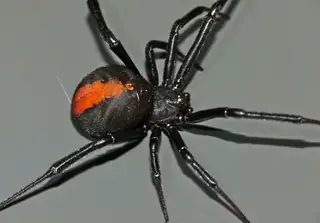
Redback spider
Latrodectus hasseltiTheridiidae
Medically significant
3–15 mm
The redback is Australia's version of the black widow. The female is round, glossy and black with a bright red stripe on her back. She hides in quiet, dry corners outdoors. Bites are not common, but they can be serious, so take care when reaching into sheds or boxes.
How to recognize it
- Round glossy black abdomen of the female
- Red or orange stripe along the top of the abdomen
- Red hourglass-like mark underneath
- Messy, tangled web low to the ground
Pattern: Round, glossy black abdomen with a red stripe on the back; males and young are paler with white markings.
Habitat: Lives in dry, sheltered spots such as sheds, letterboxes, woodpiles and under garden furniture; may be found around homes.
Range: Australia; introduced to Japan, New Zealand and Southeast Asia
Bites: Bites are uncommon, but they can cause severe pain and sweating and warrant medical attention.
Also called: Australian black widow
Often confused with: Southern black widow , Western black widow , Noble false widow
![Redback spider (Latrodectus hasselti), photo 2]()
![Redback spider (Latrodectus hasselti), photo 3]()
-
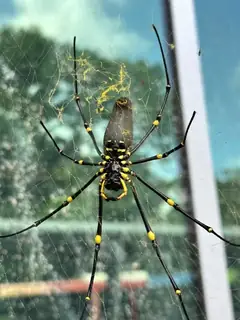
Giant golden orb weaver
Nephila pilipesNephilidae
Harmless
18–40 mm
This is one of the biggest orb weavers in the world. Females can span a hand with their legs, and their webs can be very long. Although it looks scary, it is gentle and prefers to stay on its web. It lives mostly in warm, northern forests.
How to recognize it
- Very large female with long slim body
- Yellow patches on abdomen and legs
- Legs with tufts at joints
- Huge web with a yellow tint
Pattern: Large long abdomen, olive to brown with yellow spots, and a black and yellow head region.
Habitat: Builds huge webs in forests, mangroves and gardens in the tropics; usually stays outdoors.
Range: Northern and eastern Australia, Asia and the Pacific
Bites: Bites are rare and cause only mild local pain.
Also called: Giant wood spider, Northern golden orb weaver
Often confused with: Australian golden orb weaver , Golden silk orbweaver , Tiger orbweaver
![Giant golden orb weaver (Nephila pilipes), photo 2]()
![Giant golden orb weaver (Nephila pilipes), photo 3]()
-
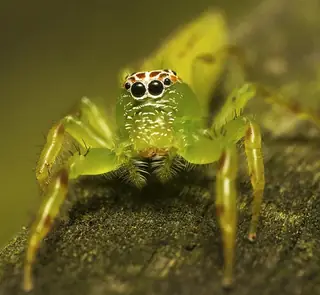
Green jumping spider
Mopsus mormonSalticidae
Harmless
8–15 mm
A bright green jumping spider with big forward-facing eyes that watches you with curiosity. It stalks insects on leaves and leaps on them. It is common on plants in warm parts of Australia and is not a danger to people.
How to recognize it
- Bright green body and legs
- Large forward-facing eyes typical of jumping spiders
- White hairy face and palps
- Males may show orange and white markings
Pattern: Bright green body, often with white hairs on the face and orange tints on the legs or abdomen.
Habitat: Hunts on plants and tree trunks in gardens, forest and sometimes verandas; rarely goes indoors.
Range: Northern and eastern Australia, New Guinea
Bites: Bites are very rare and cause little more than a small sting.
Also called: Green jumper
Often confused with: Green lynx spider , Magnolia green jumping spider , Bold jumping spider
![Green jumping spider (Mopsus mormon), photo 2]()
![Green jumping spider (Mopsus mormon), photo 3]()
-
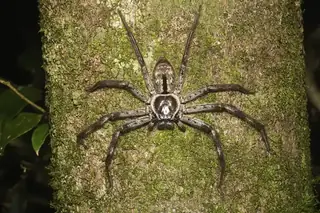
Grey huntsman spider
Holconia immanisSparassidae
Mild bite
20–30 mm
This big, flat, gray spider may startle you when it darts from behind a picture frame or car visor. It looks scary because of its size, but it is more likely to run away than bite. If it does bite, expect a painful sting.
How to recognize it
- Very large, flat, crab-like body with leg span of 15 cm
- Leg pairs held sideways
- Gray hairy body, sometimes darker banding
- Eight eyes in two rows
Pattern: Flat gray to brown body, covered in fine hairs, with a pale or dark line under the eyes.
Habitat: Hides under bark and in crevices, and often turns up behind curtains or in cars; may come indoors.
Range: Eastern Australia (New South Wales and Queensland)
Bites: Bites are uncommon and can be painful for a few minutes, but are not considered dangerous to healthy adults.
Also called: Giant huntsman, Australian huntsman
Often confused with: Social huntsman spider , Giant crab spider , Cane spider
![Grey huntsman spider (Holconia immanis), photo 2]()
![Grey huntsman spider (Holconia immanis), photo 3]()
-
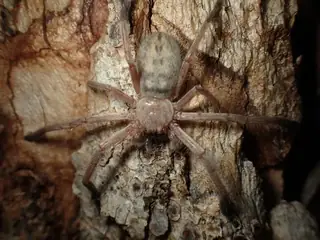
Social huntsman spider
Delena canceridesSparassidae
Mild bite
10–20 mm
The social huntsman is a flat, brownish spider that lives under bark and, unlike most spiders, shares its home with many relatives. It is quite calm, but a mother guarding her young may bite. It is fast and can sometimes appear in houses.
How to recognize it
- Flat, wide, crab-like body
- Legs bent forward and sideways
- Brown-gray hairy body with pale markings
- Found in groups under loose bark
Pattern: Flat, brown to gray body with fine hair and sometimes darker marks on the back.
Habitat: Lives under loose bark and in crevices, often in groups; sometimes enters homes.
Range: Australia (widespread); introduced elsewhere
Bites: Bites are uncommon and usually cause brief local pain; the spider is not considered dangerous.
Also called: Social huntsman
Often confused with: Grey huntsman spider , Giant crab spider , Cane spider
![Social huntsman spider (Delena cancerides), photo 2]()
![Social huntsman spider (Delena cancerides), photo 3]()
-
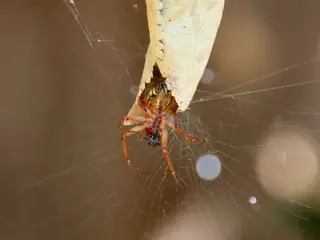
Leaf-curling spider
Phonognatha graeffeiPhonognathidae
Harmless
5–10 mm
This little spider rolls a dead leaf into a snug tube and waits there for insects to bump into its web. It has a pale, patterned abdomen and is shy. It is common in Australian gardens and is not harmful.
How to recognize it
- White-edged abdomen with pale center
- Hides in a curled dead leaf
- Small partial orb web at the leaf
- Brown legs and cephalothorax
Pattern: Brown body with a broad pale or white band down the center of the abdomen.
Habitat: Lives in shrubs and trees, using a rolled leaf as a retreat; may sometimes be seen around house gardens.
Range: Eastern and southern Australia
Bites: Bites are rare and cause only mild pain.
Also called: Leaf-curling orb weaver
Often confused with: European garden spider , Silver-sided sector spider , Spotted orbweaver
![Leaf-curling spider (Phonognatha graeffei), photo 2]()
![Leaf-curling spider (Phonognatha graeffei), photo 3]()
-
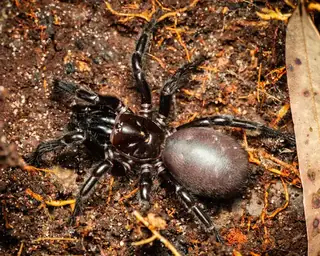
Sydney funnel-web spider
Atrax robustusAtracidae
Medically significant
10–35 mm
The Sydney funnel-web is a glossy black spider that lives in burrows near Sydney. Males wander in summer and may enter homes. Bites are rare, but they are dangerous and need urgent medical care. Antivenom is available and has been very effective, so call for help quickly after any suspected bite.
How to recognize it
- Shiny black head and thorax with no pattern
- Dark brown to black hairy abdomen
- Large, forward-pointing fangs
- Four short spinnerets at the rear
Pattern: Glossy black front half with a dark brown to black abdomen covered in short hairs.
Habitat: Lives in burrows in moist soil near Sydney; wandering males may enter houses and pools.
Range: Eastern Australia around Sydney
Bites: Bites are rare, but the venom can be life-threatening and requires urgent medical care.
Also called: Funnel-web spider
Often confused with: Funnel-web spider , Mouse spider , California turret spider
![Sydney funnel-web spider (Atrax robustus), photo 2]()
![Sydney funnel-web spider (Atrax robustus), photo 3]()
-
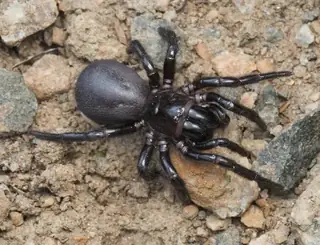
Funnel-web spider
HadronycheAtracidae
Medically significant
10–40 mm
This group of funnel-web spiders lives in forests and mountain areas across eastern Australia. They are dark and glossy with large fangs. Most stay in burrows in trees or logs. Bites are uncommon but can be dangerous and need urgent medical care.
How to recognize it
- Shiny, hairless-looking carapace
- Large spaced fangs
- Four spinnerets at the rear
- Dark brown to black body with no patterns
Pattern: Glossy black or dark brown front body with a dark, lightly haired abdomen.
Habitat: Lives in bushland and cool forests, in burrows under logs or tree bark; occasionally wanders into homes.
Range: Eastern Australia, including Tasmania
Bites: Bites are uncommon, but the venom can be life-threatening and needs urgent medical care.
Also called: Tree-dwelling funnel-web spider, Mountain funnel-web spider
Often confused with: Sydney funnel-web spider , Mouse spider , California turret spider
![Funnel-web spider (Hadronyche), photo 2]()
![Funnel-web spider (Hadronyche), photo 3]()
-
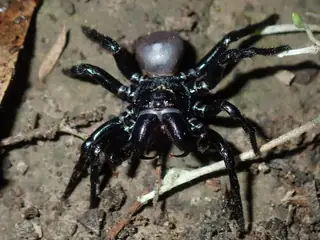
Mouse spider
MissulenaActinopodidae
Medically significant
10–35 mm
Mouse spiders are stocky burrowing spiders from Australia. Males can be eye-catching, with a bright red head, while females are dark and heavy. They dig burrows in soil and rarely bite, but bites can be serious and need medical care.
How to recognize it
- Bulbous head with wide jaws
- Males may show red head and black abdomen
- Females dark brown to black, bulky
- Short, strong legs
Pattern: Bulky, glossy dark body; males of some species have a bright red head or blue-gray abdomen.
Habitat: Lives in burrows in soil in woodland, scrub and gardens; occasionally wandering males are seen indoors.
Range: Mainland Australia
Bites: Bites are rare and mostly minor, but severe cases have occurred, so symptoms after a bite warrant urgent medical attention.
Also called: Mouse spiders
Often confused with: Sydney funnel-web spider , Funnel-web spider , California turret spider
![Mouse spider (Missulena), photo 2]()
![Mouse spider (Missulena), photo 3]()
-
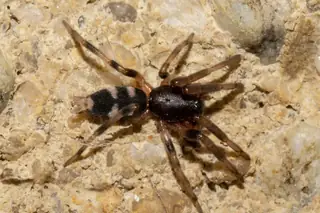
White-tailed spider
Lampona cylindrataLamponidae
Mild bite
10–18 mm
The white-tailed spider is a slim gray spider with a small white spot at the end of its body. It hunts other spiders at night and often wanders indoors. Bites are rare and cause a short sting, despite scary rumors about skin damage.
How to recognize it
- Small white spot at the tip of the abdomen
- Slim cigar-shaped body
- Reddish-brown front body with banded legs
- Fast-moving, no web
Pattern: Slim dark gray to reddish-brown body with a white spot at the tip of the abdomen.
Habitat: Hunts at night on the ground and walls, and often wanders into homes.
Range: Southern Australia and New Zealand
Bites: Bites are uncommon and usually cause short-lived burning pain, redness or itching; skin ulceration has not been confirmed.
Also called: Common white-tail spider
Often confused with: Eastern parson spider , Yellow sac spider , Broad-faced sac spider
![White-tailed spider (Lampona cylindrata), photo 2]()
![White-tailed spider (Lampona cylindrata), photo 3]()
-
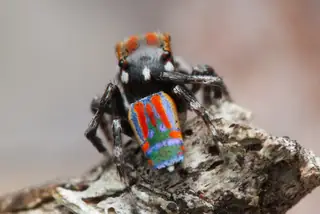
Flying peacock spider
Maratus volansSalticidae
Harmless
2–5 mm
This tiny jumping spider is famous for the male's colorful courtship dance. He raises a bright fan on his back and waves his legs to impress a mate. It is only a few millimeters long, so it is easy to miss on a walk. It is completely harmless to people.
How to recognize it
- Males display a colorful fan on the back
- Tiny size (about 5 mm)
- Females brown with white spots
- Large forward-facing eyes
Pattern: Males have a bright, colorful abdominal fan with red, blue and black stripes; females are brown.
Habitat: Lives in leaf litter and low plants in woodland; not found in homes.
Range: Eastern Australia
Bites: Bites are essentially unknown, and the spiders are too small to hurt people.
Also called: Peacock spider
Often confused with: White banded house jumper , Zebra jumping spider , Bold jumping spider
![Flying peacock spider (Maratus volans), photo 2]()
![Flying peacock spider (Maratus volans), photo 3]()
-
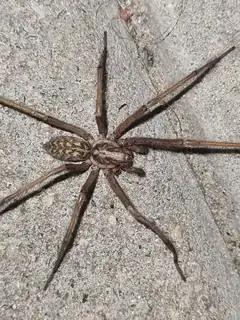
Giant house spider
Eratigena atricaAgelenidae
Harmless
10–18 mm
The giant house spider is a large, fast brown spider that often appears in houses in autumn. It builds sheet webs with a funnel retreat. It looks scary but rarely bites. Males are the ones that wander indoors looking for a mate.
How to recognize it
- Long hairy legs
- Brown abdomen with pale chevron-like marks
- Two long spinnerets at the rear
- Large size with a leg span up to 10 cm
Pattern: Brown body with pale markings on the abdomen and long, hairy legs.
Habitat: Builds funnel webs in corners, sheds and cellars, and often comes indoors in fall.
Range: UK and Europe; introduced to the US
Bites: Bites are very rare, and there is no medically significant venom.
Also called: Common house spider
Often confused with: Giant house spider , Barn funnel weaver , Labyrinth spider
![Giant house spider (Eratigena atrica), photo 2]()
![Giant house spider (Eratigena atrica), photo 3]()
-
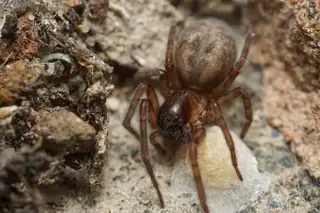
Lace-weaver spider
Amaurobius similisAmaurobiidae
Harmless
8–14 mm
The lace-weaver spider is a brown spider that makes bluish, fuzzy, lace-like webs in window frames, walls, and fences. It is shy and stays tucked inside its silk-lined hole during the day, coming out at night. It rarely bites and is not dangerous to people or pets.
How to recognize it
- Brown body with dark and pale marks
- Lace-like bluish webbing
- Dark red-brown front part
- Hairy-looking legs
Pattern: Brown body with pale chevron marks along the back of the abdomen.
Habitat: Lives in walls, fences and bark, and sometimes around window frames; can come indoors.
Range: UK and Europe; introduced to North America
Bites: Bites are rare and cause only minor local symptoms.
Also called: Lace weaver, Window lace-weaver
Often confused with: Black lace weaver , Black house spider , Barn funnel weaver
![Lace-weaver spider (Amaurobius similis), photo 2]()
![Lace-weaver spider (Amaurobius similis), photo 3]()
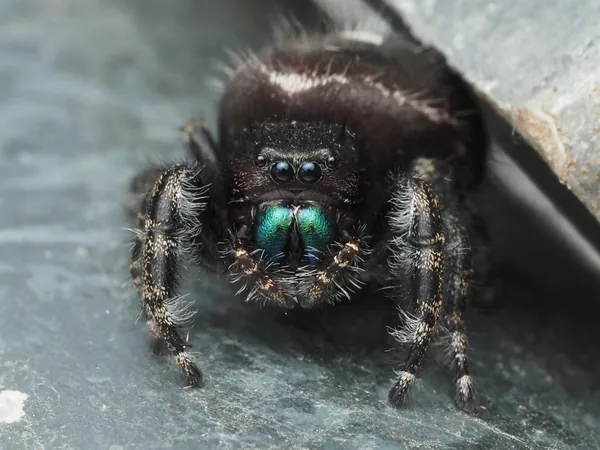
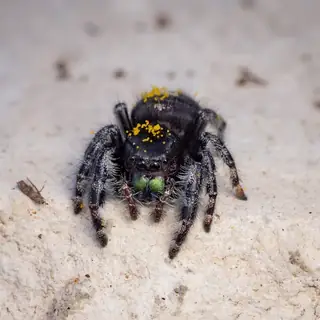
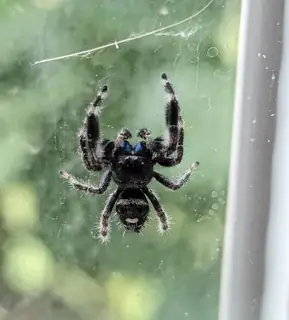
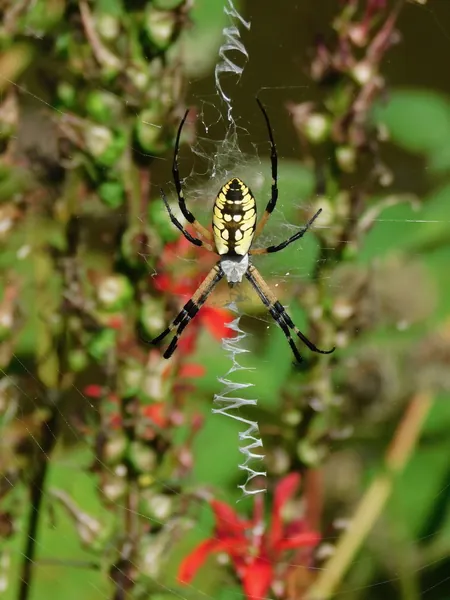
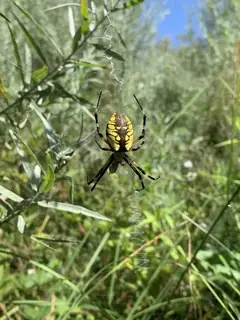
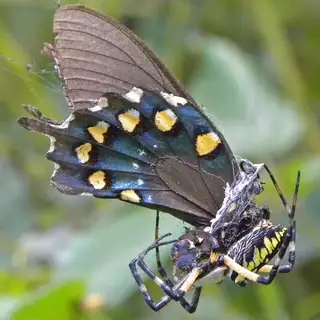
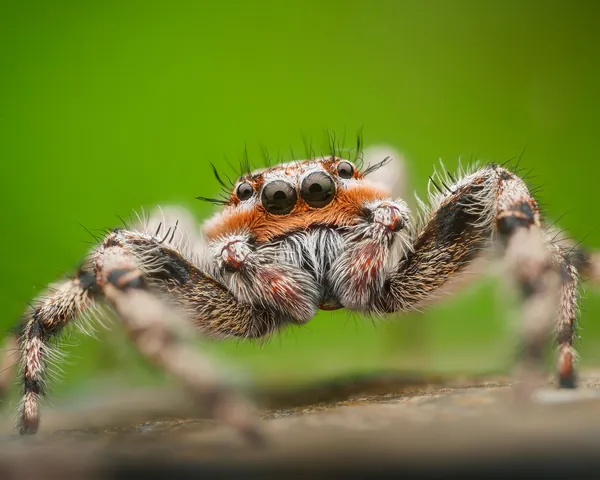
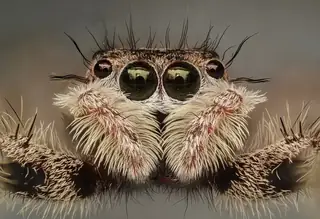
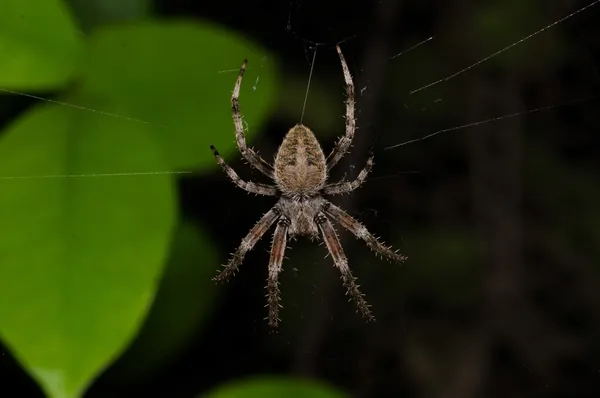
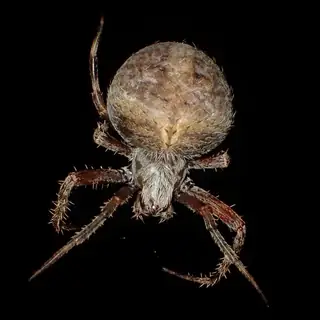
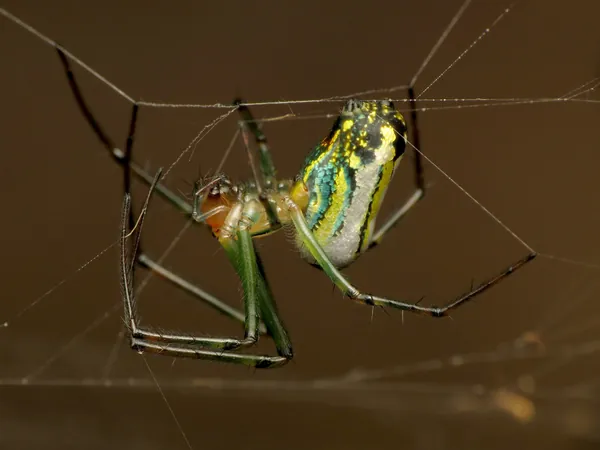
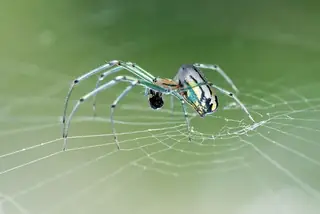
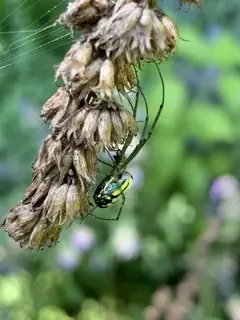
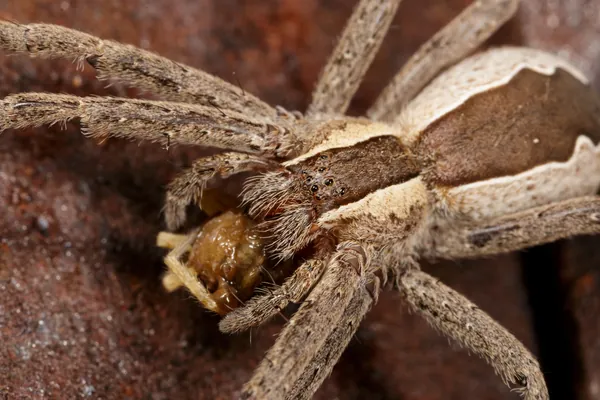
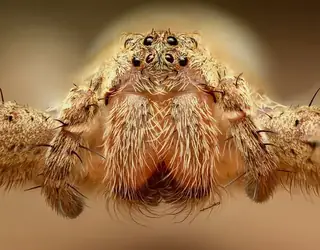
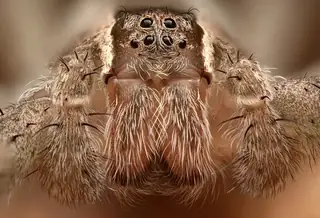
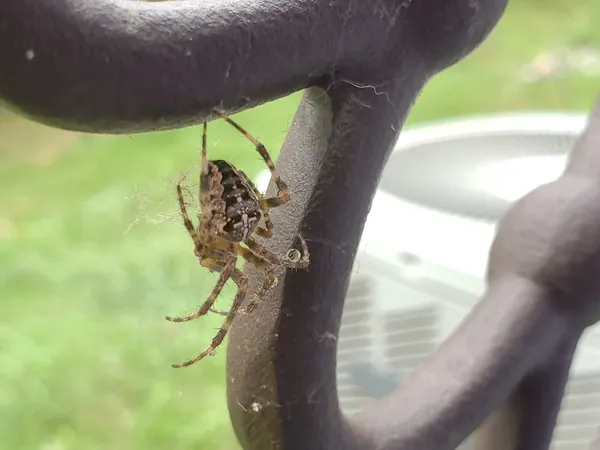
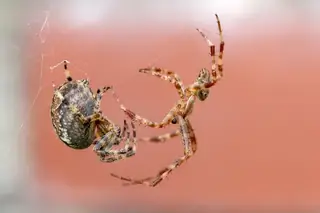
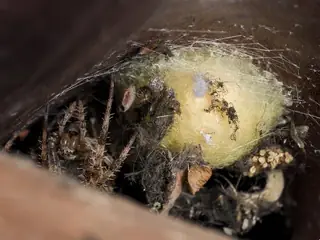
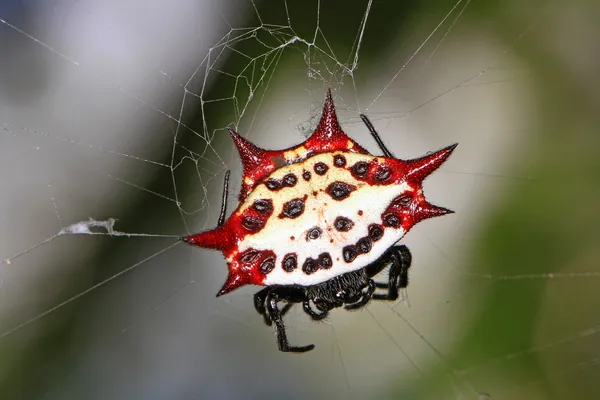
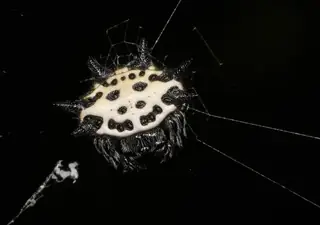
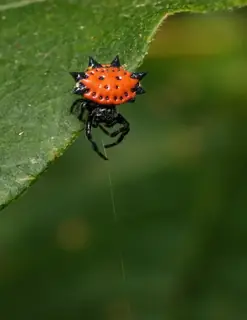
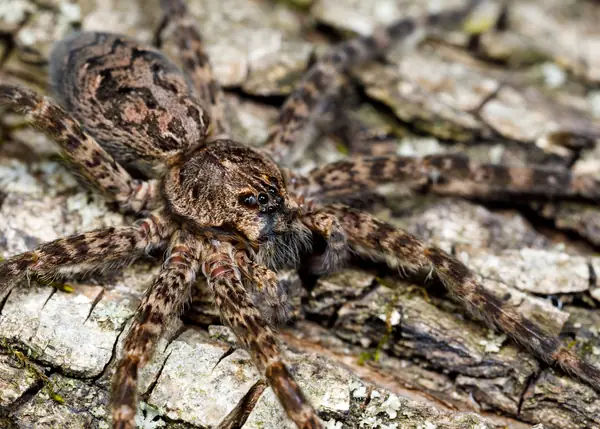
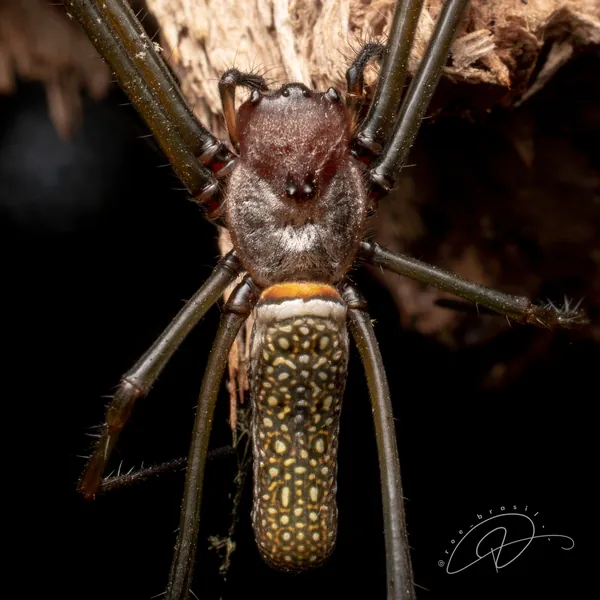
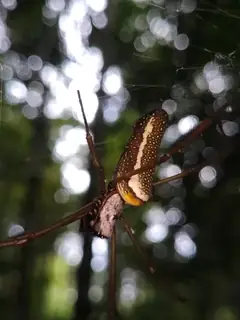
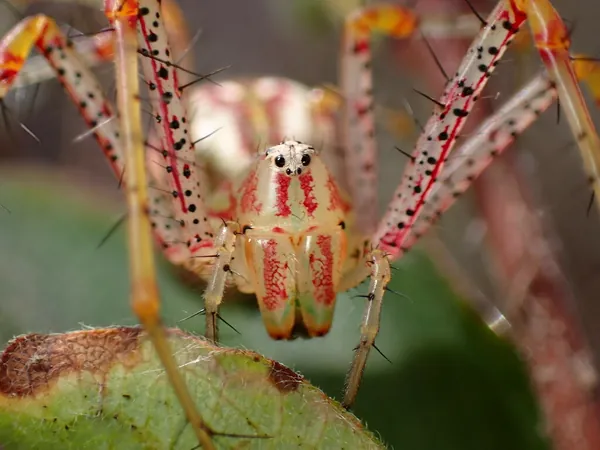
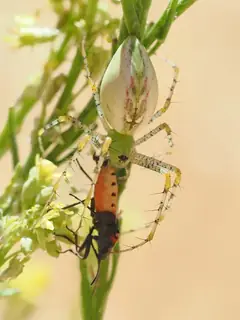
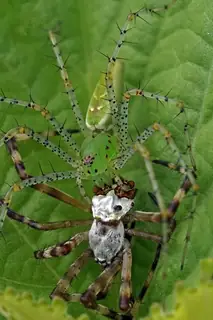
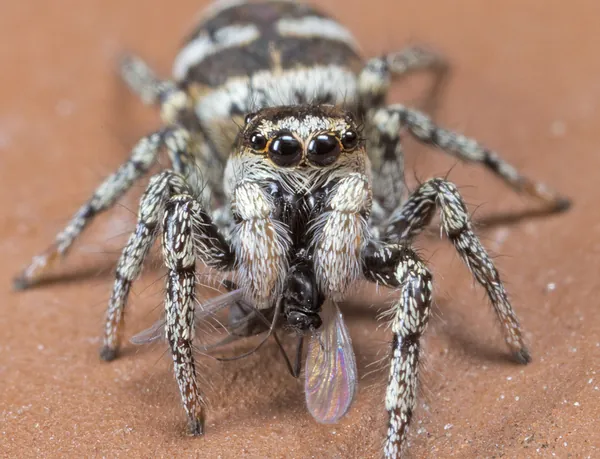
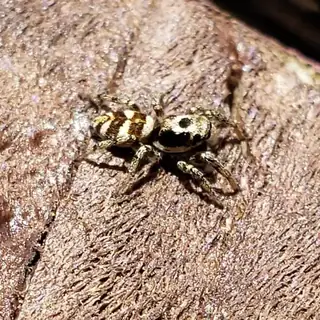
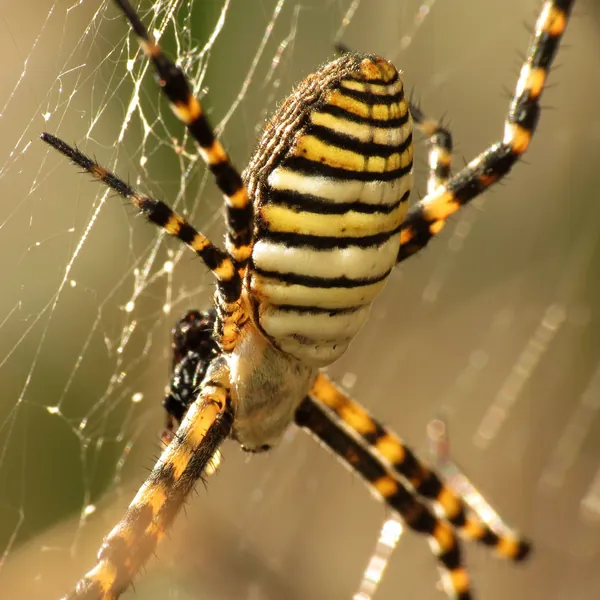
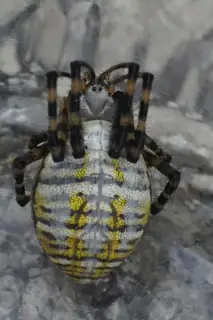
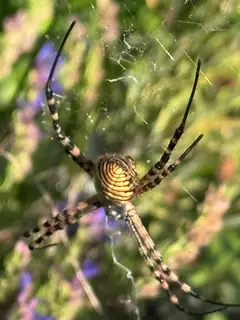
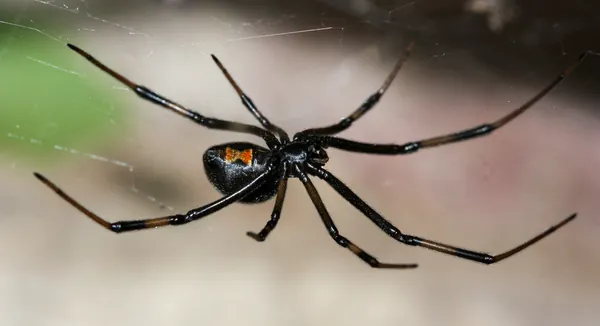
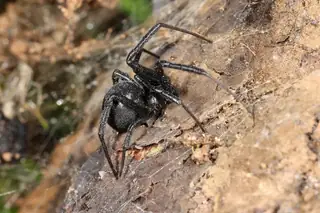
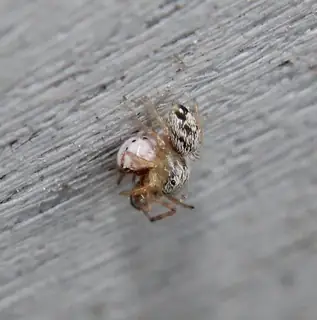
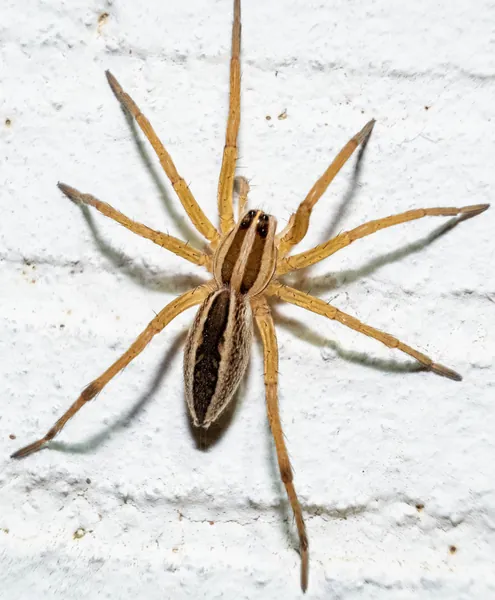
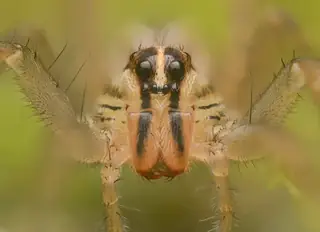
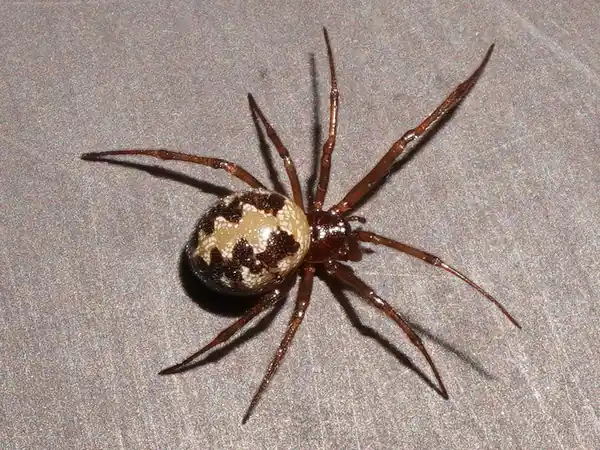
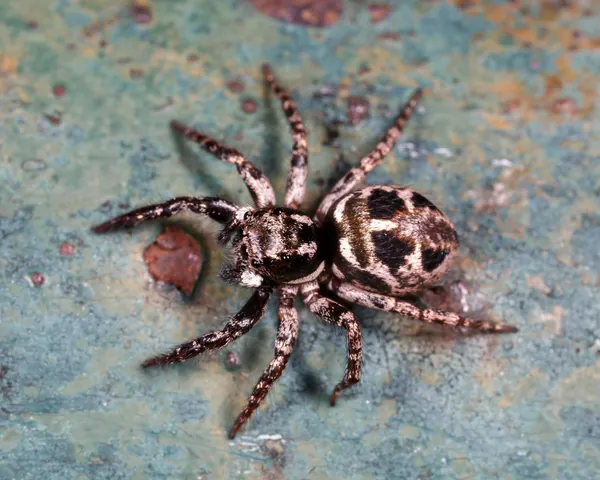
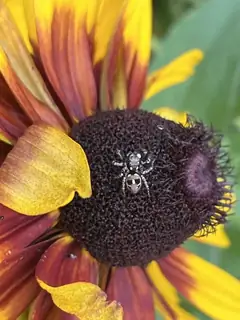
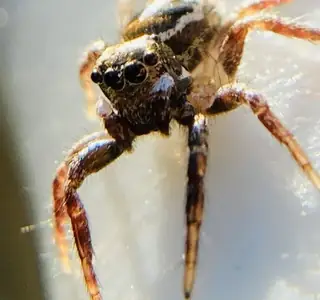
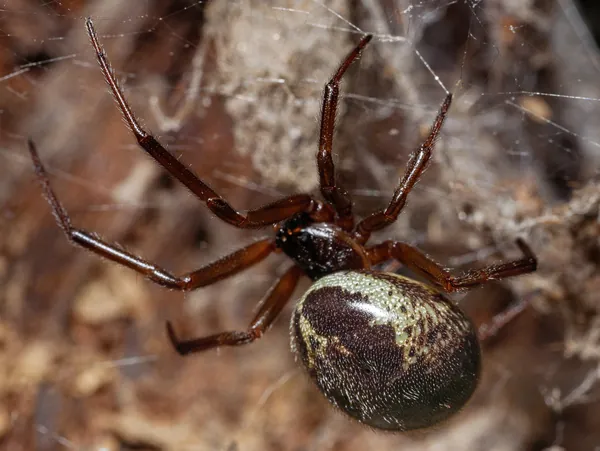
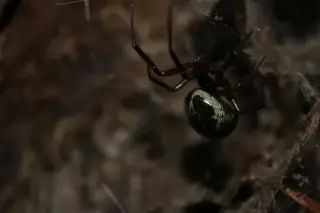
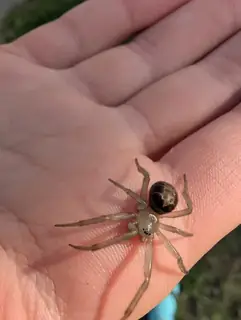
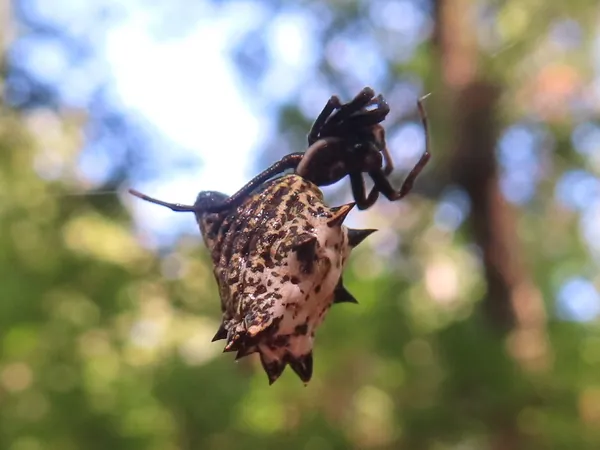
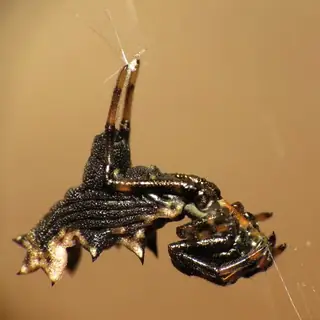
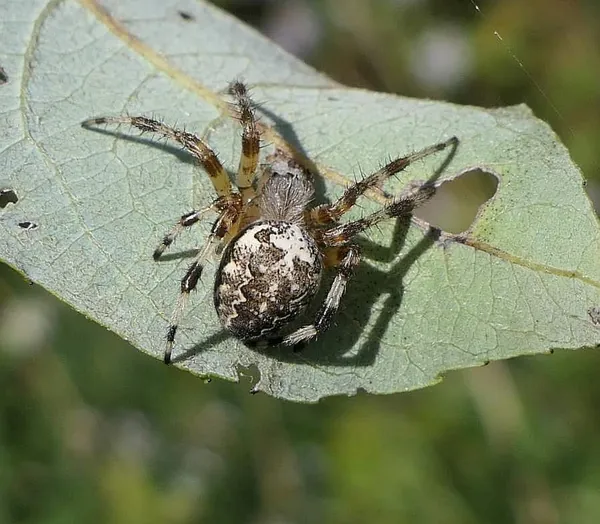
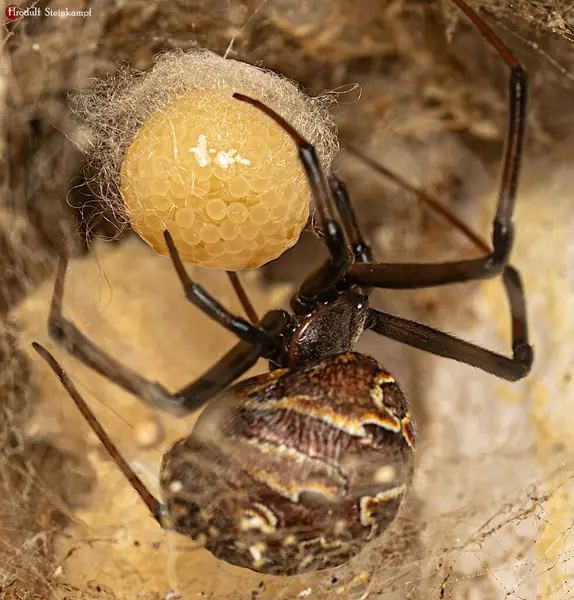
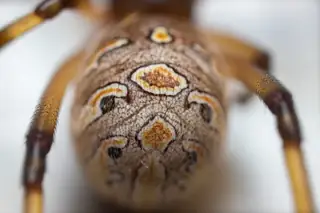
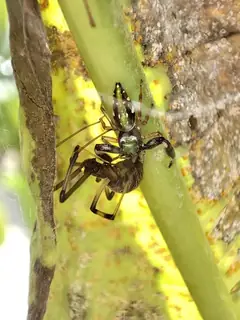
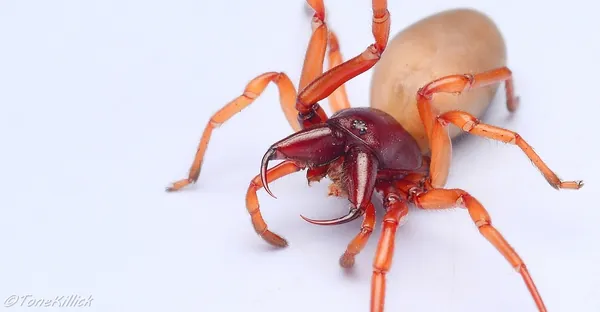
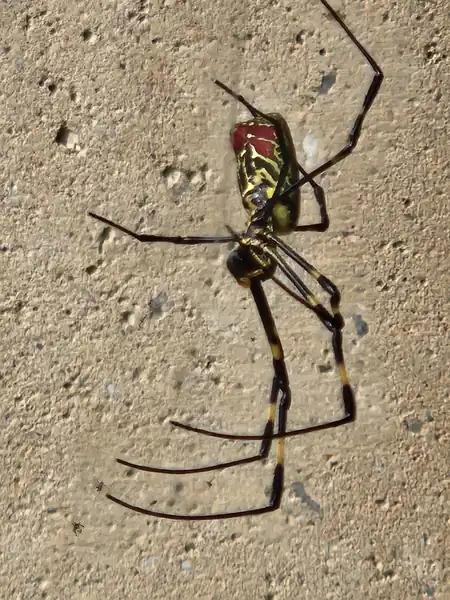
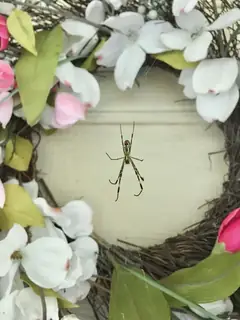
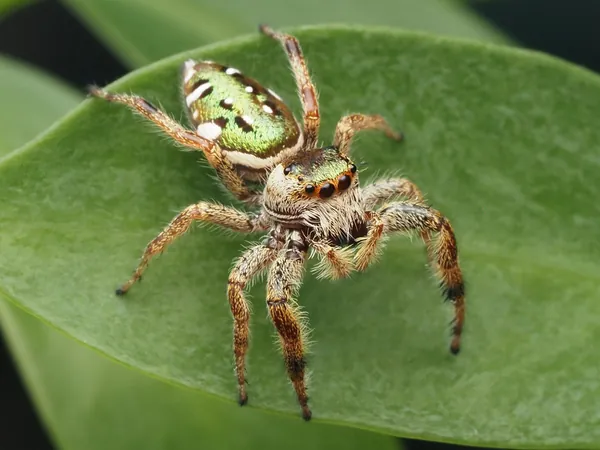
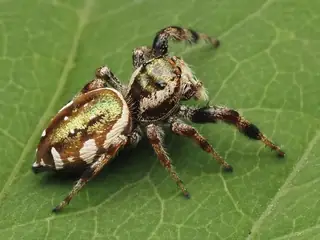
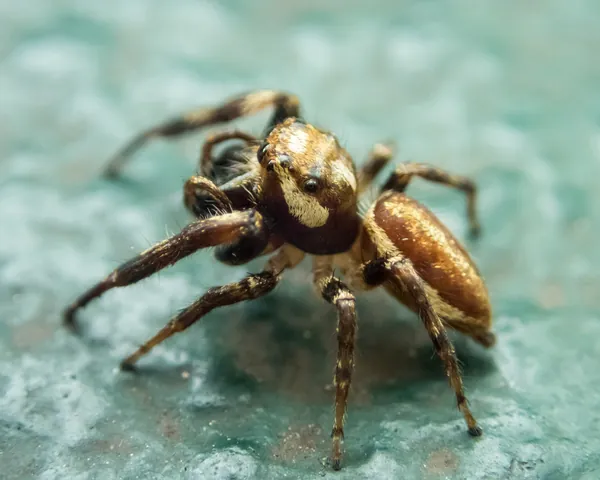
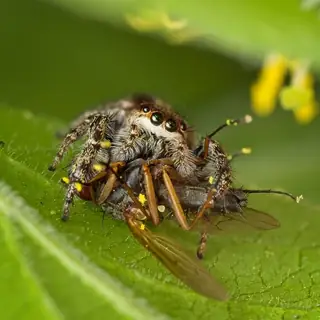
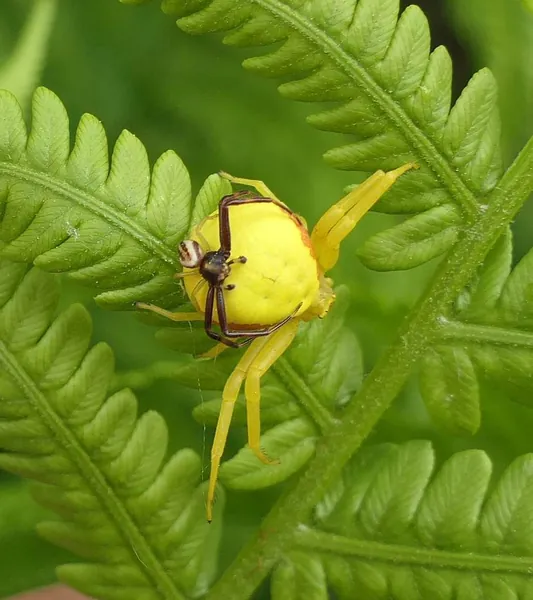
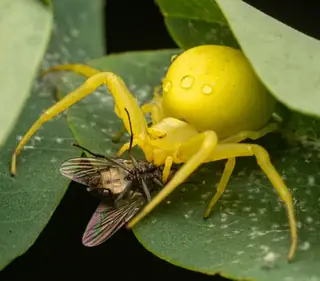
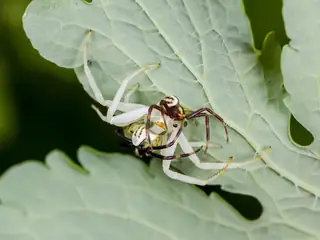
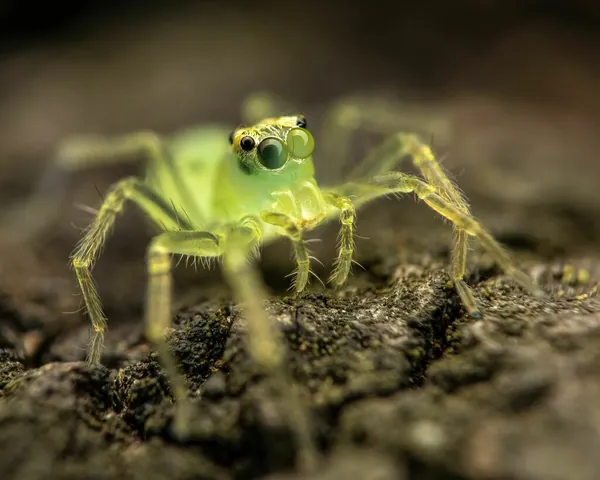
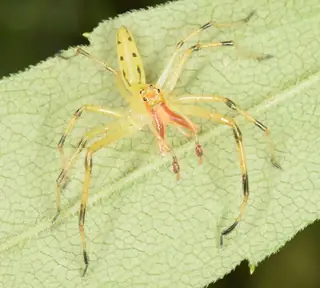
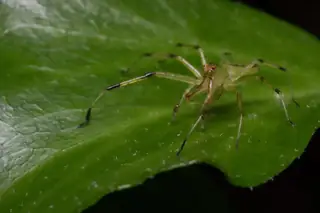
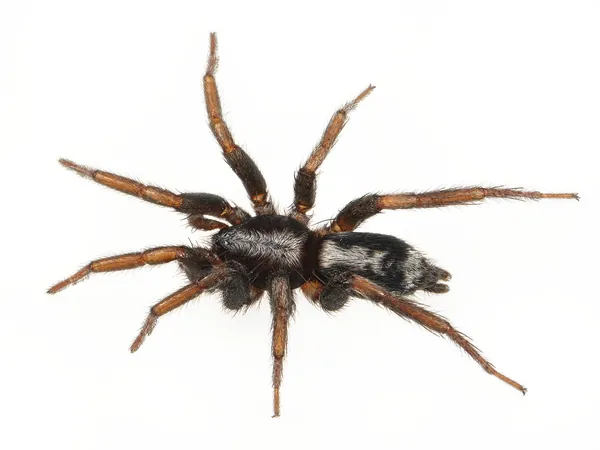
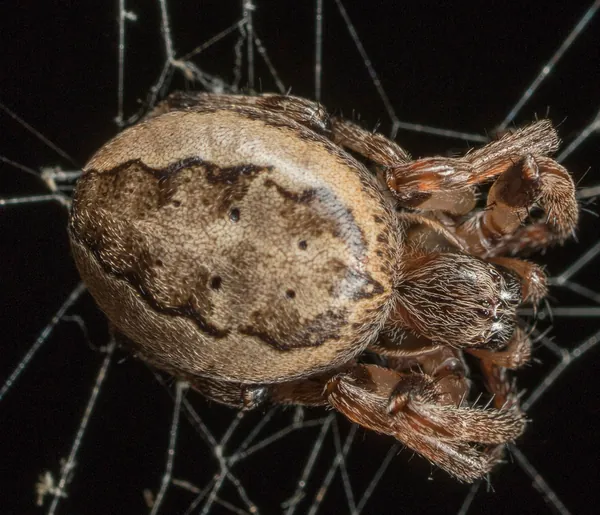
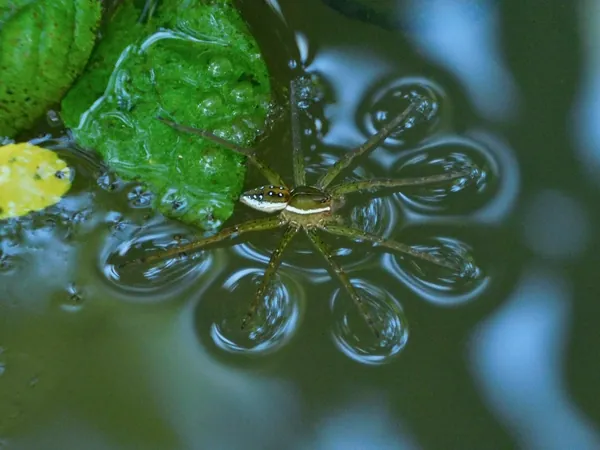
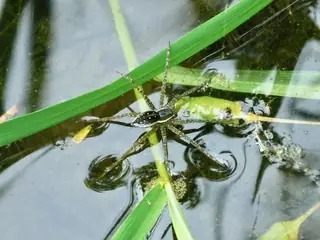
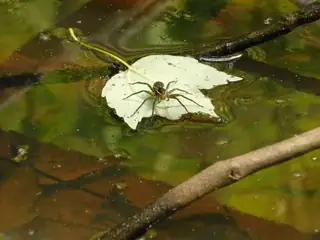
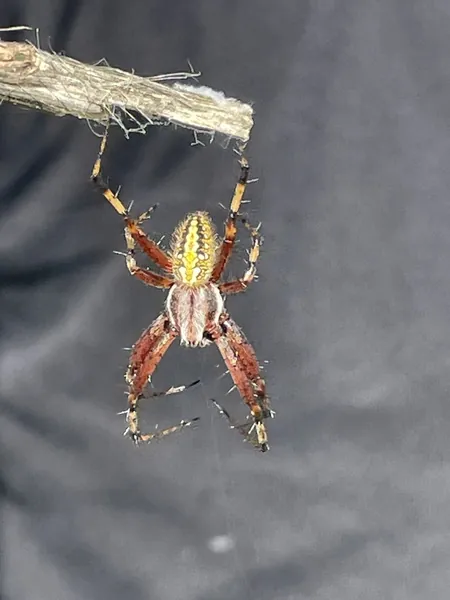
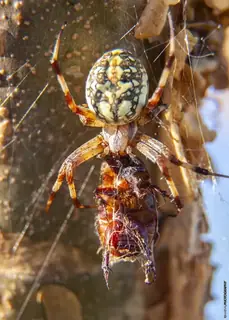
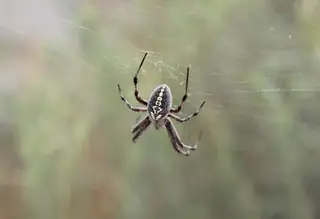
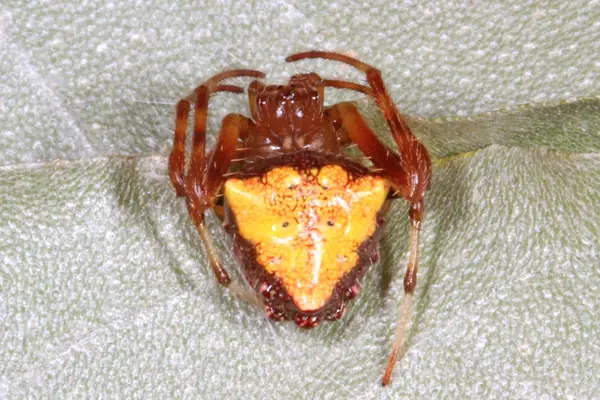
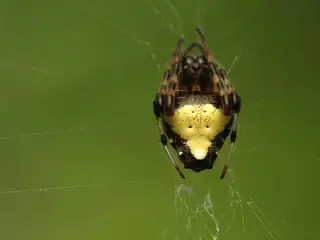
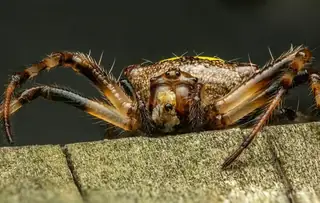
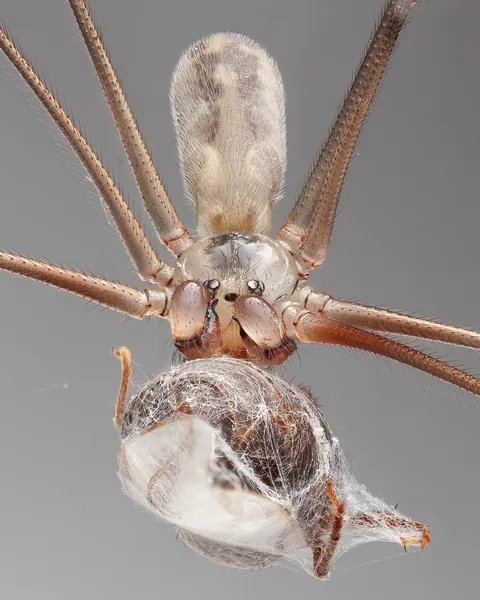
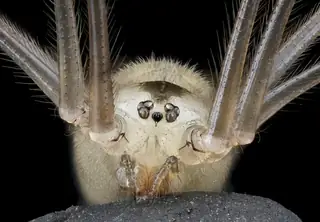
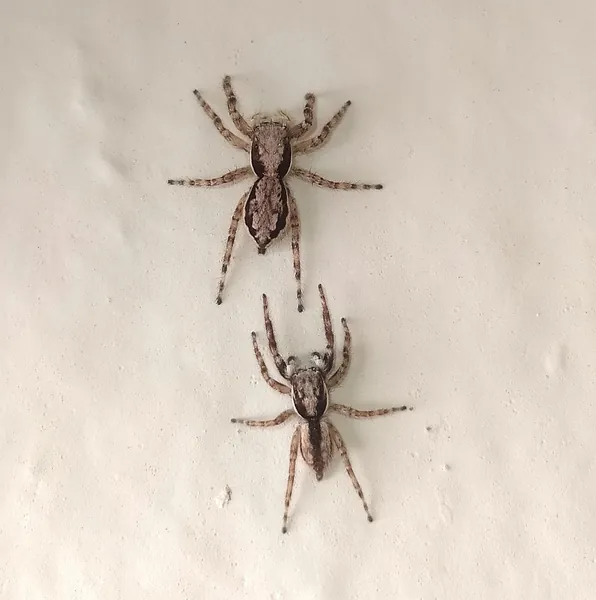
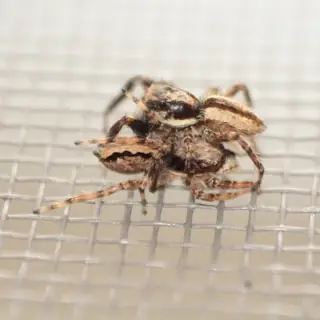
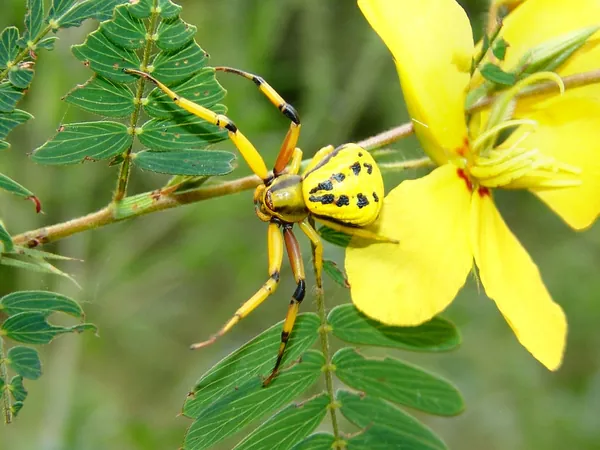
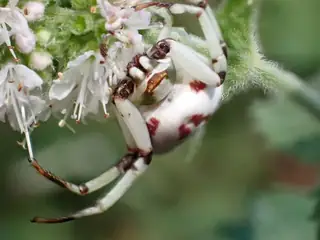
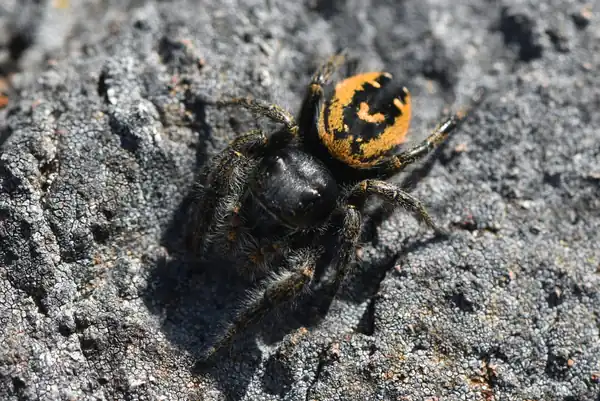
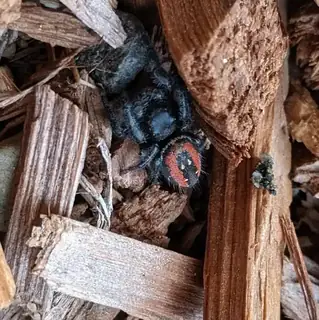
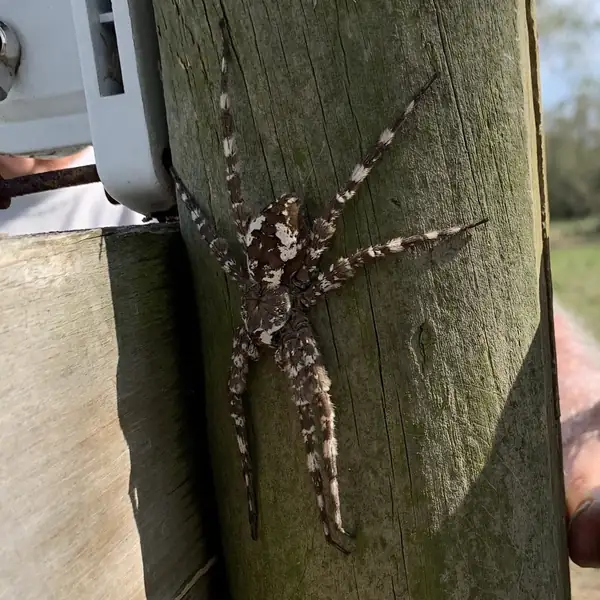
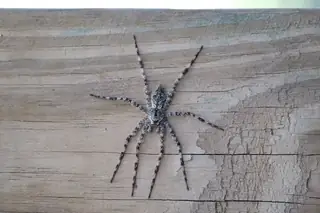
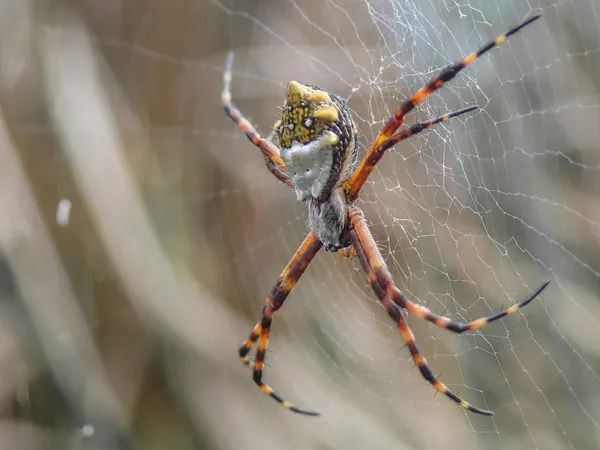
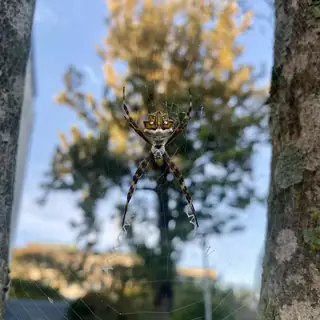
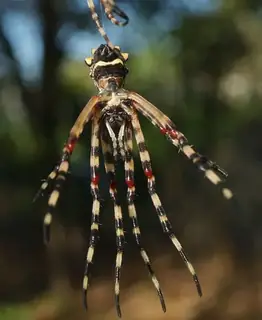
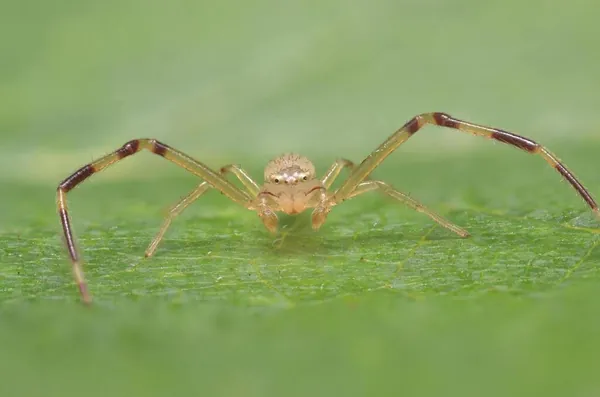
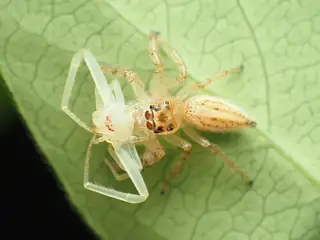
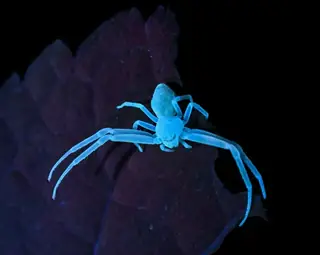
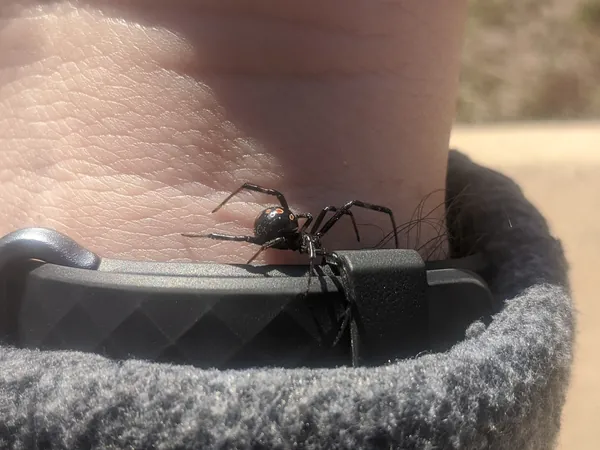
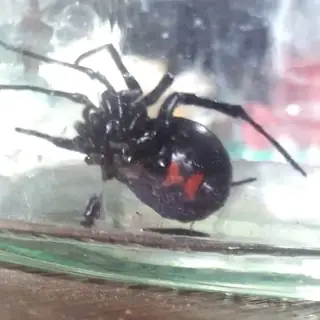
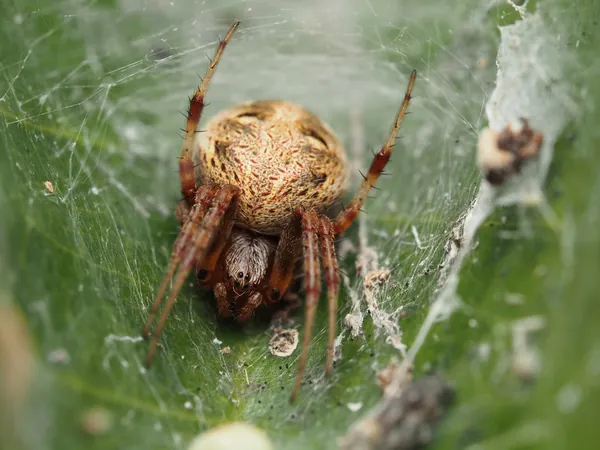
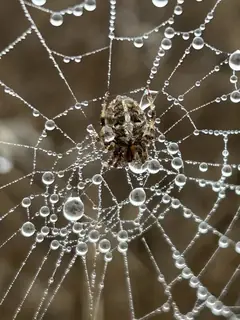
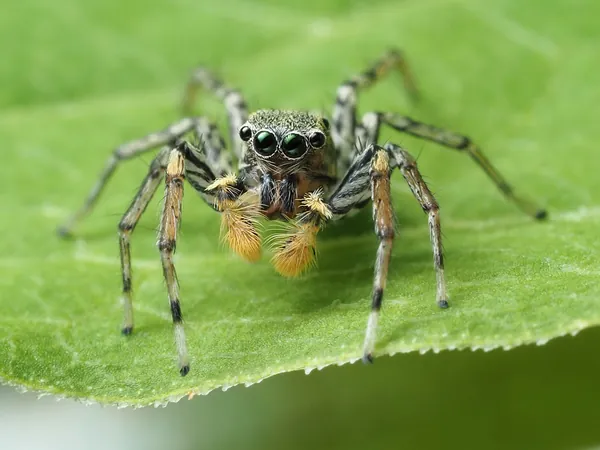
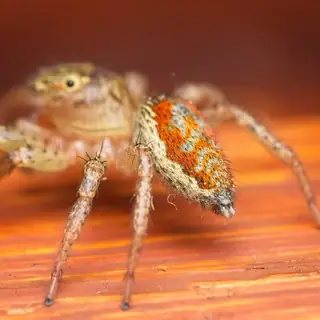
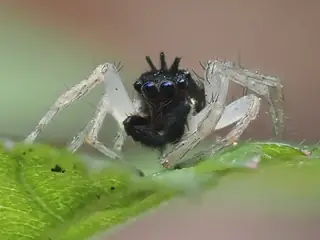
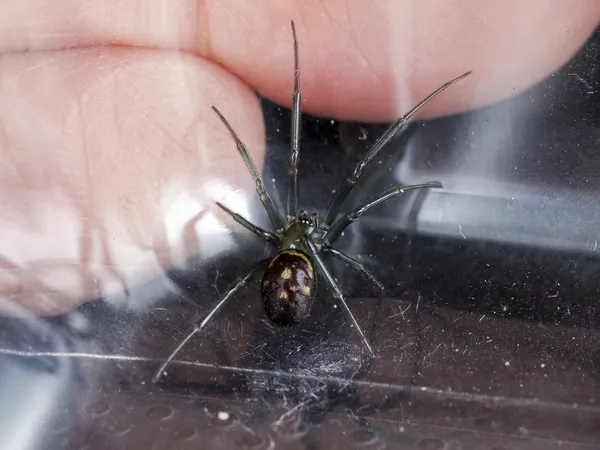
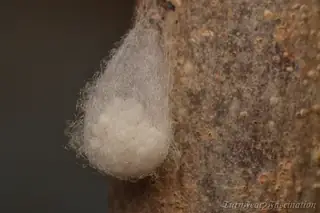
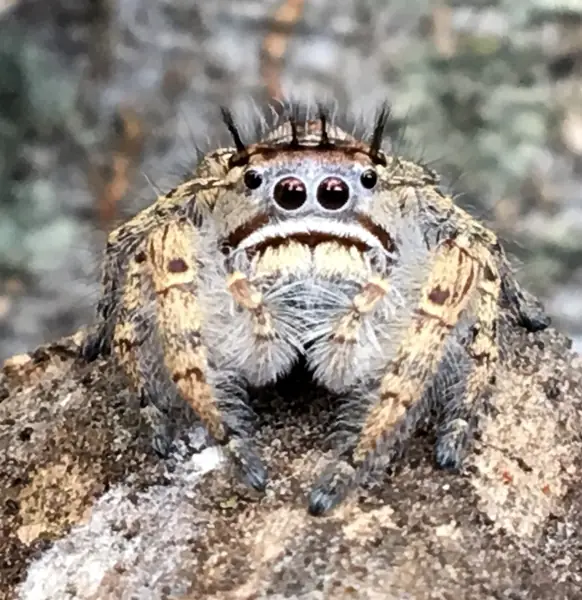
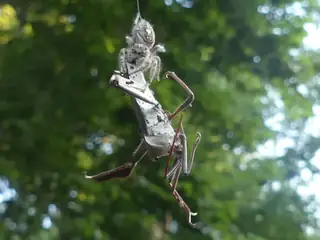
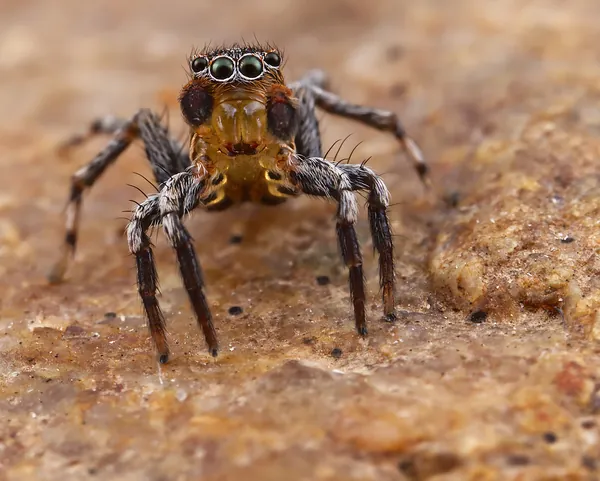
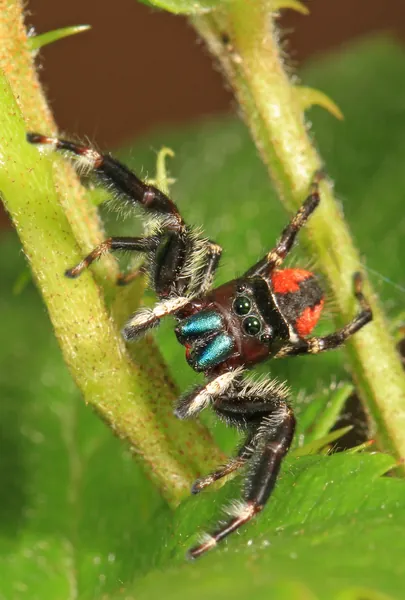
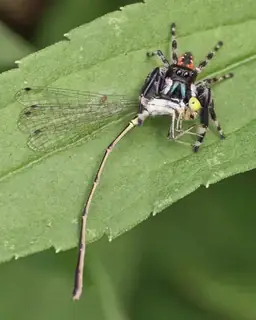
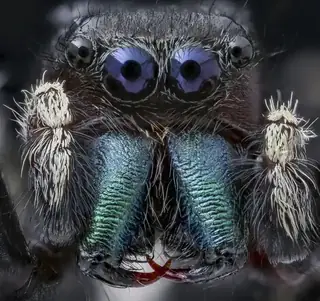
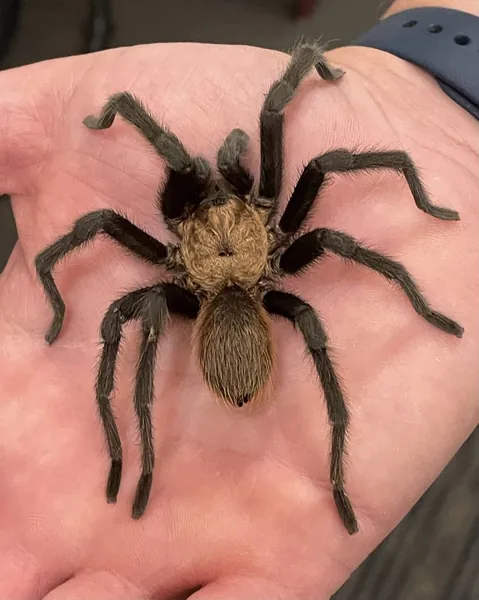
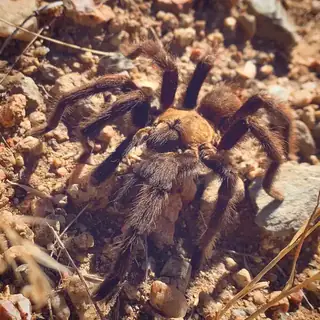
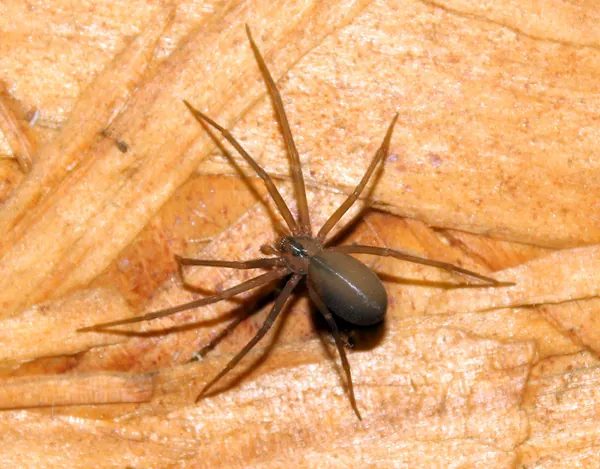
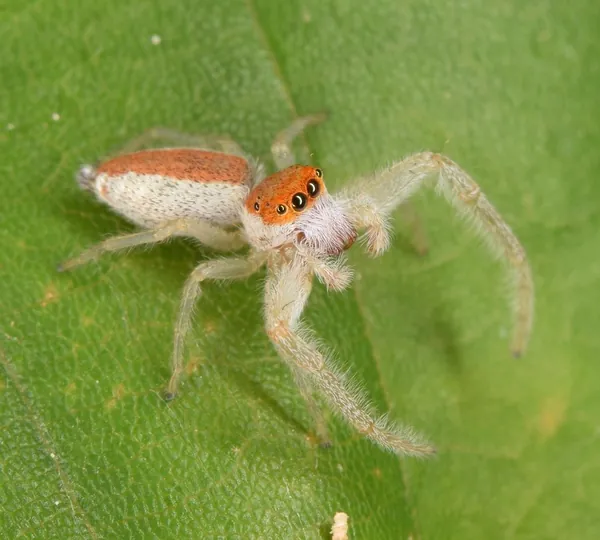
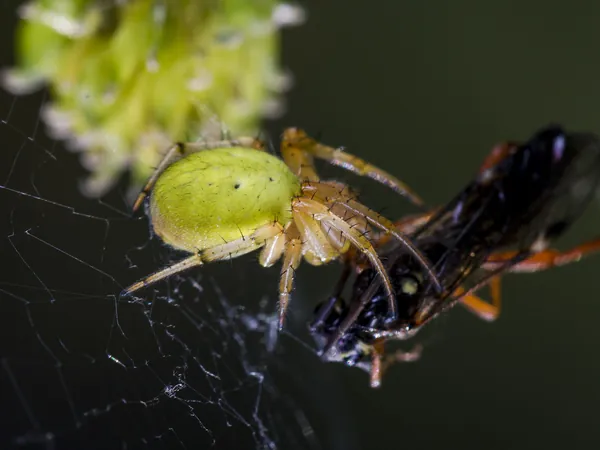
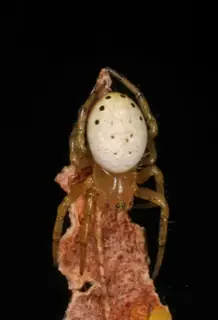
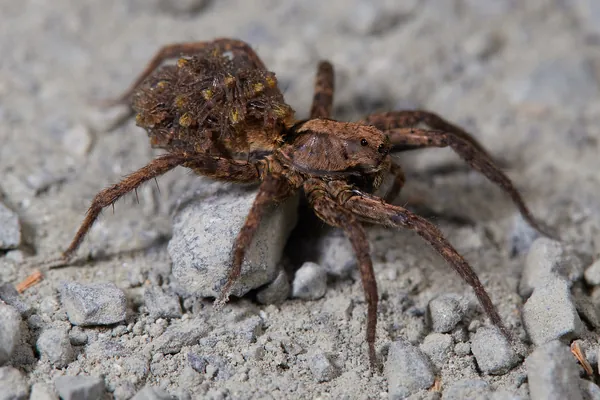
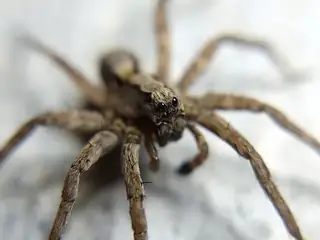
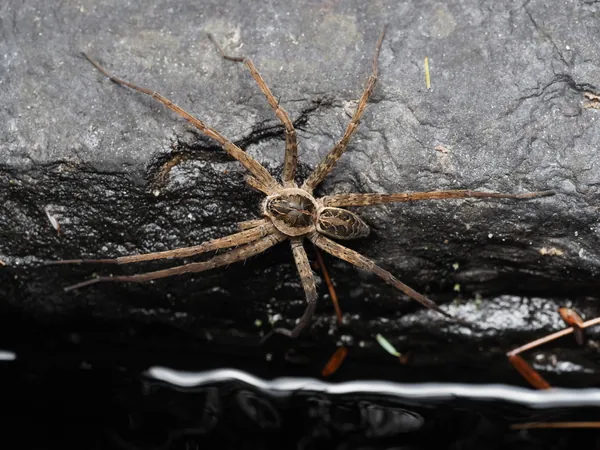
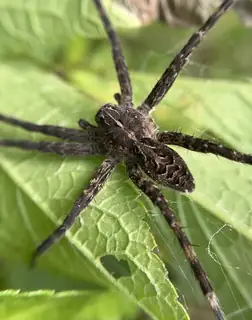
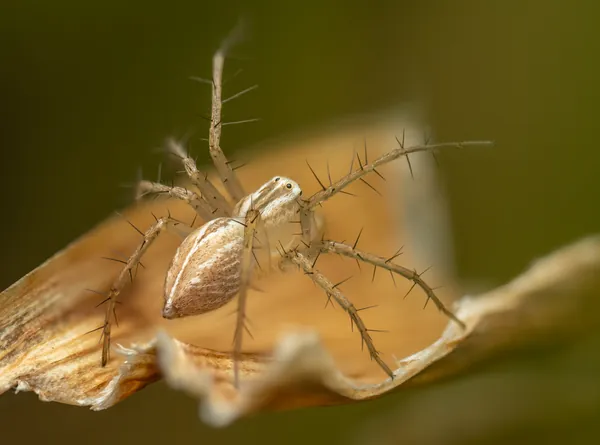
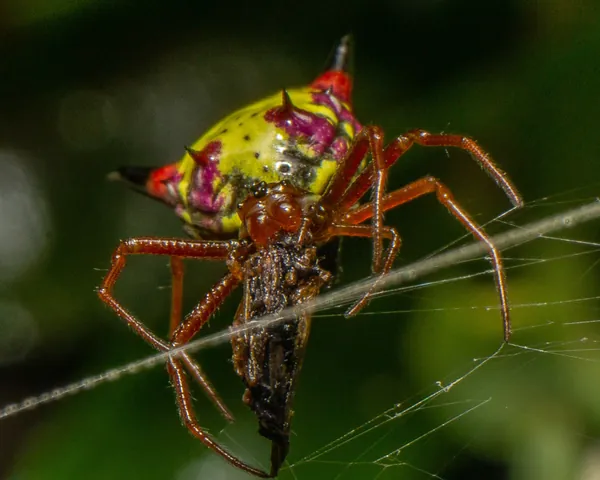
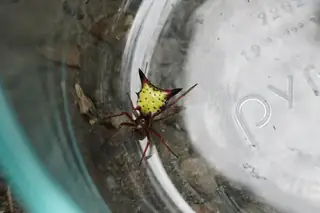
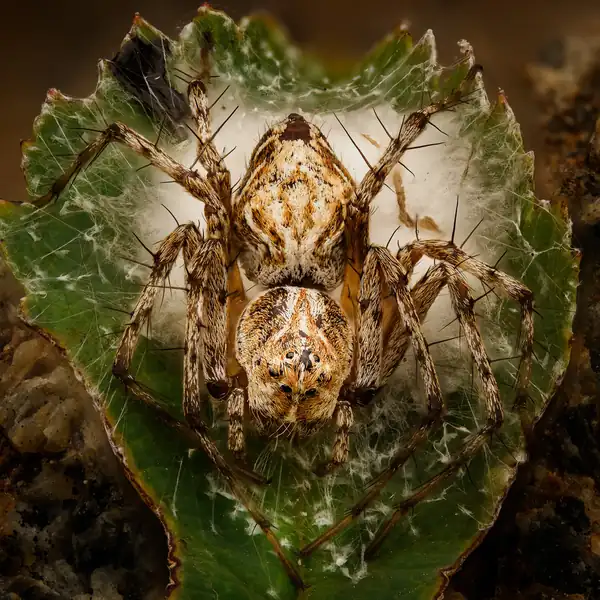
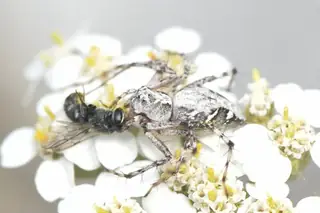
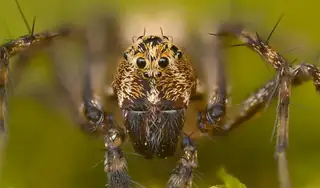
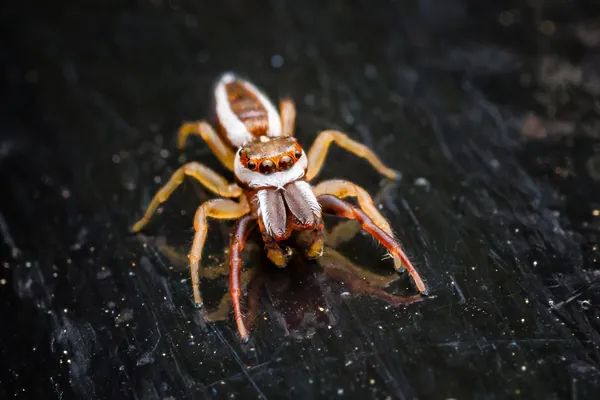
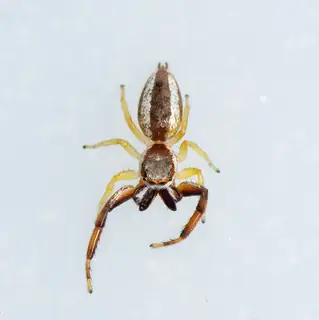
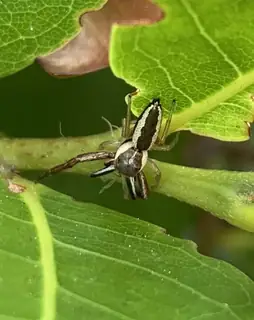
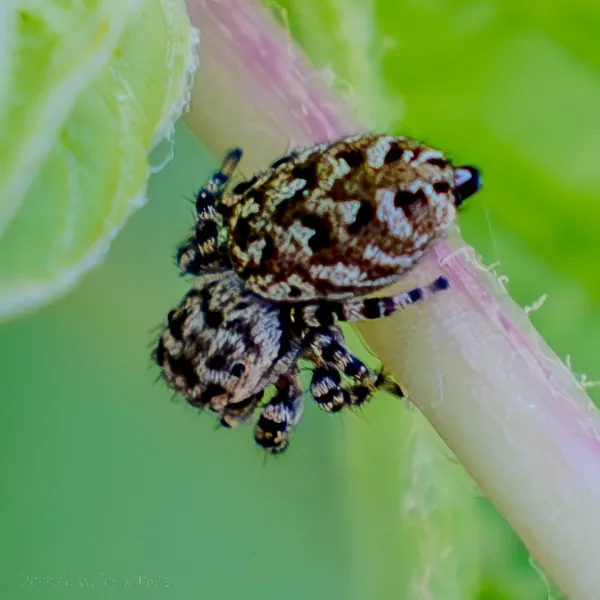
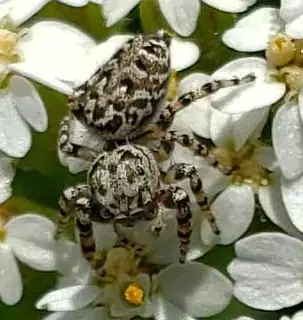
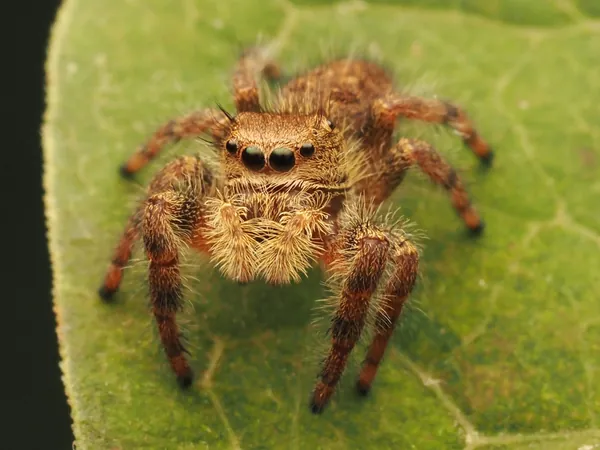
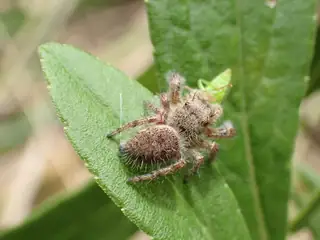
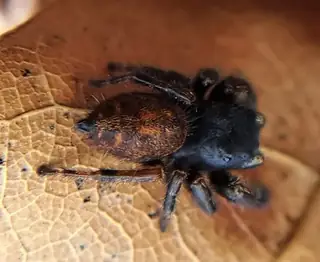
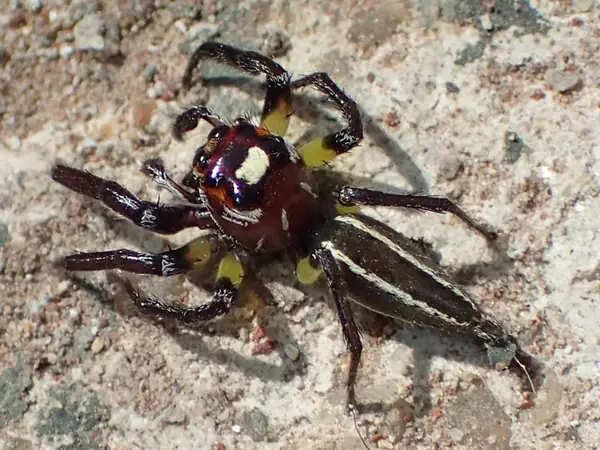
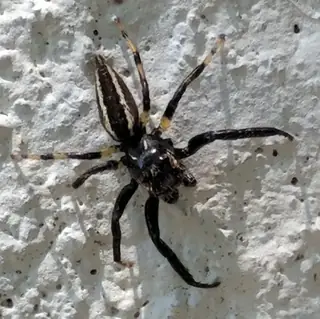
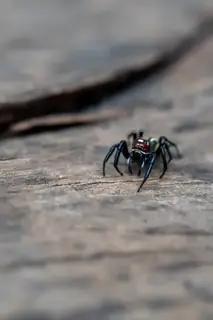
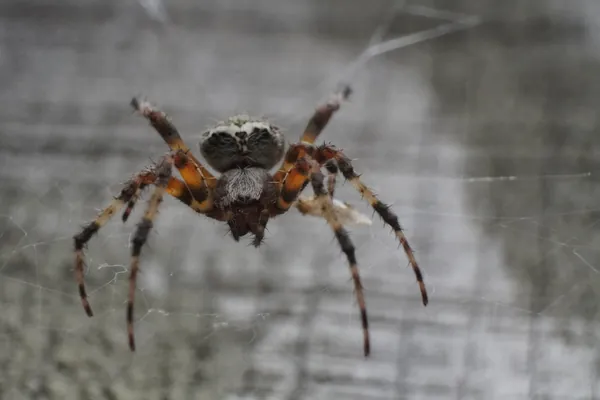
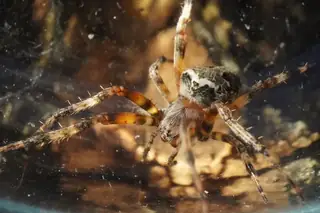
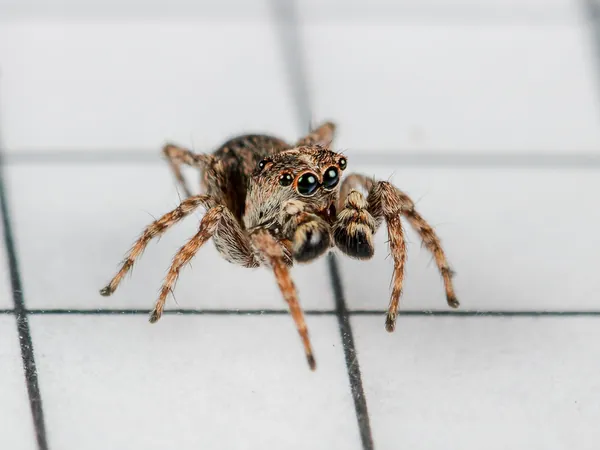
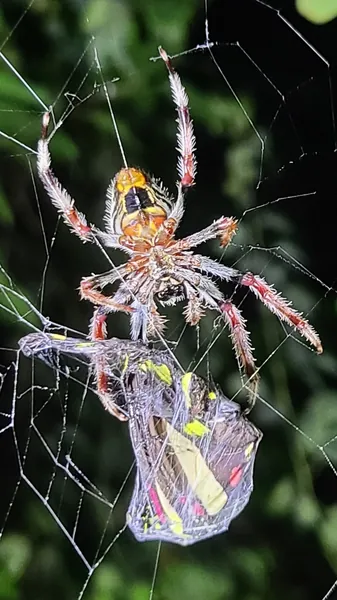
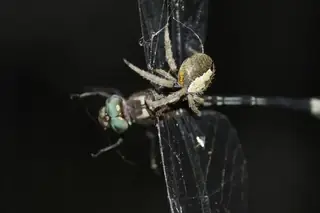
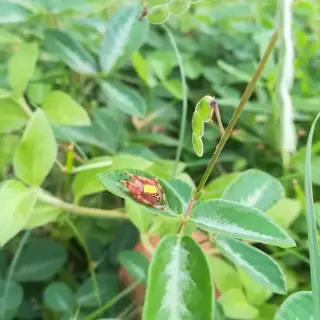
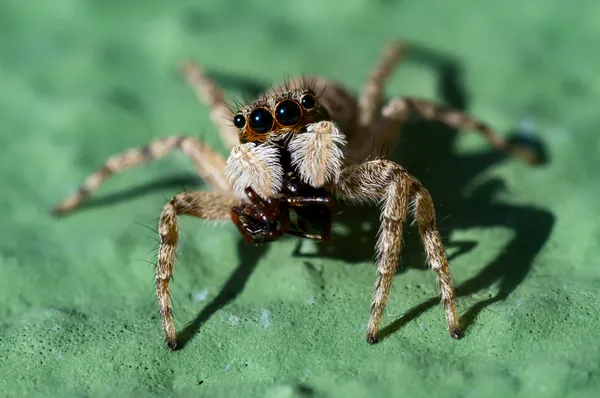
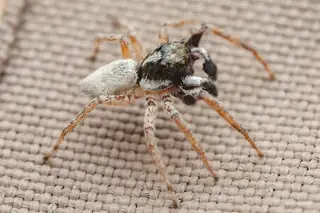
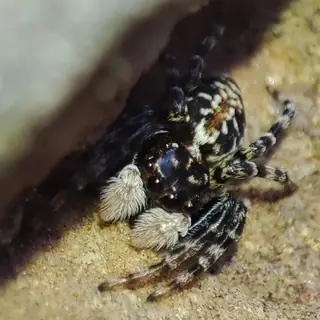
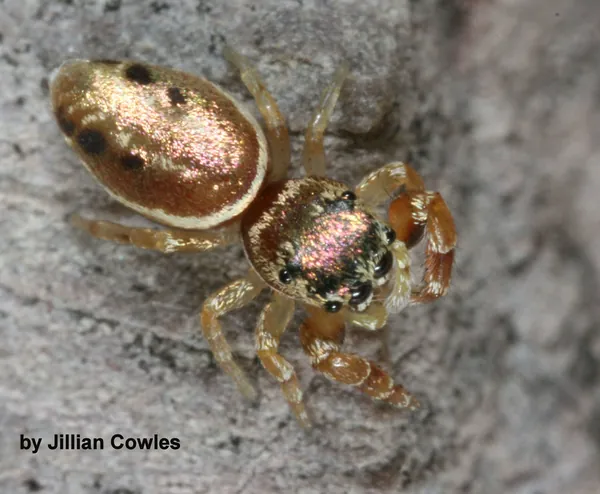
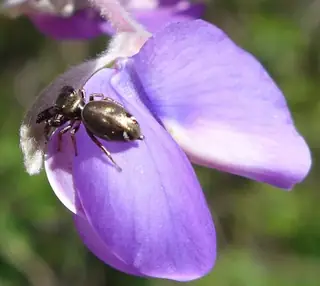
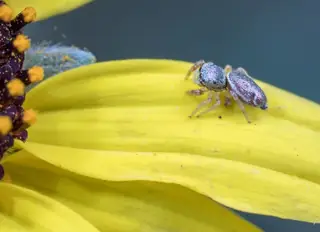
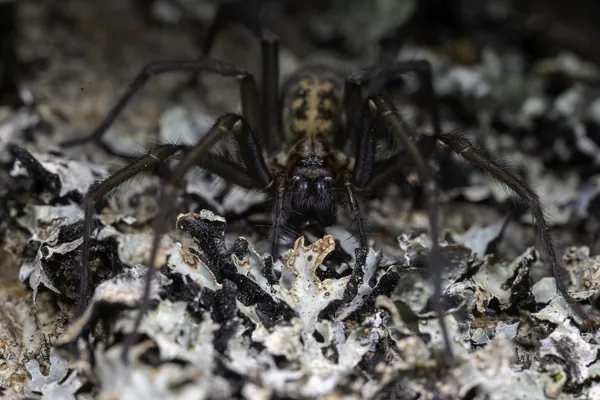
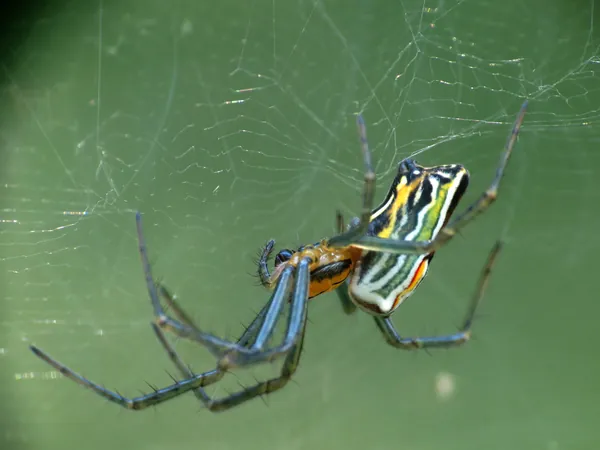
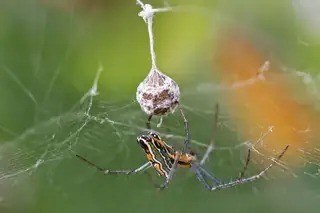
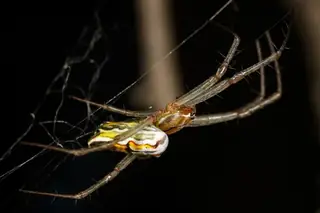
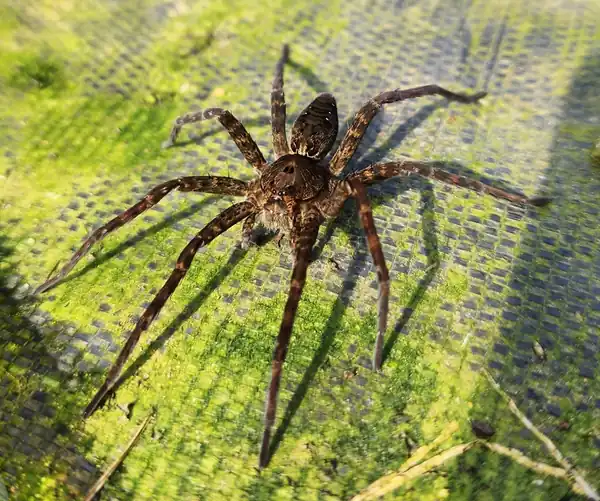
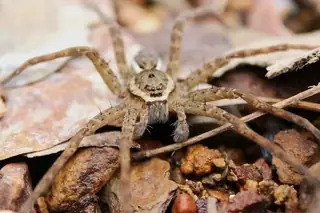
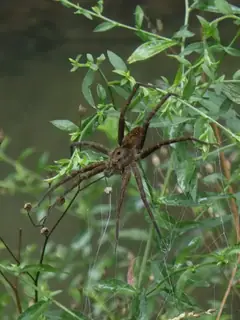
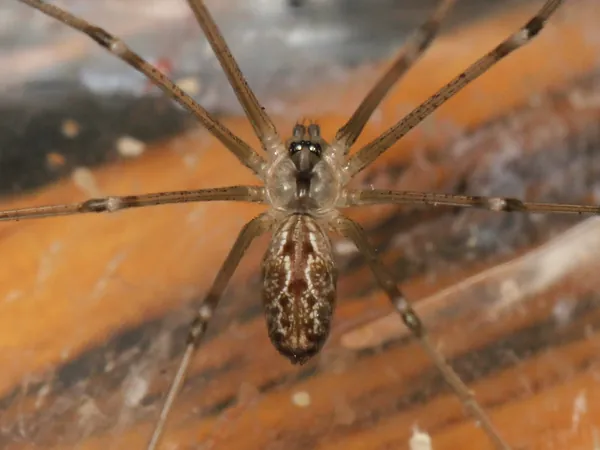
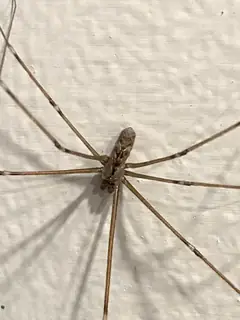
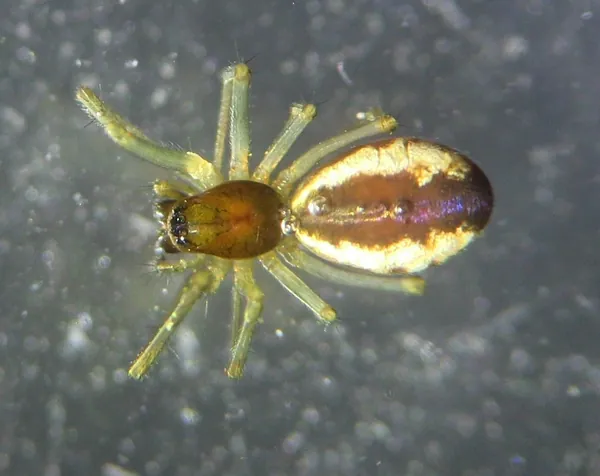
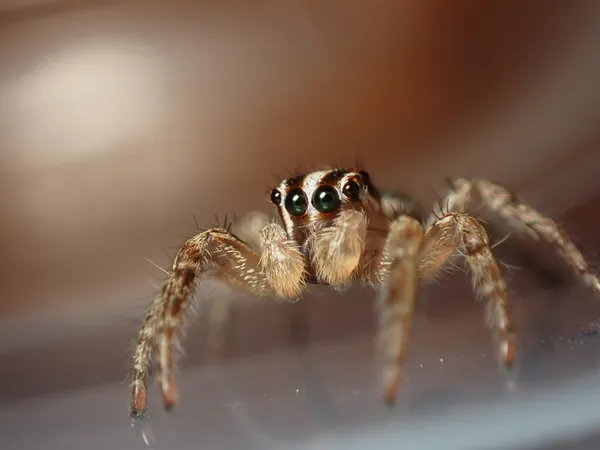
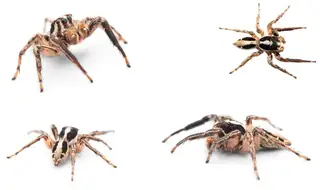
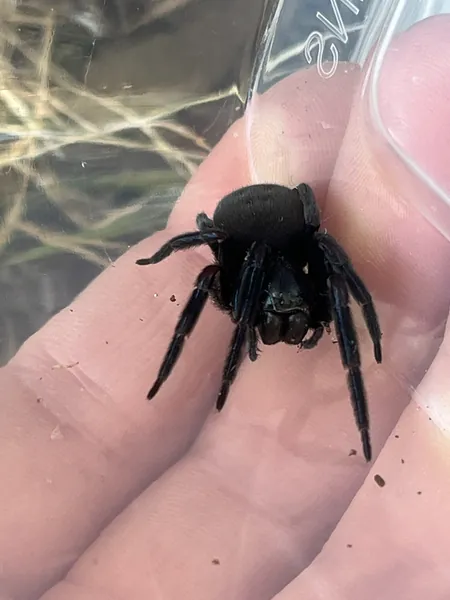
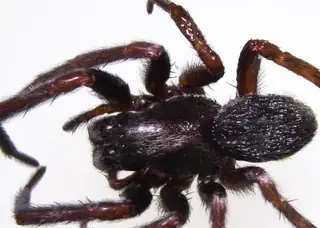
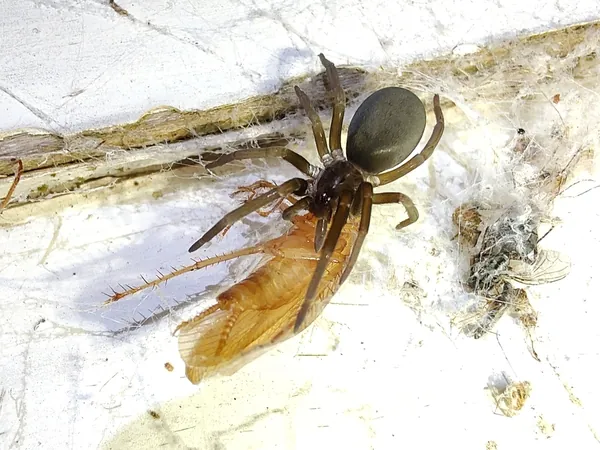
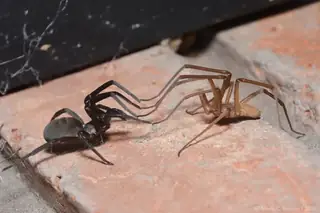
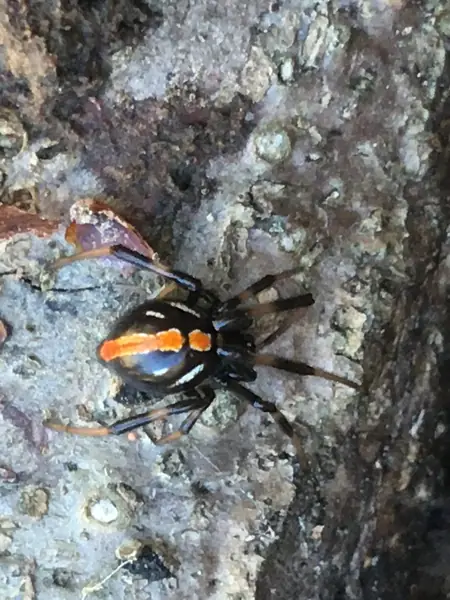
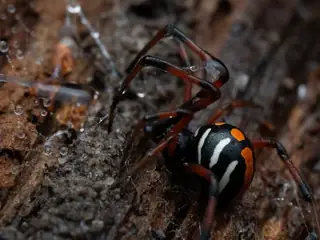
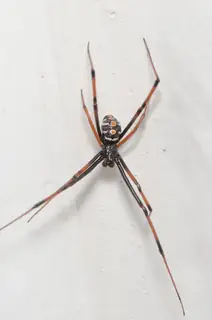
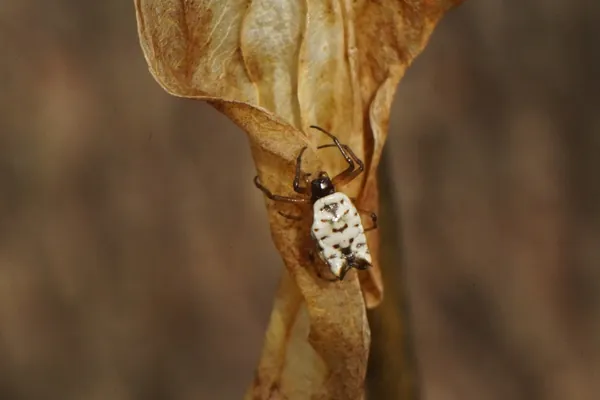
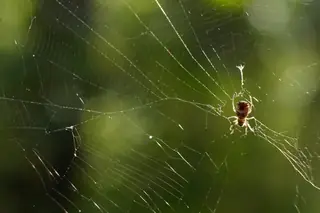
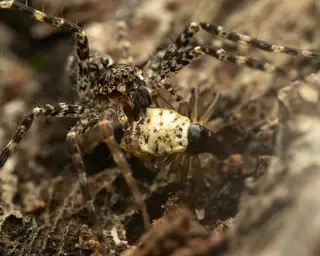
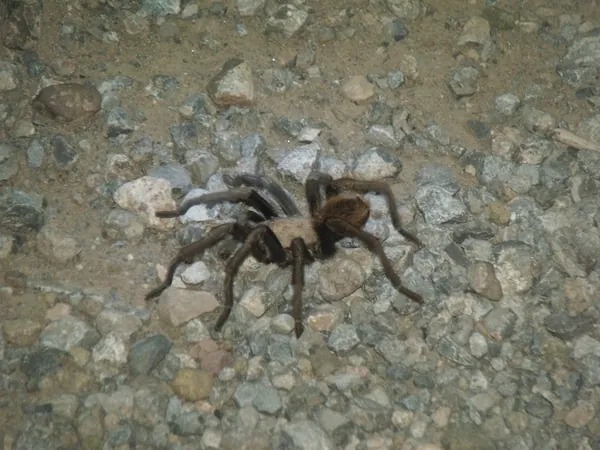
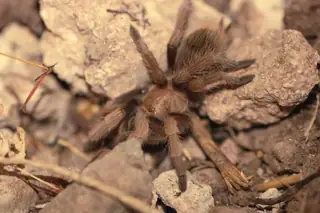
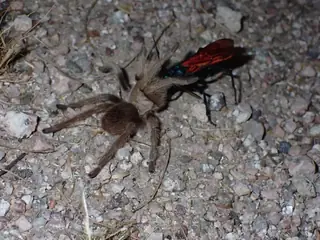
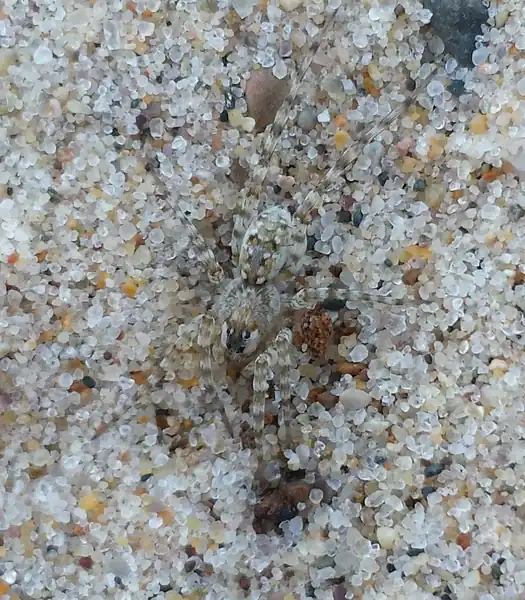
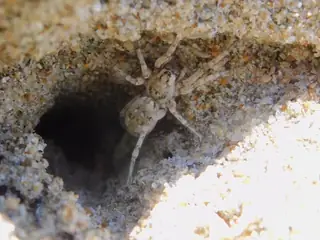
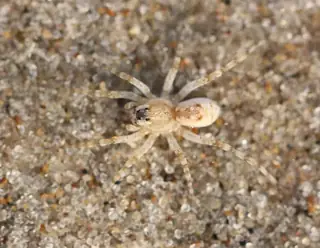
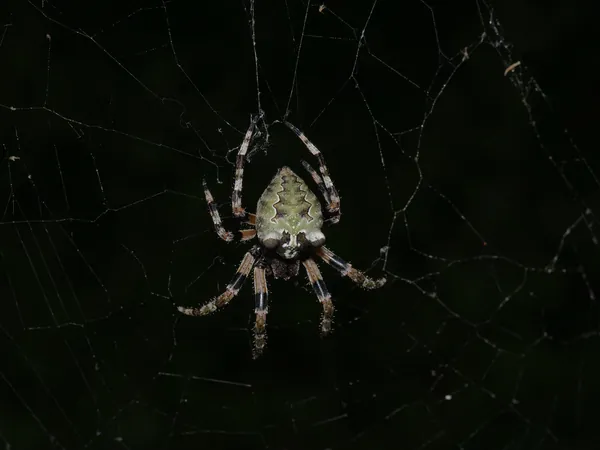
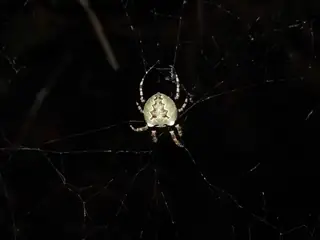
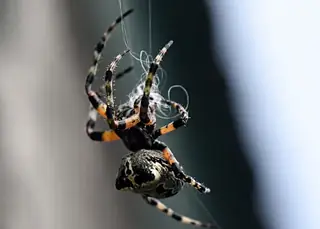
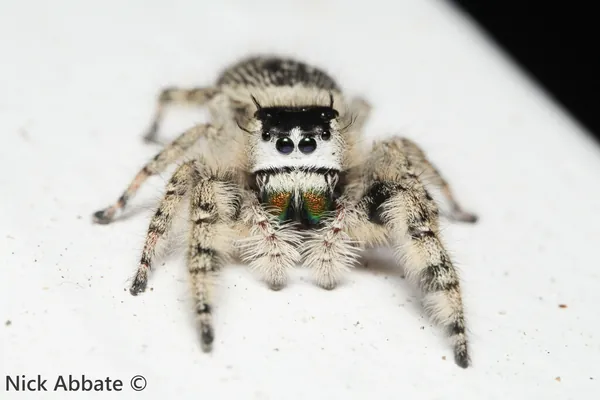
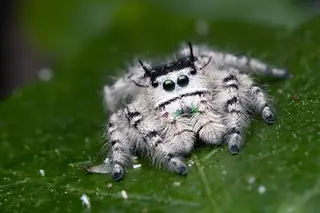
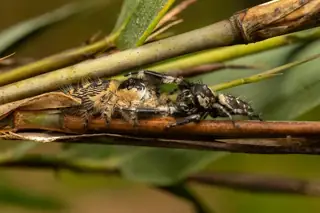
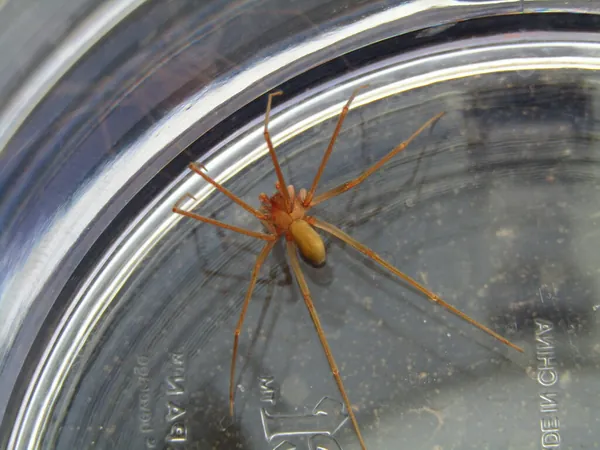
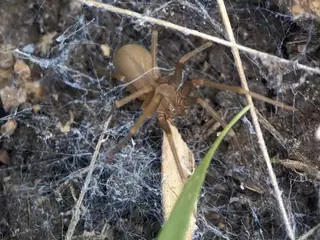
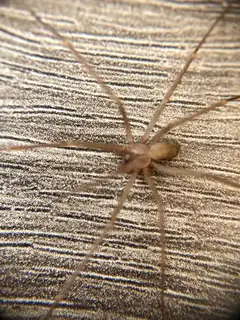
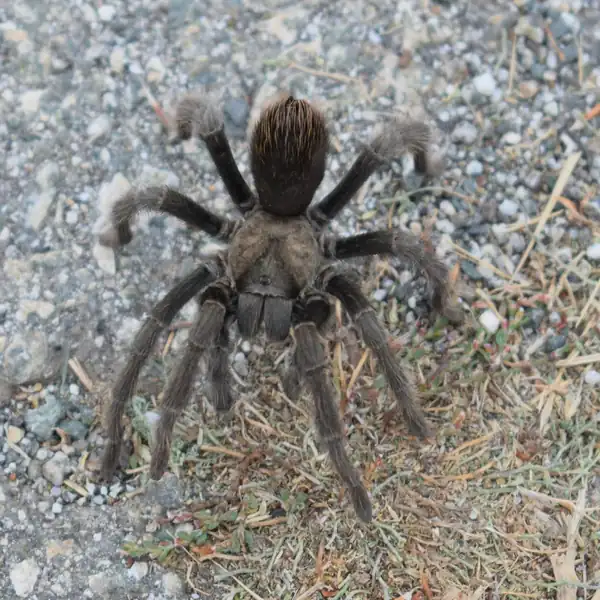
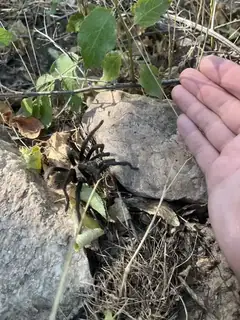
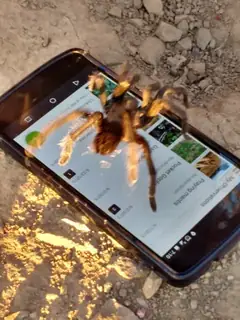
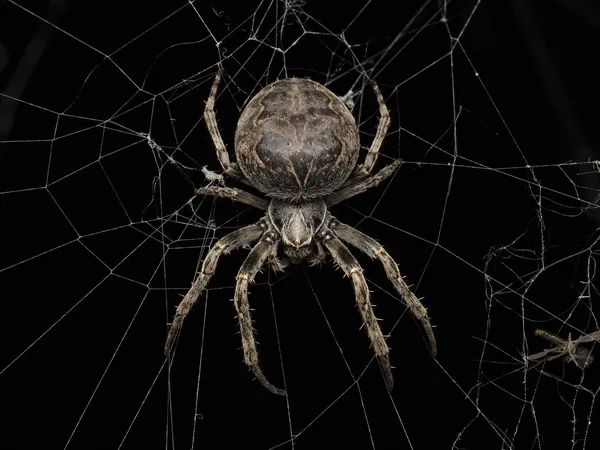
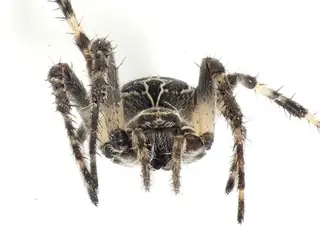
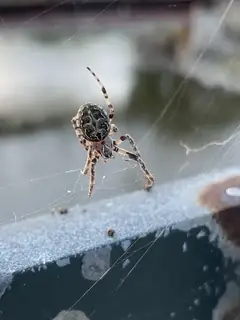
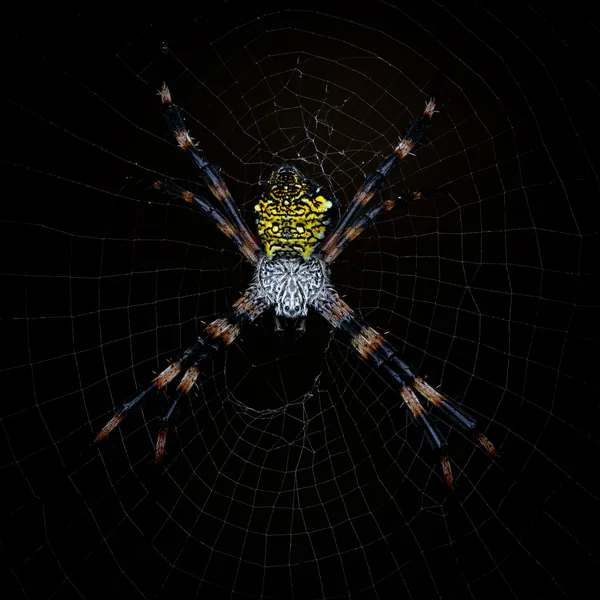
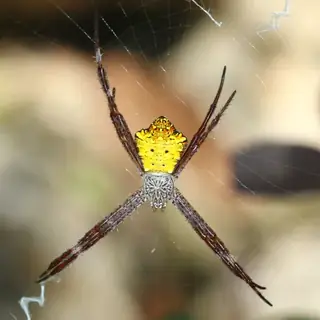
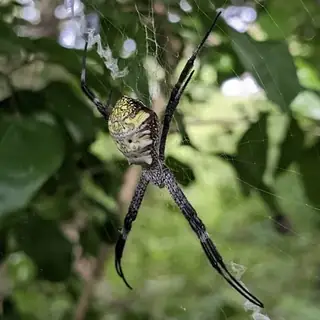
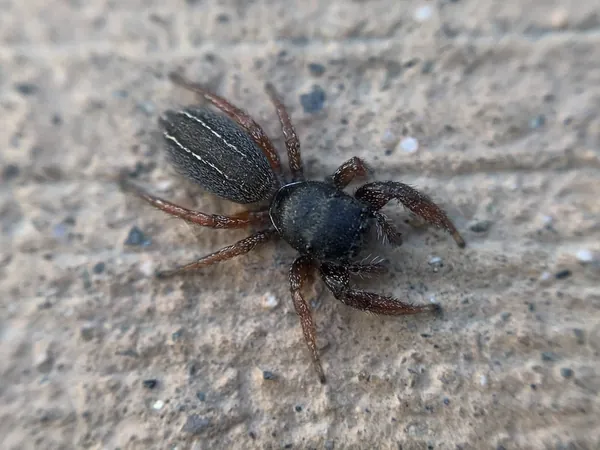
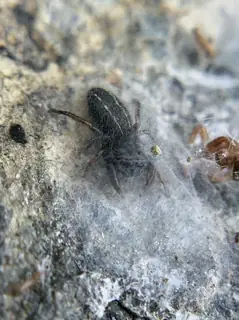
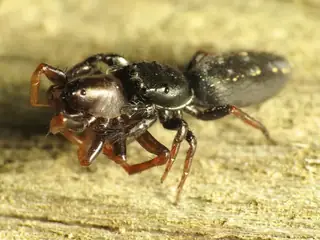
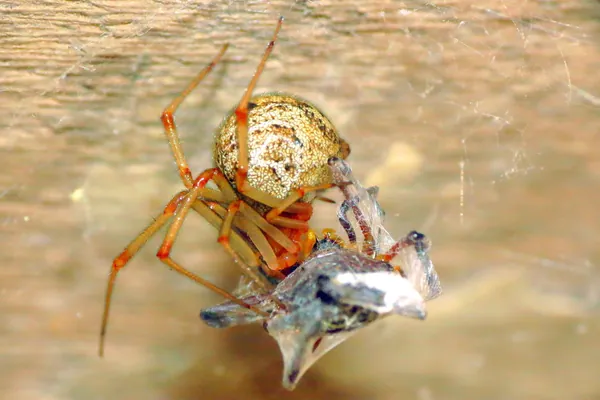
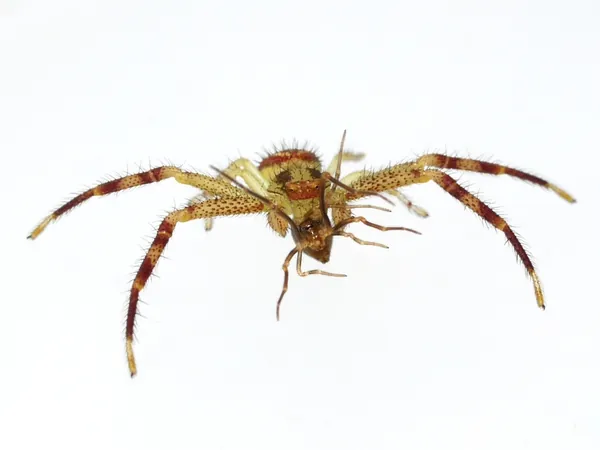
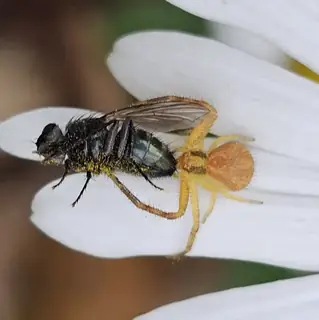
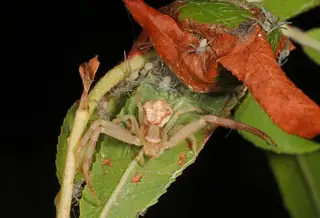
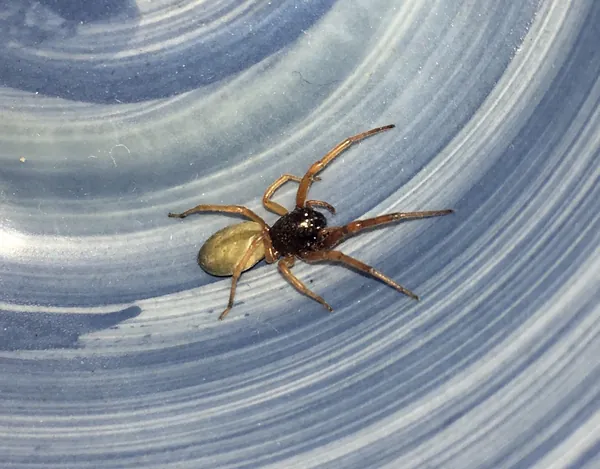
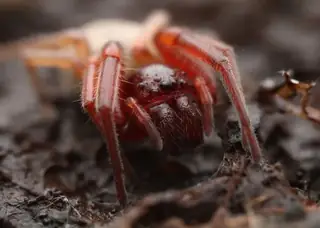
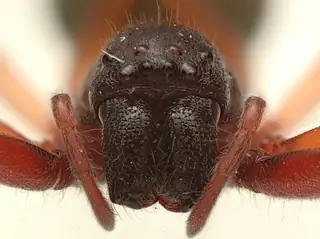
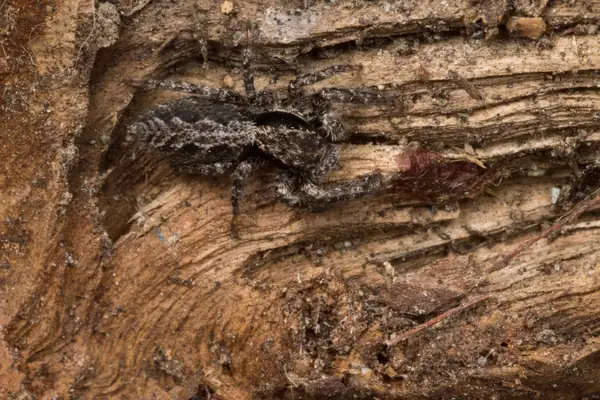
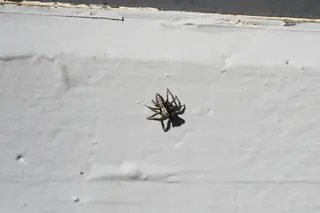
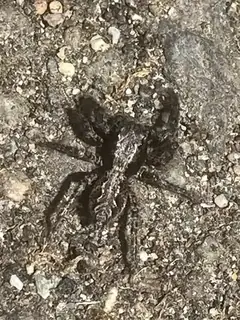
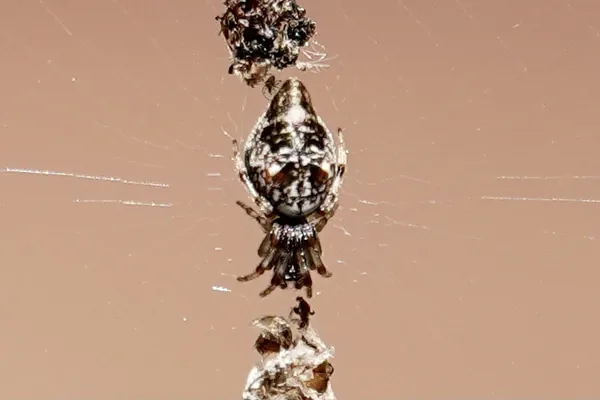
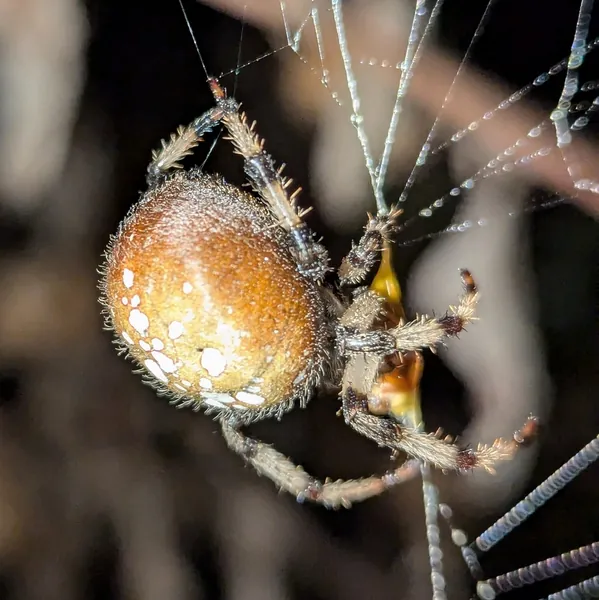
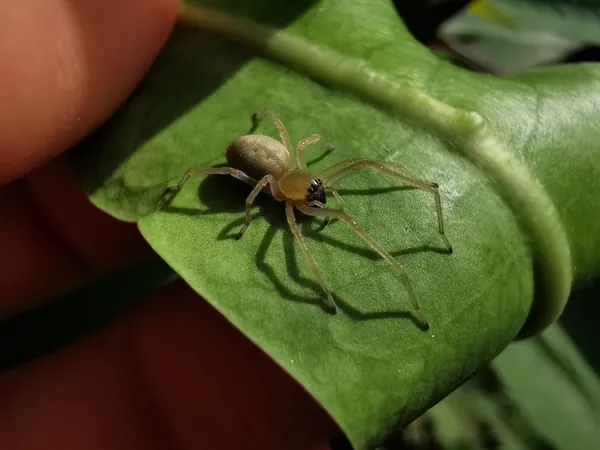
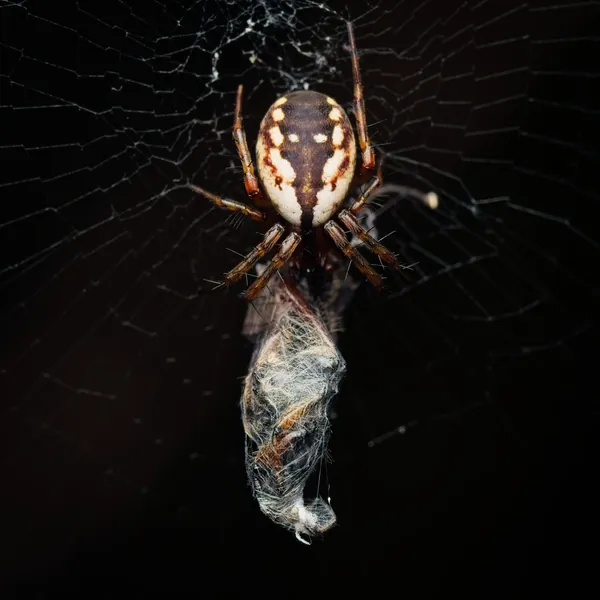
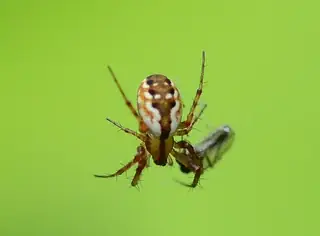
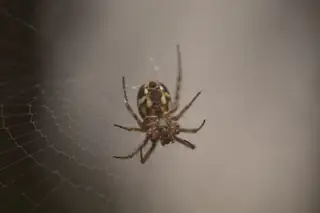
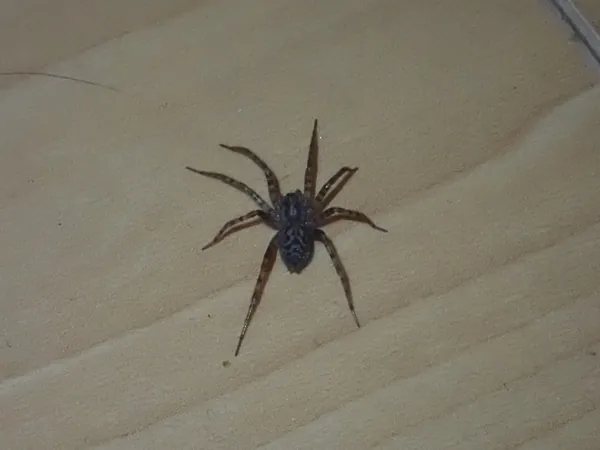
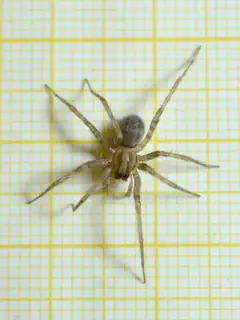
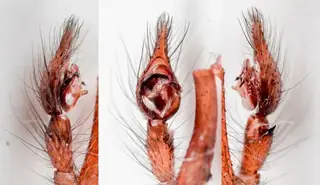
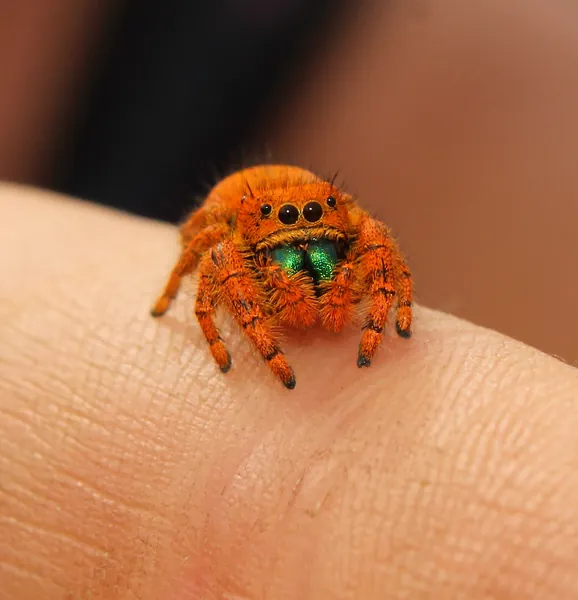
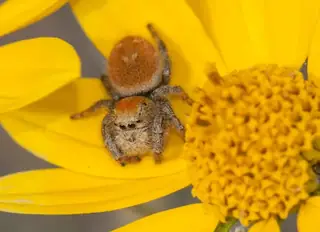
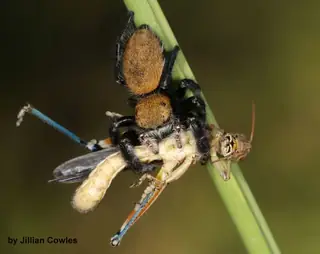
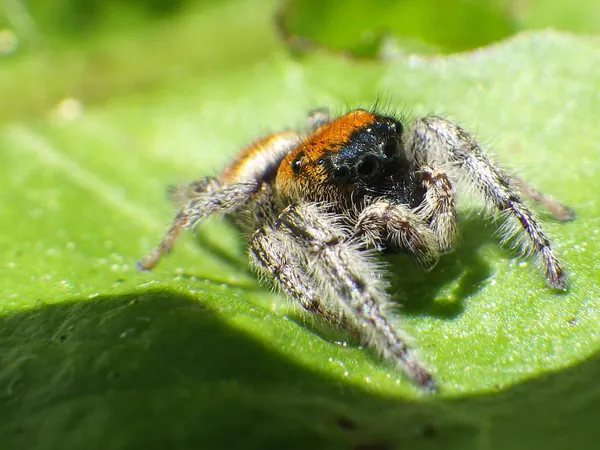
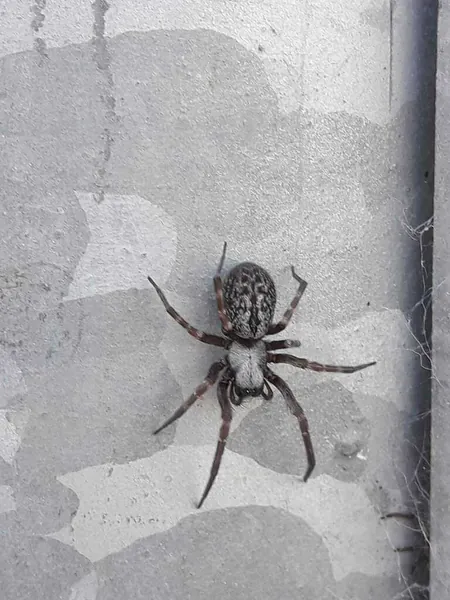
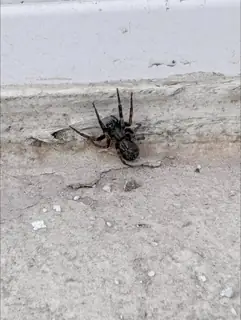
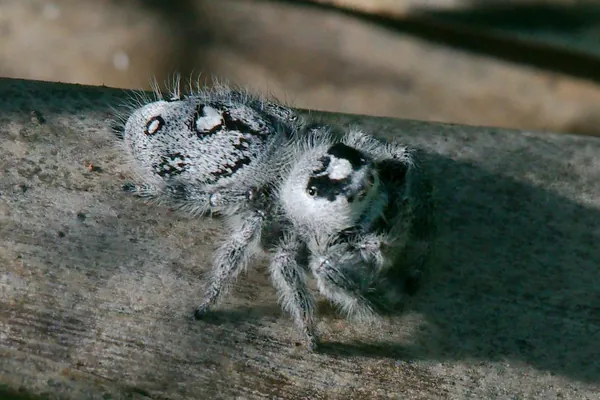
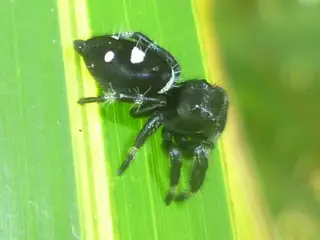
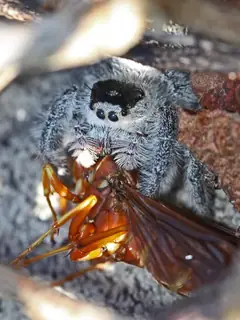
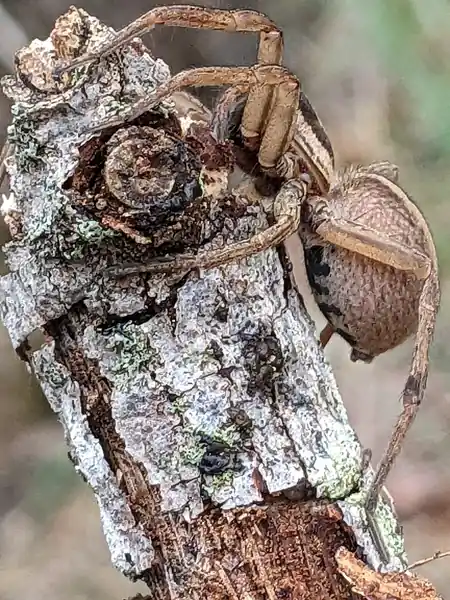
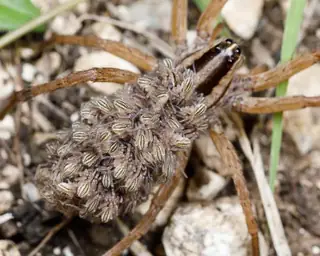
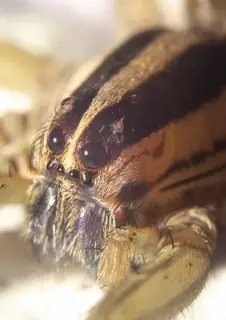
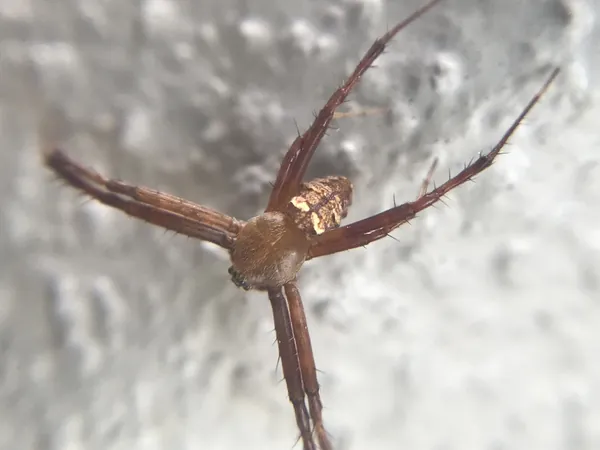
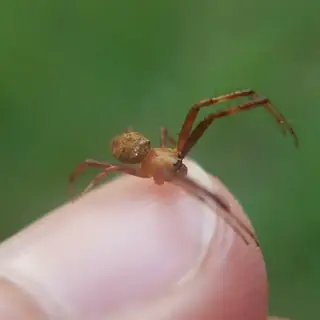
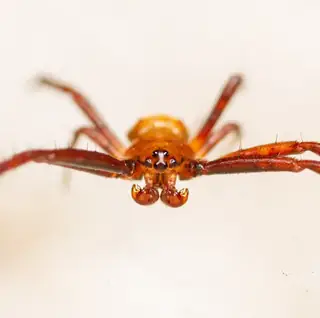
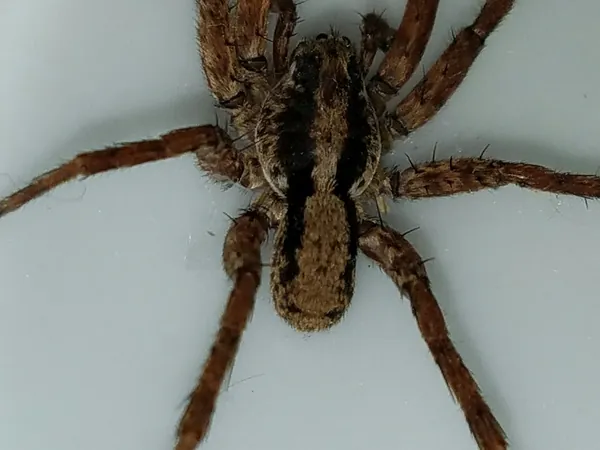
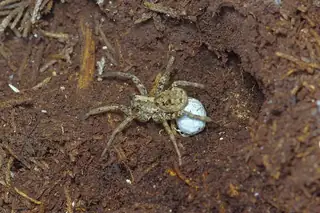
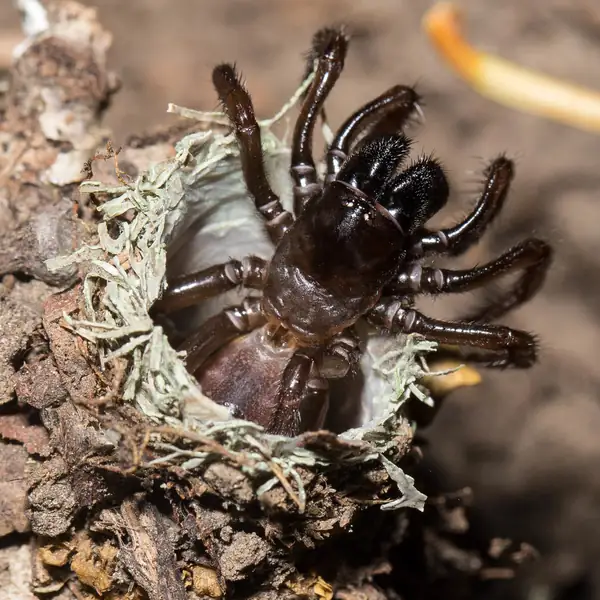
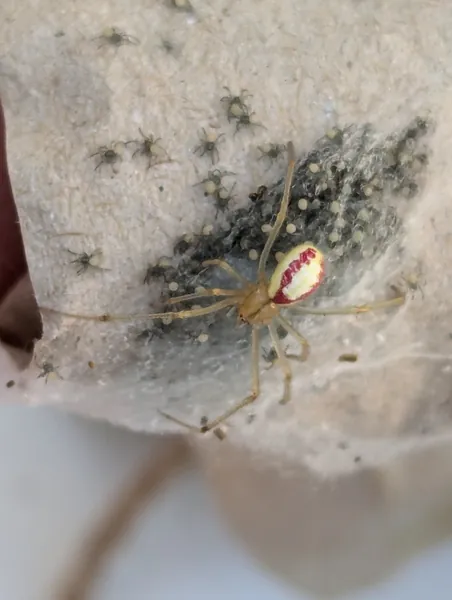
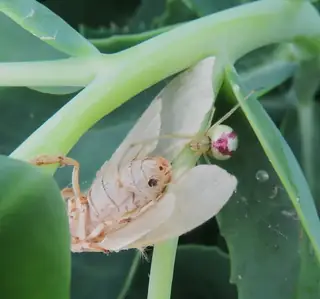
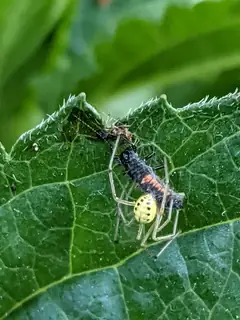
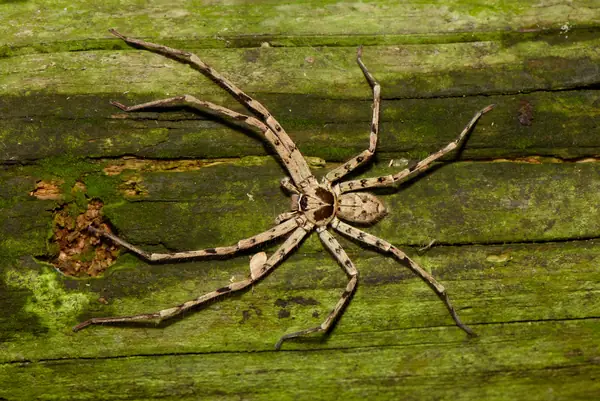
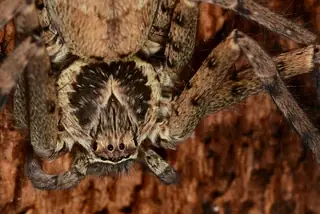
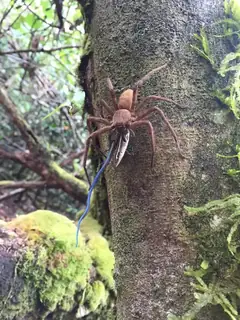
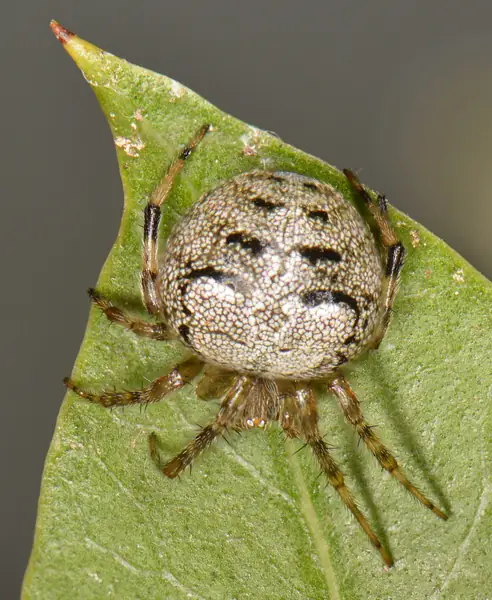
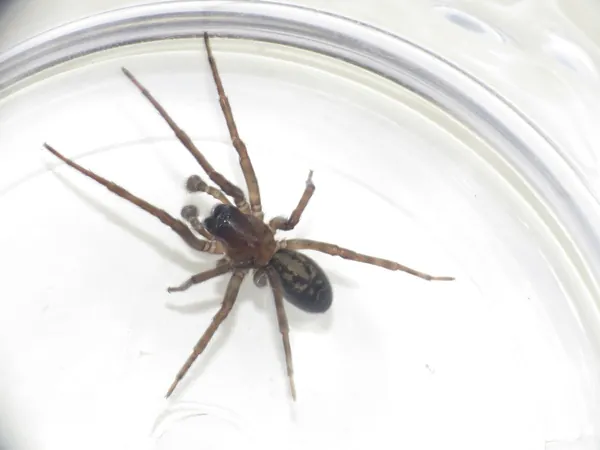
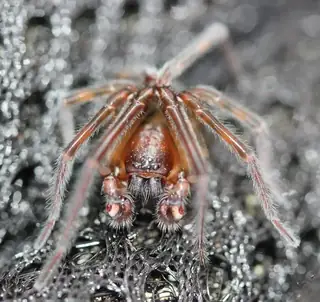
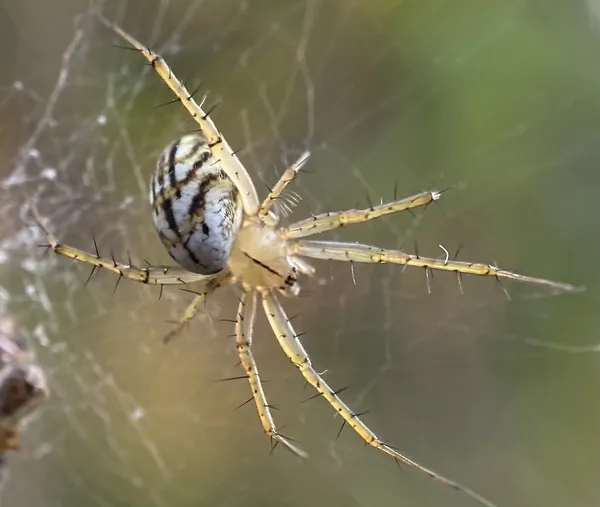
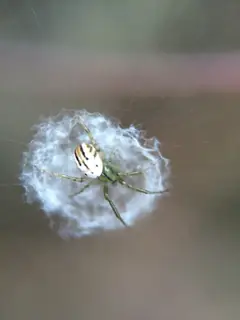
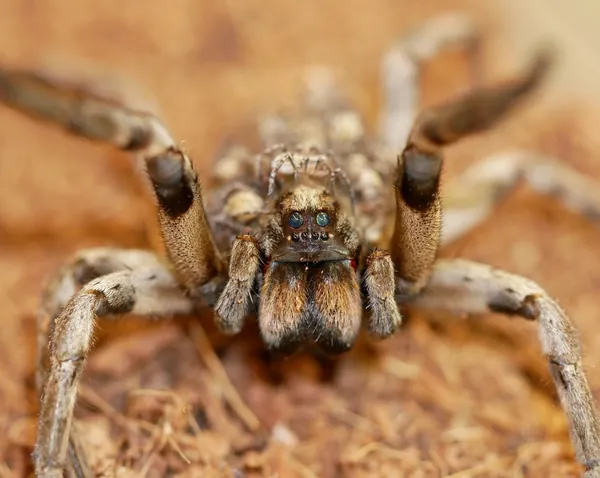
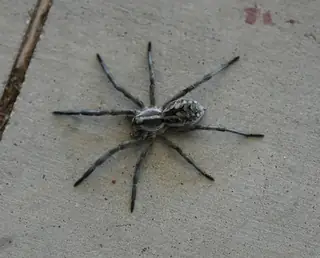
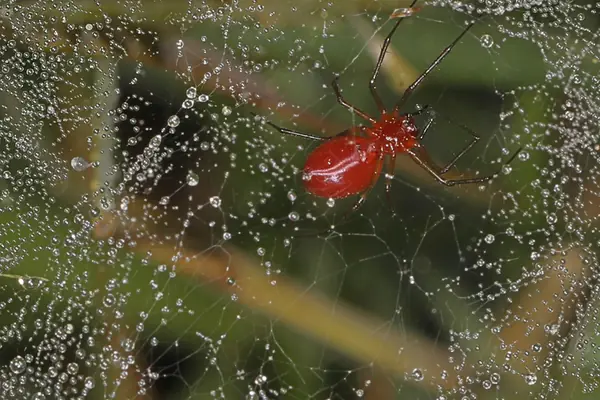
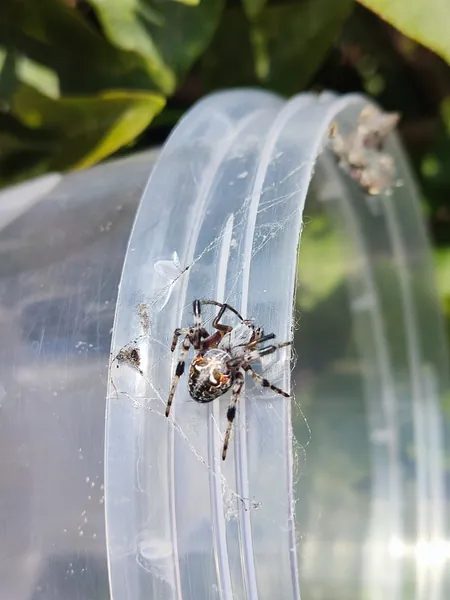
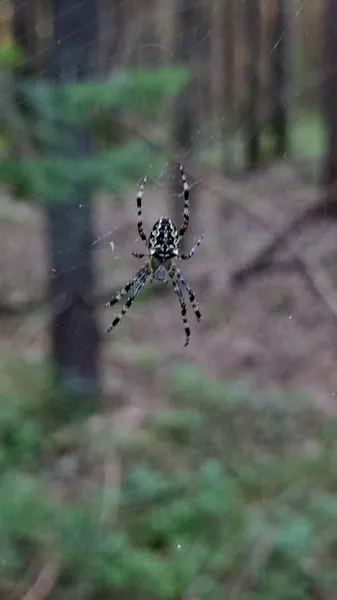
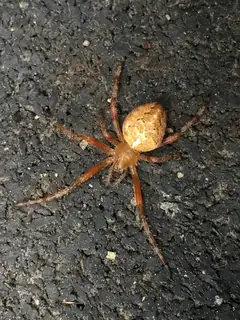
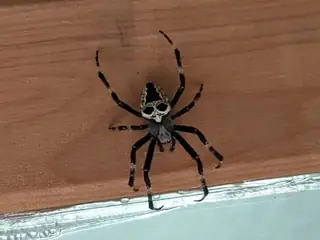
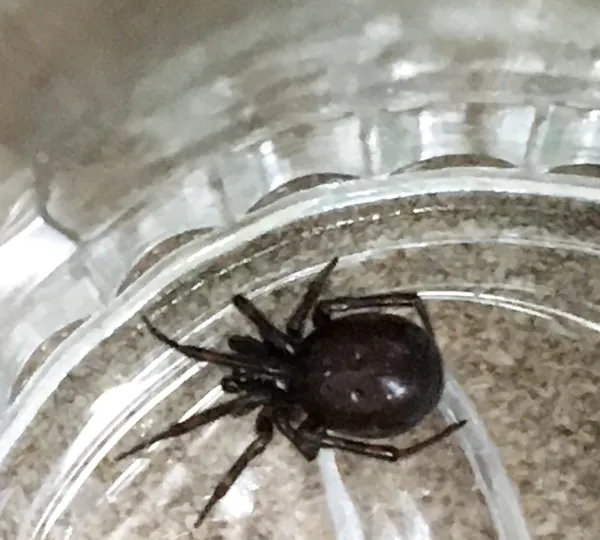
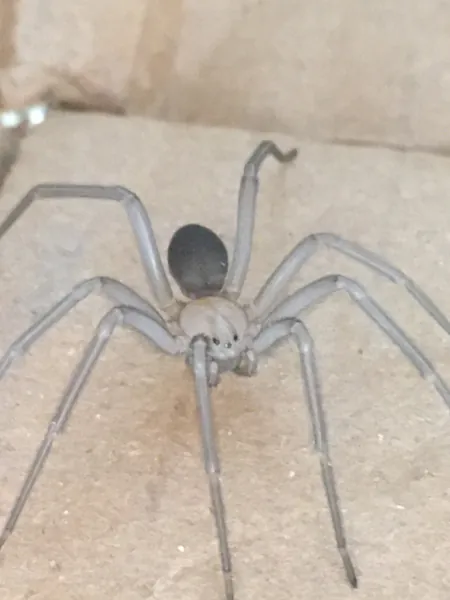
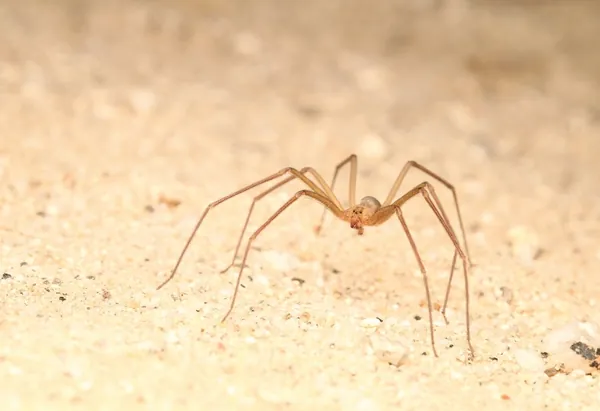
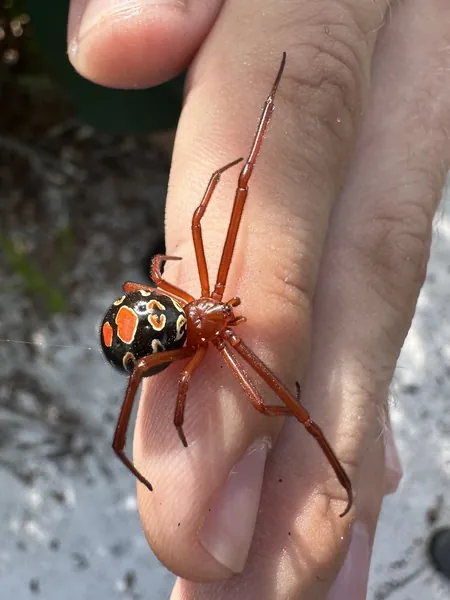
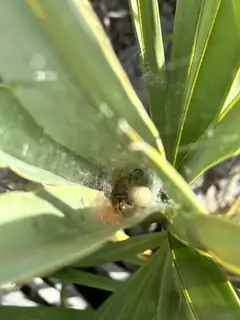
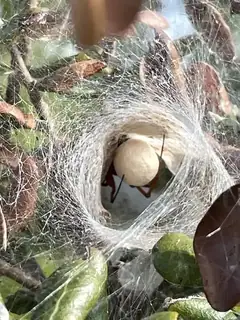
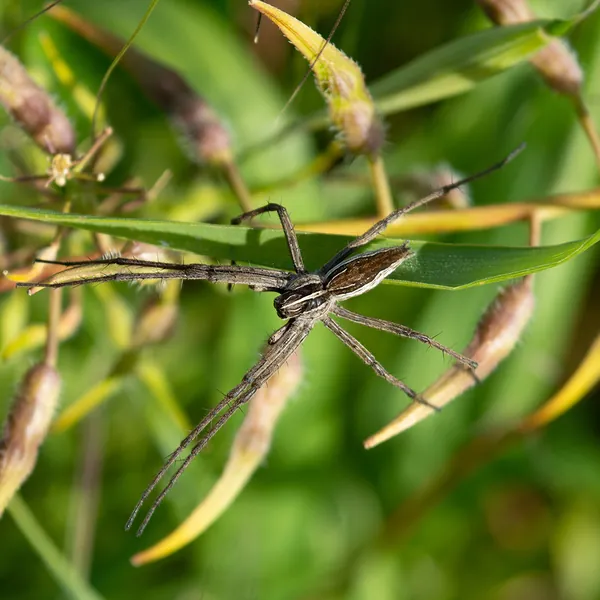
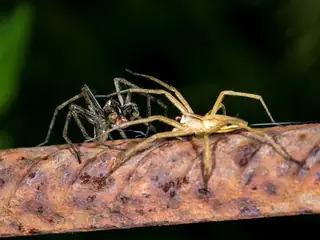
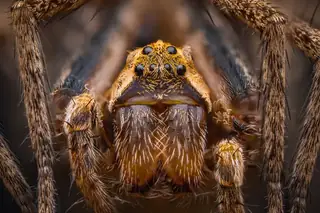
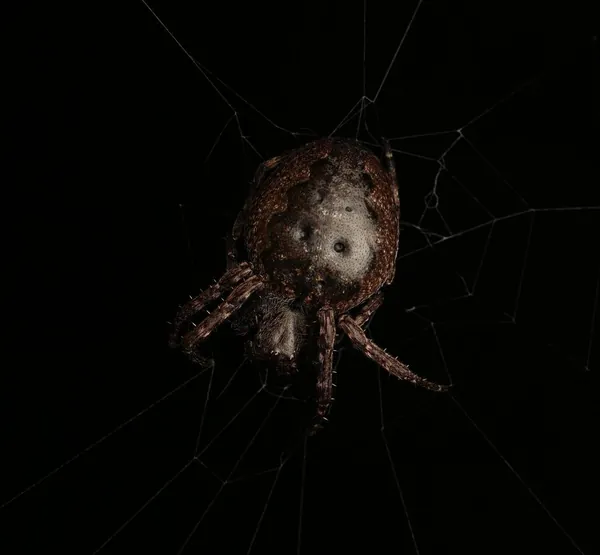
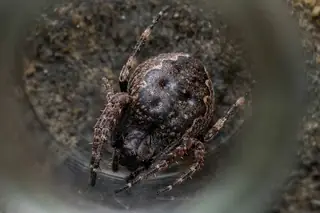
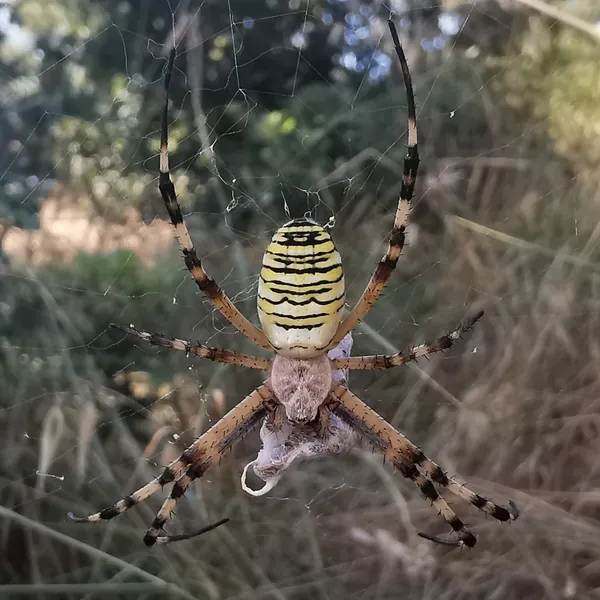
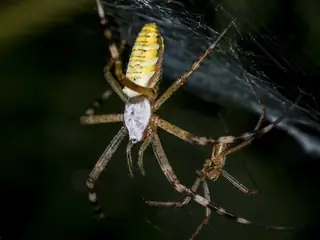
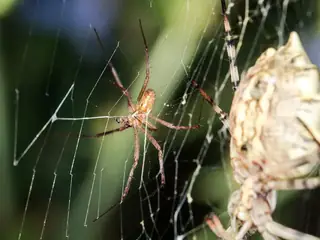
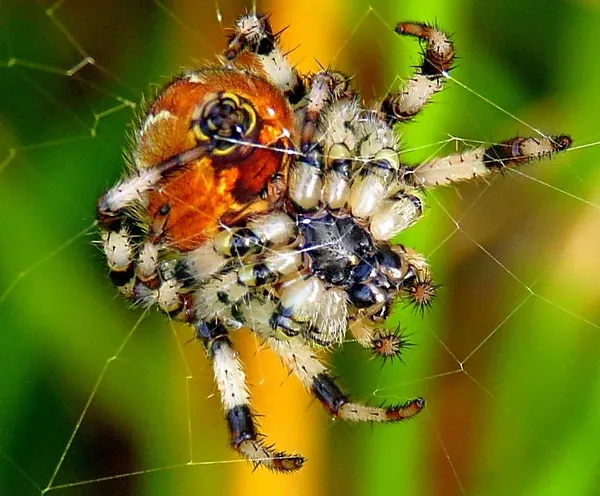
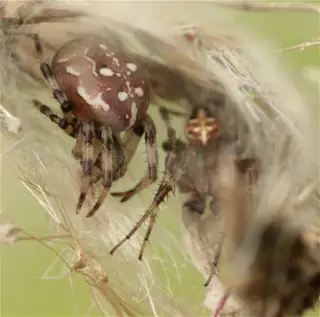
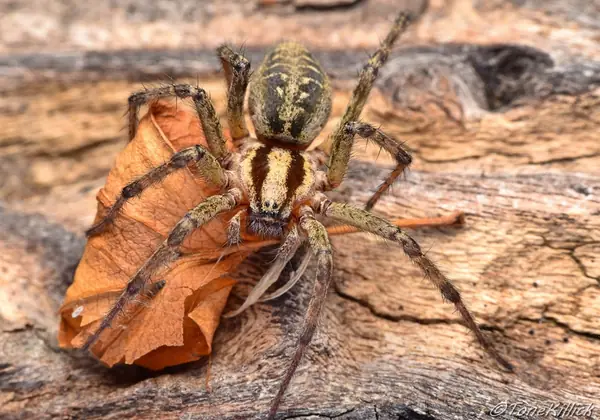
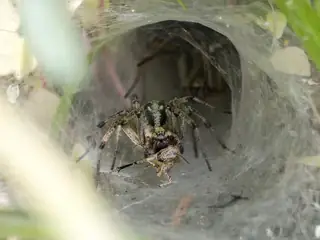
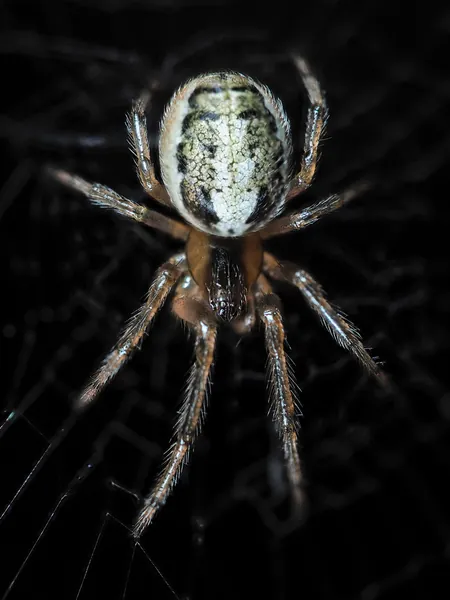
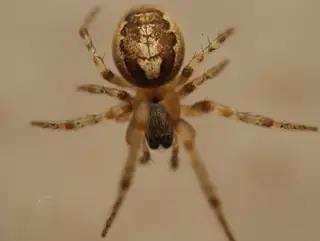
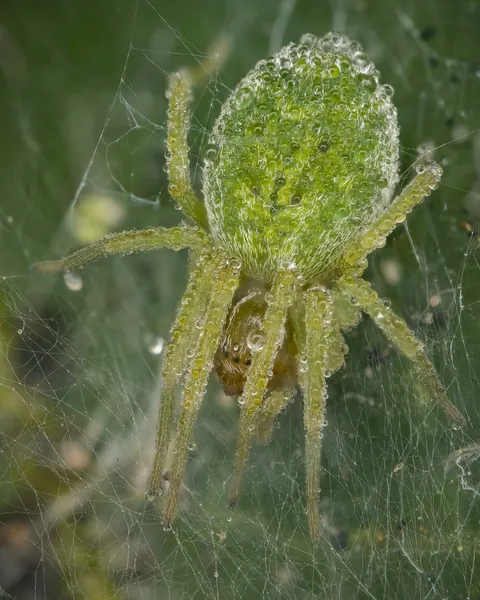
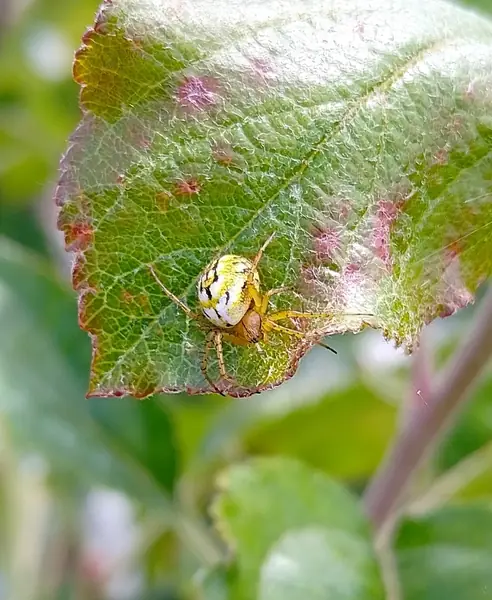
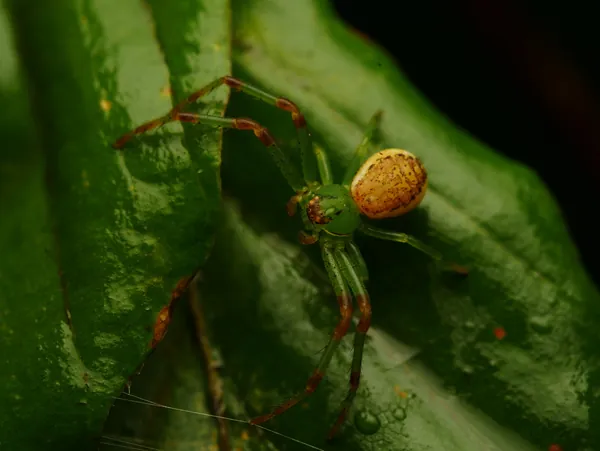
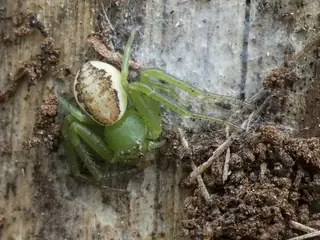
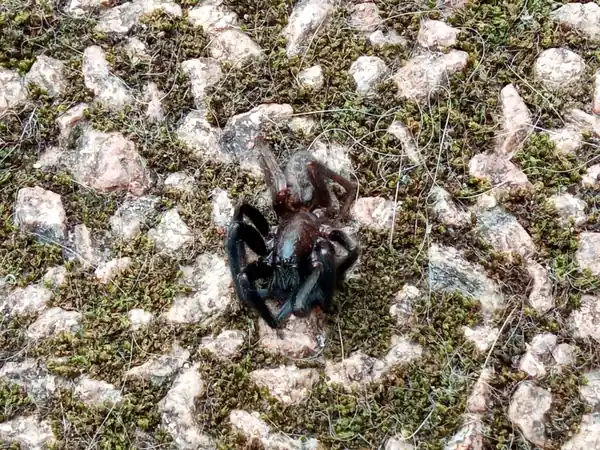
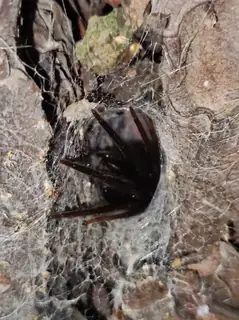
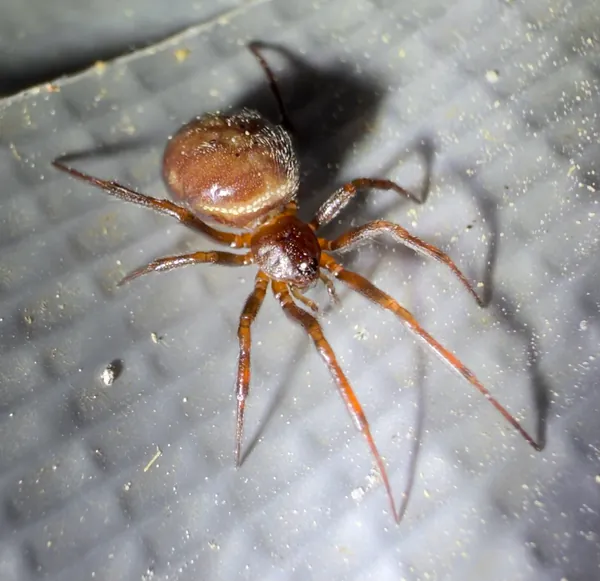
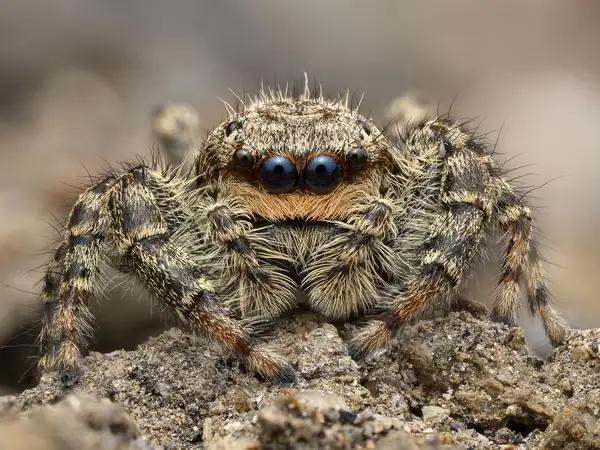
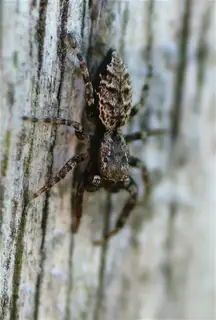
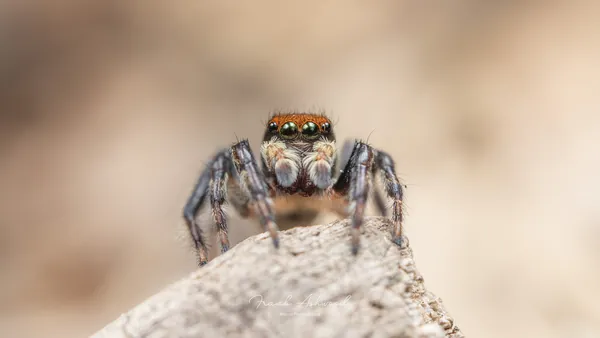
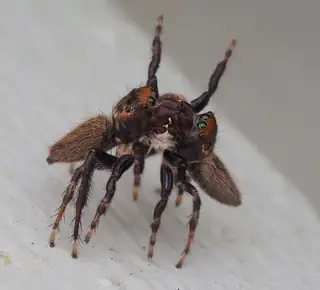
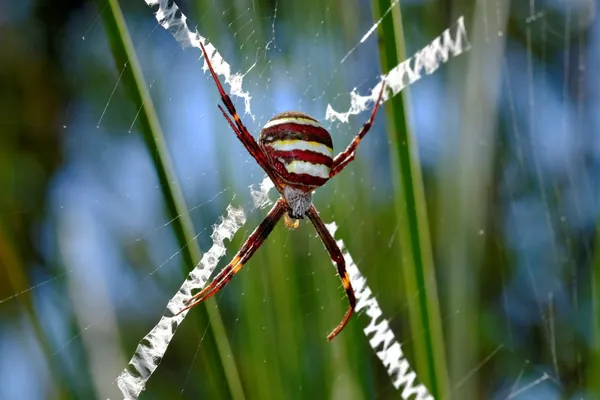
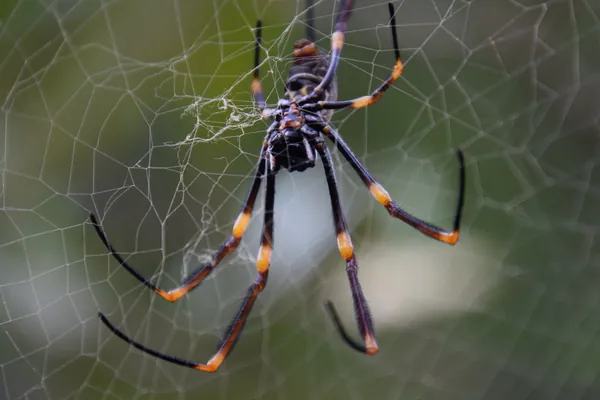
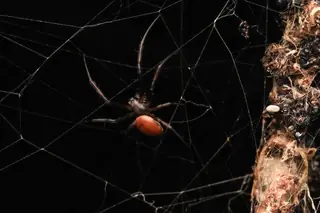
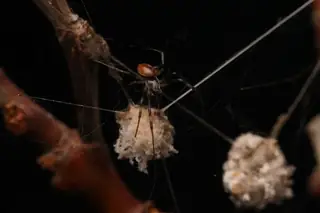
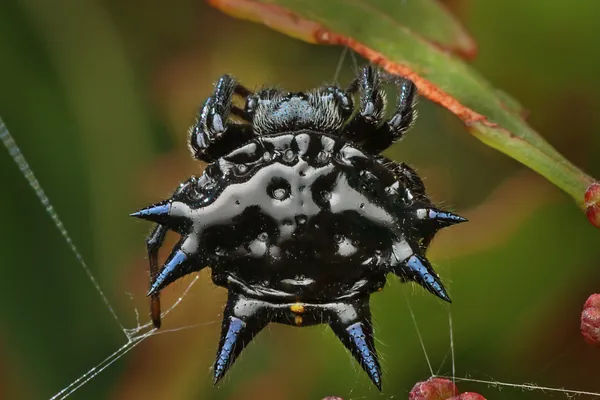
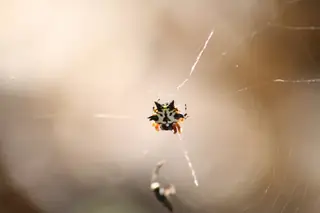
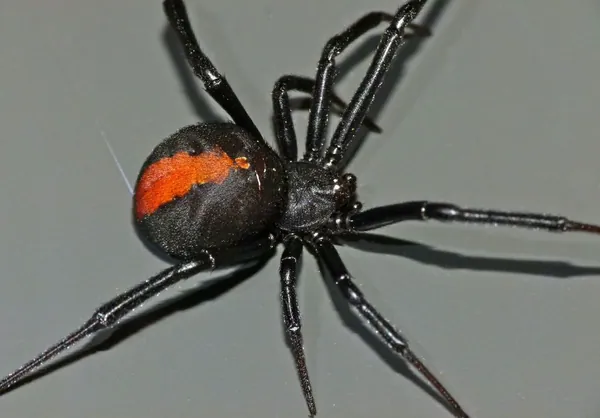
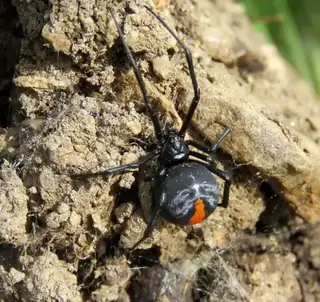
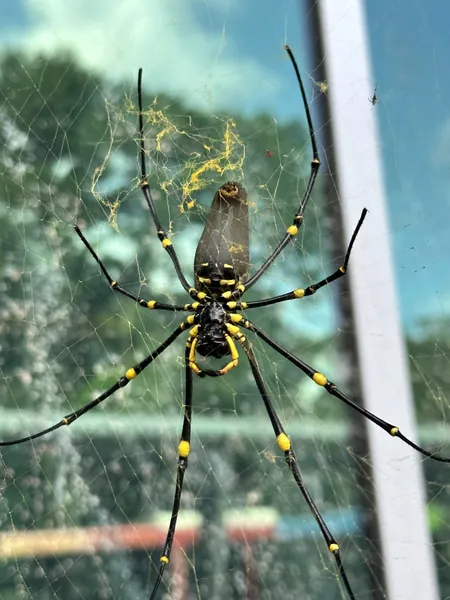
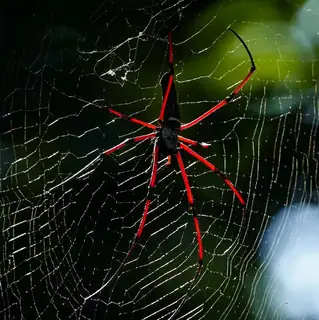
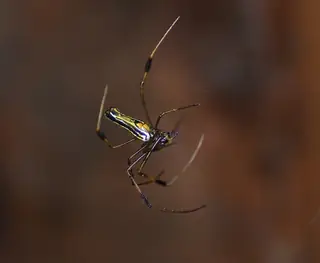
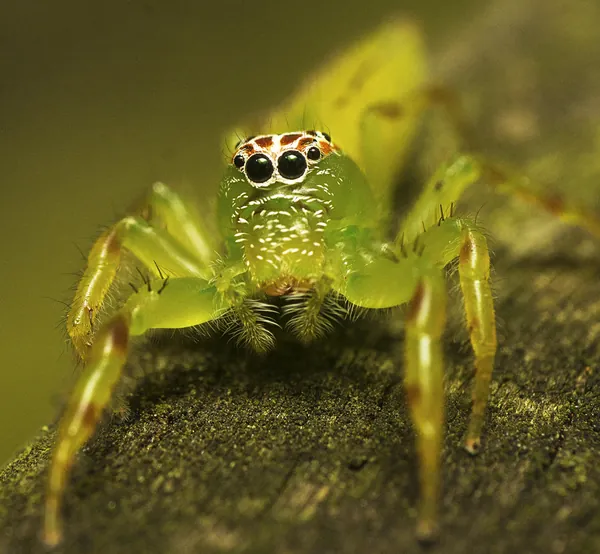
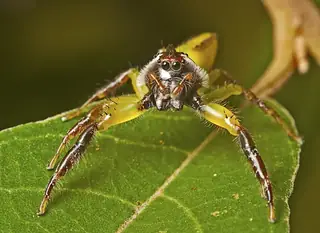
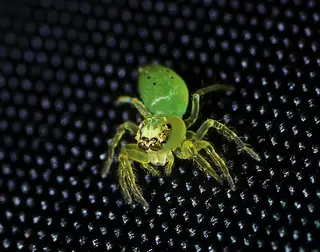
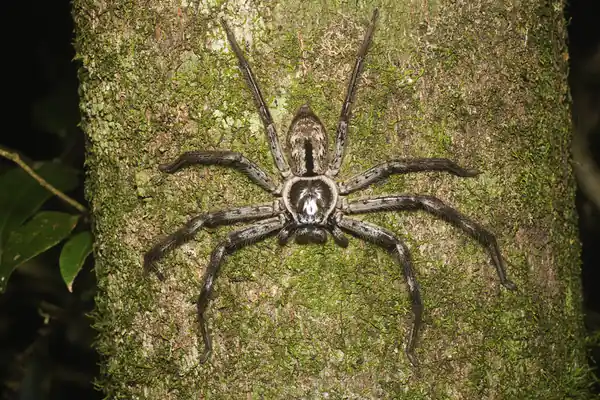
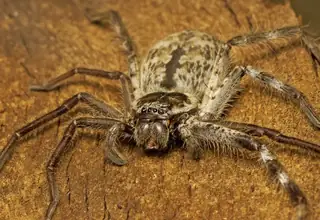
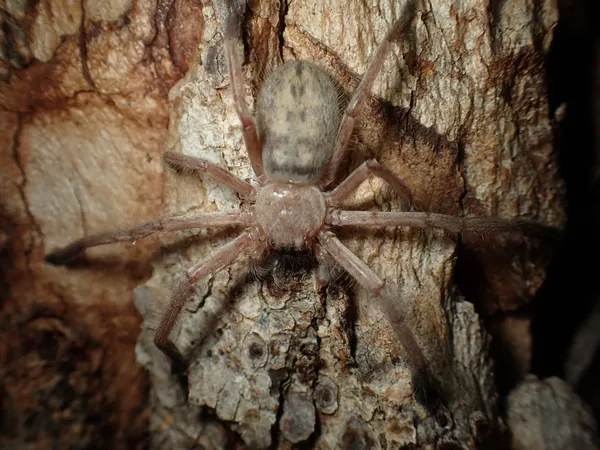
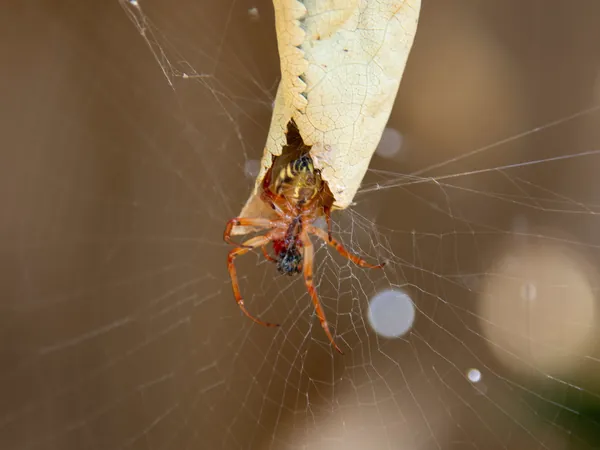
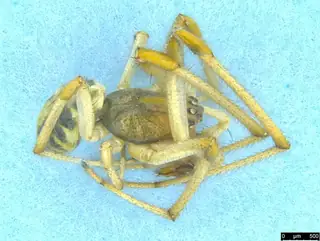
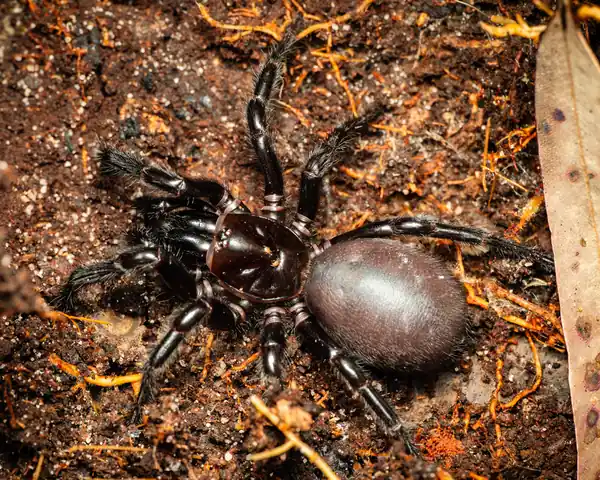
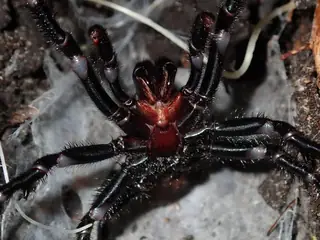
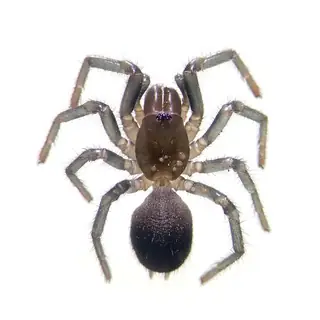
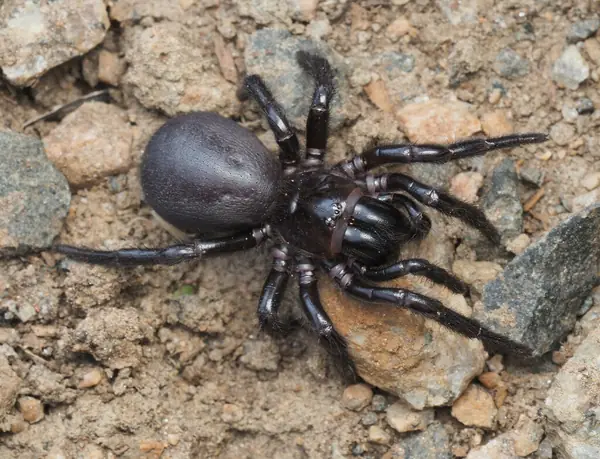
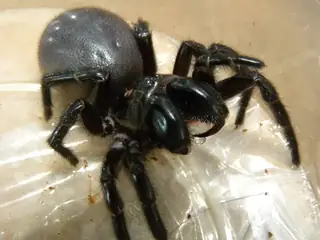
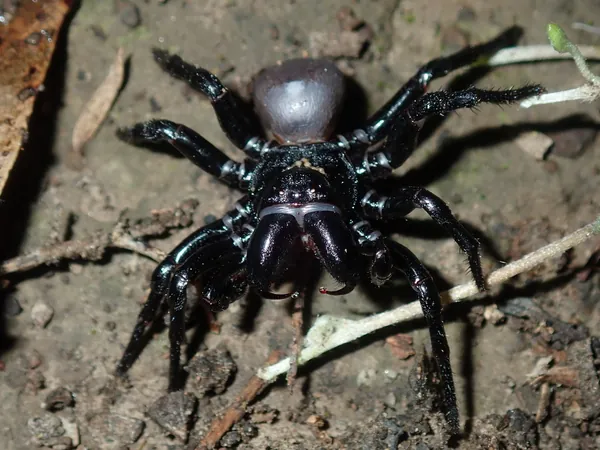
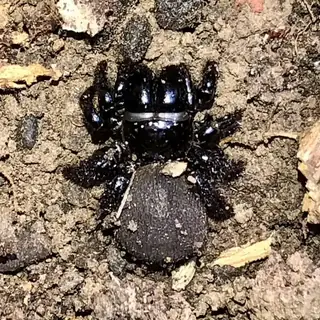
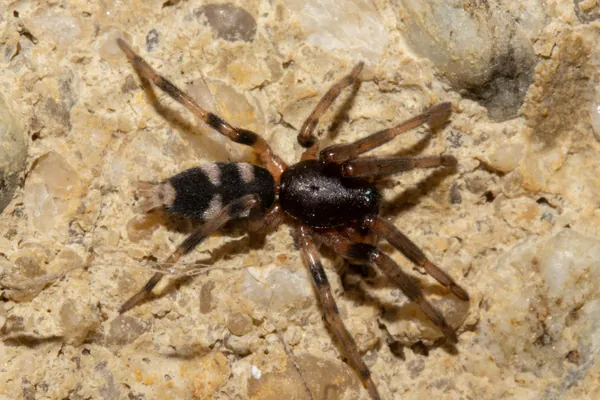
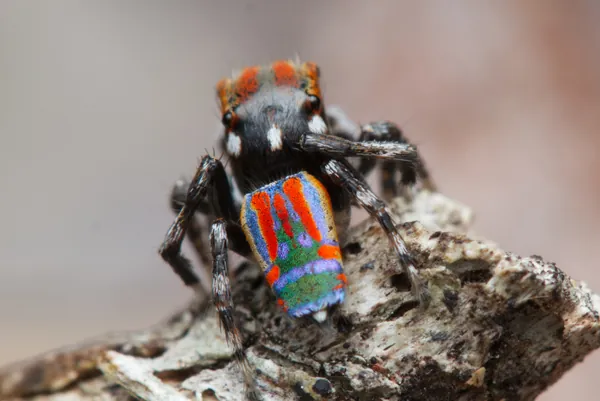
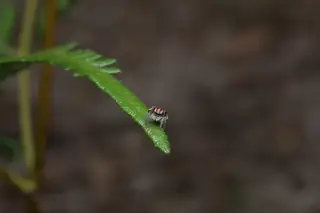
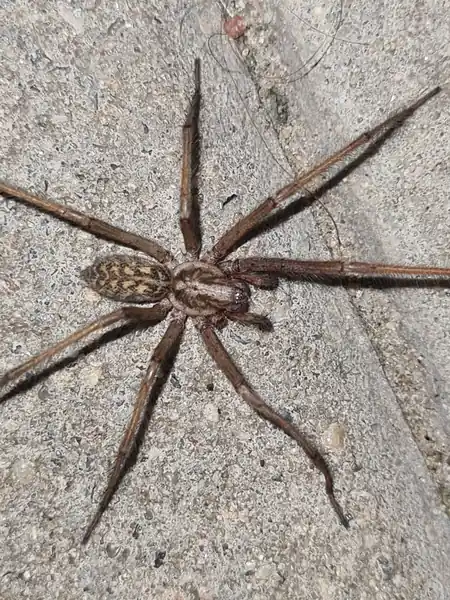
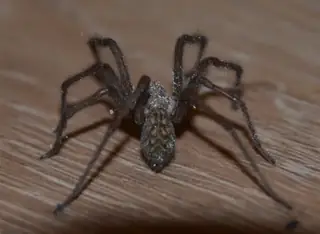
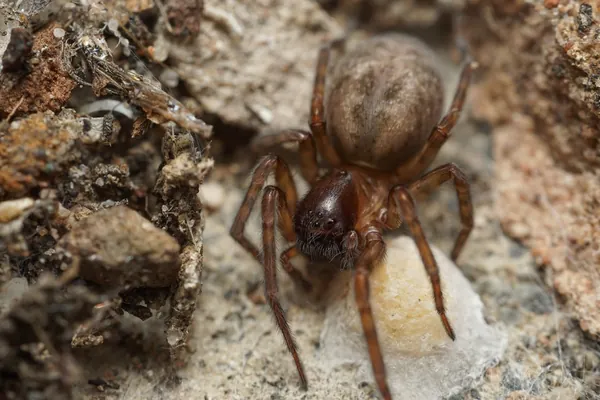
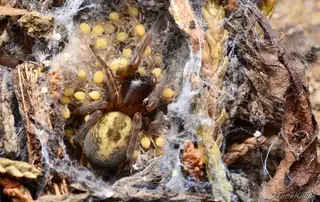
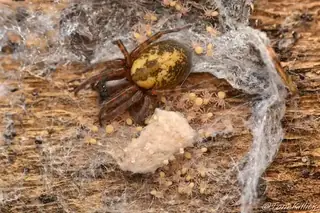
No spiders match all of these filters. Remove one to see more.
Spider identification chart
A quick comparison of every spider on this page. Size is adult body length without legs.
| Spider | Size | Colors | Danger | Where in the US | Key mark |
|---|---|---|---|---|---|
| Bold jumping spider Phidippus audax | 6–13 mm | Black, White, Hairy | Harmless | Nationwide | Chunky, hairy black body |
| Yellow garden spider Argiope aurantia | 5–28 mm | Black, Yellow, Striped | Harmless | Nationwide | Large oval abdomen with yellow and black pattern |
| Tan jumping spider Platycryptus undatus | 6–14 mm | Tan, Gray, Brown, Hairy | Harmless | Northeast, Southeast, Midwest, Southwest | Flattened, mottled tan-gray body |
| Spotted orbweaver Neoscona crucifera | 6–20 mm | Brown, Gray, Orange, Spotted | Harmless | Northeast, Southeast, Midwest, Southwest | Plump abdomen with pale marks and black spots |
| Orchard orbweaver Leucauge venusta | 4–8 mm | Green, Silver, Yellow, Orange | Harmless | Northeast, Southeast, Midwest, Southwest | Shiny silvery abdomen with dark stripes |
| American nursery web spider Pisaurina mira | 9–18 mm | Brown, Tan, Striped | Harmless | Northeast, Southeast, Midwest, Southwest | Long, slender legs held forward in resting pose |
| European garden spider Araneus diadematus | 6–18 mm | Brown, Orange, White, Banded legs | Harmless | Northeast, Midwest, Pacific Northwest, West | White spots arranged in a cross on abdomen |
| Spinybacked orbweaver Gasteracantha cancriformis | 2–13 mm | White, Yellow, Red, Black, Spotted | Harmless | Southeast, Southwest | Hard crab-shaped shell with six spines |
| Dark fishing spider Dolomedes tenebrosus | 12–26 mm | Brown, Gray, Banded legs, Hairy | Harmless | Northeast, Southeast, Midwest, Southwest | Large, heavy body with long banded legs |
| Golden silk orbweaver Trichonephila clavipes | 4–30 mm | Yellow, Brown, Gold, Banded legs | Harmless | Southeast, Southwest | Long, narrow, torpedo-shaped abdomen |
| Green lynx spider Peucetia viridans | 10–22 mm | Green, Orange, Hairy | Harmless | Southeast, Southwest, West | Bright translucent green body |
| Zebra jumping spider Salticus scenicus | 5–8 mm | Black, White, Striped | Harmless | Nationwide | Small flat body with black and white bands |
| Banded garden spider Argiope trifasciata | 4–25 mm | Silver, Yellow, Striped, Banded legs | Harmless | Nationwide | Narrow dark crosswise bands on pale abdomen |
| Western black widow Latrodectus hesperus | 3–16 mm | Black, Red | Medically significant | West, Southwest, Pacific Northwest | Glossy jet-black round abdomen |
| Rabid wolf spider Rabidosa rabida | 12–22 mm | Brown, Tan, Striped, Hairy | Harmless | Northeast, Southeast, Midwest, Southwest | Pale stripe down the center of the carapace |
| Triangulate cobweb spider Steatoda triangulosa | 3–7 mm | Tan, Brown, White, Banded legs | Harmless | Nationwide | Row of pale triangles on the back |
| Twin-flagged jumping spider Anasaitis canosus | 3–5 mm | Black, White, Gray | Harmless | Southeast | Tiny black body with white bands |
| Noble false widow Steatoda nobilis | 7–14 mm | Brown, Black, White | Mild bite | West | Pale marks on front of abdomen, often skull-like |
| Spined micrathena Micrathena gracilis | 3–10 mm | White, Brown, Black, Spotted | Harmless | Northeast, Southeast, Midwest, Southwest | Hard shell abdomen with ten spines |
| Marbled orbweaver Araneus marmoreus | 5–14 mm | Orange, Yellow, White, Banded legs | Harmless | Northeast, Midwest, Southeast, Pacific Northwest | Round bright orange or yellow abdomen |
| Brown widow Latrodectus geometricus | 4–13 mm | Brown, Tan, Gray, Orange | Medically significant | Southeast, Southwest, West, Hawaii | Orange hourglass underneath |
| Woodlouse spider Dysdera crocata | 9–15 mm | Red, Tan, Gray | Harmless | Nationwide | Orange-red head and legs |
| Joro spider Trichonephila clavata | 6–25 mm | Yellow, Black, Gray, Banded legs | Harmless | Southeast, Northeast | Yellow and black body with dark gray bands |
| Golden jumping spider Paraphidippus aurantius | 6–12 mm | Brown, Orange, Black, Hairy | Harmless | Northeast, Southeast, Midwest, Southwest | Hairy brown body with golden or orange hairs |
| Bronze jumping spider Eris militaris | 5–9 mm | Black, Brown, White, Metallic | Harmless | Northeast, Southeast, Midwest, Southwest | Bronze iridescent head area |
| Goldenrod crab spider Misumena vatia | 2.5–11 mm | White, Yellow, Gray | Harmless | Nationwide | Crab-like sideways stance with front two leg pairs held wide |
| Magnolia green jumping spider Lyssomanes viridis | 4–8 mm | Green, White, Tan | Harmless | Southeast | Pale translucent green body and legs |
| Eastern parson spider Herpyllus ecclesiasticus | 6–10 mm | Black, Gray, White, Brown | Harmless | Northeast, Southeast, Midwest | White chevron or band across the middle of the abdomen |
| Furrow orbweaver Larinioides cornutus | 5–14 mm | Brown, Gray, Tan, White | Harmless | Nationwide | Leaf-like pattern with dark scalloped edges on abdomen |
| Six-spotted fishing spider Dolomedes triton | 9–17 mm | Brown, Gray, White, Banded legs, Spotted | Harmless | Nationwide | Pale white or cream stripe along each side of the body |
| Western spotted orbweaver Neoscona oaxacensis | 6–14 mm | Brown, Tan, Gray, White, Spotted | Harmless | Southwest, West, Southeast | Sharp, white-edged dark spots on the abdomen |
| Arrowhead orbweaver Verrucosa arenata | 3–9 mm | White, Yellow, Brown, Red | Harmless | Southeast, Northeast, Midwest, Southwest | Triangular, arrowhead-shaped abdomen with a point at the back |
| Daddy longlegs spider Pholcus phalangioides | 5–10 mm | Tan, Gray, Brown | Harmless | Nationwide | Extremely long, thin legs |
| Gray wall jumping spider Menemerus bivittatus | 5–9 mm | Gray, White, Brown, Striped | Harmless | Southeast, Southwest, West, Hawaii | Flat, silvery-gray, striped body |
| White-banded crab spider Misumenoides formosipes | 3–12 mm | White, Yellow, Green, Brown | Harmless | Nationwide | Pale body with a white band across the front of the head |
| Johnson's jumping spider Phidippus johnsoni | 5–13 mm | Black, Red, Orange, White | Harmless | West, Pacific Northwest, Southwest | Bright red-orange back on adult males |
| White-banded fishing spider Dolomedes albineus | 9–18 mm | Brown, Gray, White, Banded legs | Harmless | Southeast | Wide white stripe along each side of the body |
| Silver garden orbweaver Argiope argentata | 3–15 mm | Silver, Yellow, Black, White | Harmless | Southwest, Southeast, West | Shiny silver cephalothorax |
| American green crab spider Misumessus oblongus | 3–8 mm | Green, White, Yellow | Harmless | Nationwide | Entirely bright green body and legs |
| Southern black widow Latrodectus mactans | 4–13 mm | Black, Red | Medically significant | Southeast, Midwest, Southwest, Northeast | Glossy jet black round abdomen |
| Arabesque orbweaver Neoscona arabesca | 4–10 mm | Gray, Brown, White, Banded legs | Harmless | Southeast, Northeast, Midwest, Southwest | Dark, scalloped folium pattern on the abdomen |
| Dimorphic jumping spider Maevia inclemens | 4–8 mm | Black, White, Gray, Striped | Harmless | Northeast, Southeast, Midwest, Southwest | Males: black with white head tufts and striped legs |
| False black widow Steatoda grossa | 4–10 mm | Black, Brown, Gray | Mild bite | Nationwide | Glossy dark brown to black round abdomen |
| Putnam's jumping spider Phidippus putnami | 4–10 mm | Black, Orange, White, Hairy | Harmless | Northeast, Midwest, Southeast | Dark body with white hair on the sides |
| Flea jumping spider Naphrys pulex | 2.5–5 mm | Black, Gray, White, Striped | Harmless | Nationwide | Very small, flea-sized flat body |
| Brilliant jumping spider Phidippus clarus | 5–13 mm | Red, Orange, Black, Hairy | Harmless | Northeast, Southeast, Midwest | Males: bright red-orange abdomen |
| Texas brown tarantula Aphonopelma hentzi | 25–50 mm | Brown, Tan, Hairy, Black | Mild bite | Southwest, Midwest, Southeast | Large, hairy brown body |
| Brown recluse Loxosceles reclusa | 6–12 mm | Brown, Tan, Gray | Medically significant | Midwest, Southeast, Southwest | Dark violin shape on the front body, neck pointing back |
| White-jawed jumping spider Hentzia mitrata | 3–7 mm | Gray, White, Brown, Striped | Harmless | Northeast, Southeast, Midwest, Southwest | Males: bright white jaws |
| Six-spotted orbweaver Araniella displicata | 3–8 mm | Green, White, Yellow, Spotted | Harmless | Northeast, Midwest, Pacific Northwest, West | Pale green abdomen with a light central stripe |
| Koch's wolf spider Alopecosa kochi | 7–12 mm | Brown, Tan, Hairy, Striped | Harmless | Northeast, Midwest, West, Pacific Northwest | Pale median stripe on the carapace |
| Striped fishing spider Dolomedes scriptus | 10–20 mm | Brown, Gray, Striped, Banded legs | Harmless | Northeast, Southeast, Midwest | Pale lateral stripes on carapace and abdomen |
| Striped lynx spider Oxyopes salticus | 5–8 mm | Tan, Brown, Striped, Hairy | Harmless | Southeast, Midwest, Southwest, West, Northeast | Long spiny legs with dark spots |
| Arrow-shaped micrathena Micrathena sagittata | 6–9 mm | Yellow, Red, Black | Harmless | Northeast, Southeast, Midwest | Flat triangular abdomen like an arrowhead |
| Western lynx spider Oxyopes scalaris | 5–10 mm | Tan, Gray, Striped, Hairy | Harmless | West, Pacific Northwest, Southwest | Long spiny legs with dark spots |
| Common Hentz jumping spider Hentzia palmarum | 4–7 mm | Gray, Brown, Striped, Hairy | Harmless | Southeast, Northeast, Midwest, Southwest | Slim, tapered gray-brown body |
| Peppered jumping spider Pelegrina galathea | 4–7 mm | Gray, Brown, White, Hairy | Harmless | Northeast, Southeast, Midwest, Southwest, West | Peppery mottled gray-brown coloring |
| Grayish jumping spider Phidippus princeps | 8–14 mm | Gray, Black, White, Hairy | Harmless | Northeast, Southeast, Midwest, Southwest | Stocky, hairy gray-black body |
| Sylvan jumping spider Colonus sylvanus | 5–9 mm | Brown, Gray, Hairy, Striped | Harmless | Southeast, Northeast, Midwest | Flat, mottled gray-brown body |
| Red-femured spotted orbweaver Neoscona domiciliorum | 7–14 mm | Brown, Gray, Red, Spotted | Harmless | Southeast, Northeast, Midwest | Reddish-orange thigh segments on legs |
| Asiatic wall jumping spider Attulus fasciger | 3–5 mm | Brown, Gray, Striped | Harmless | Northeast, Southeast, Midwest, Pacific Northwest | Very small brown jumping spider |
| Tropical orbweaver Eriophora ravilla | 10–22 mm | Brown, Gray, Tan | Harmless | Southeast, Southwest | Bumpy shoulders on a stout abdomen |
| Half-edged wall jumping spider Menemerus semilimbatus | 5–9 mm | Gray, Black, White, Striped | Harmless | Southeast, Southwest | Flat, gray-black body with pale edging |
| Buttonhook leafbeetle jumping spider Sassacus vitis | 3–5 mm | Brown, Orange, Metallic, Spotted | Harmless | Southeast, Northeast, Midwest, Southwest | Beetle-like shiny, rounded body |
| Giant house spider Eratigena duellica | 9–18 mm | Brown, Tan, Hairy, Striped | Harmless | Pacific Northwest, Northeast, West | Long, hairy brown legs |
| Basilica orbweaver Mecynogea lemniscata | 7–12 mm | Brown, White, Tan | Harmless | Southeast, Southwest | Hunched, knobby abdomen |
| Banded fishing spider Dolomedes vittatus | 8–16 mm | Brown, Tan, Striped, Banded legs | Harmless | Southeast, Northeast | Pale lateral stripes |
| Marbled cellar spider Holocnemus pluchei | 5–8 mm | Tan, Brown, Gray, Banded legs | Harmless | West, Southwest, Southeast | Very long thin legs |
| Bowl-and-doily spider Frontinella pyramitela | 3–5 mm | Black, Brown, White, Orange | Harmless | Northeast, Southeast, Midwest, Southwest | Tiny, with tan-and-black body |
| Pantropical jumping spider Plexippus paykulli | 8–12 mm | Brown, Tan, White, Striped | Harmless | Southeast, Southwest, Hawaii | Striped carapace with pale border |
| Black house spider Badumna insignis | 10–18 mm | Black, Brown, Gray | Mild bite | Not in the US | Dark, chunky body |
| Southern house spider Kukulcania hibernalis | 8–15 mm | Brown, Black, Gray, Hairy | Harmless | Southeast, Southwest, West | Fuzzy, dark brown-black body |
| Northern black widow Latrodectus variolus | 8–13 mm | Black, Red, Spotted | Medically significant | Northeast, Southeast, Midwest | Shiny black, round abdomen |
| White micrathena Micrathena mitrata | 5–9 mm | White, Black, Spotted | Harmless | Southeast, Northeast, Midwest | White hard-looking abdomen with black dots |
| Desert blonde tarantula Aphonopelma chalcodes | 35–55 mm | Tan, Brown, Hairy, Gold | Mild bite | Southwest | Blonde to tan carapace and legs |
| Shoreline wolf spider Arctosa littoralis | 8–16 mm | Tan, Gray, Brown, Hairy | Harmless | Northeast, Southeast, Midwest | Sandy tan-gray color |
| Filmy dome spider Neriene radiata | 4–6 mm | Brown, White, Tan | Harmless | Northeast, Southeast, Midwest | Builds a domed sheet web with a flat sheet beneath |
| Giant lichen orbweaver Araneus bicentenarius | 10–20 mm | Brown, Gray, Hairy, Banded legs | Harmless | Northeast, Southeast, Midwest | Large rounded abdomen with two bumps near the front |
| Canopy jumping spider Phidippus otiosus | 8–15 mm | Black, White, Hairy, Gray | Harmless | Southeast | Stocky, fuzzy black body |
| Mediterranean recluse Loxosceles rufescens | 6–10 mm | Tan, Brown | Medically significant | Northeast, Southeast, Southwest | Violin-shaped mark on the front of the body |
| Desert tarantula Aphonopelma iodius | 30–40 mm | Brown, Black, Hairy | Mild bite | Southwest, West | Very large and hairy with thick legs |
| Bridge orbweaver Larinioides sclopetarius | 7–14 mm | Gray, Brown, White | Harmless | Northeast, Midwest, Pacific Northwest | Gray-brown abdomen with a pale central band |
| Giant crab spider Olios giganteus | 15–25 mm | Tan, Brown, Banded legs, Hairy | Mild bite | Southwest | Very long legs held out crab-like to the side |
| Hawaiian garden spider Argiope appensa | 10–25 mm | Yellow, Black, Silver, Striped | Harmless | Hawaii | Bright yellow and black banded abdomen |
| South American toothed hacklemesh weaver Metaltella simoni | 5–10 mm | Brown, Tan, Gray | Harmless | West | Plain brown, medium-sized body |
| Ribbon jumping spider Metacyrba taeniola | 4–7 mm | Black, Brown, White | Harmless | Southeast | Flat, dark body with white edge stripes |
| Common house spider Parasteatoda tepidariorum | 4–8 mm | Brown, Tan, Gray | Harmless | Nationwide | Round, bulbous abdomen with mottled markings |
| Northern crab spider Mecaphesa asperata | 3–8 mm | White, Yellow, Tan, Spotted | Harmless | Nationwide | Crab-like body with front legs held out |
| Broad-faced sac spider Trachelas tranquillus | 4–7 mm | Brown, Tan, Orange | Harmless | Northeast, Southeast, Midwest | Dark reddish-brown front part with a lighter abdomen |
| California flattened jumping spider Platycryptus californicus | 7–14 mm | Gray, Brown, Black, Hairy | Harmless | West, Southwest, Southeast | Flat wide body held close to surfaces |
| Humped trashline orbweaver Cyclosa turbinata | 4–7 mm | Brown, Gray, Tan | Harmless | Southeast, Northeast, Midwest | Cone-shaped hump on the back of the abdomen |
| Shamrock orbweaver Araneus trifolium | 9–20 mm | White, Gray, Tan, Brown | Harmless | Northeast, Southeast, Midwest | Large rounded abdomen |
| Yellow sac spider Cheiracanthium inclusum | 5–10 mm | Tan, Yellow, Brown | Mild bite | Southeast, Southwest, Midwest, Northeast, West | Pale yellow or cream body |
| Tuft-legged orbweaver Mangora placida | 3–5 mm | Tan, Brown, White | Harmless | Northeast, Southeast, Midwest | Slim pale body with dark side lines |
| Barn funnel weaver Tegenaria domestica | 6–11 mm | Brown, Tan, Gray | Harmless | Northeast, Midwest, West, Pacific Northwest | Brown body with chevron pattern |
| Apache jumping spider Phidippus apacheanus | 6–13 mm | Black, Red, Orange, Hairy | Harmless | Southwest, West | Orange-red abdomen with black center stripe |
| Whitman's jumping spider Phidippus whitmani | 6–12 mm | Black, White, Orange, Hairy | Harmless | Northeast, Midwest, West | Black fuzzy body |
| Grey house spider Badumna longinqua | 6–11 mm | Gray, Brown, Banded legs | Mild bite | West | Gray-brown body with pale mottled pattern |
| Regal jumping spider Phidippus regius | 8–18 mm | Black, White, Orange, Hairy | Harmless | Southeast | Large and bulky for a jumping spider |
| Dotted wolf spider Rabidosa punctulata | 10–20 mm | Brown, Tan, Gray, Striped | Harmless | Northeast, Southeast, Midwest, Southwest | Pale cream band down the middle |
| Heptagonal orbweaver Gea heptagon | 3–7 mm | Brown, Tan, White, Spotted | Harmless | Southeast, Southwest | Seven-sided or polygonal shape of the abdomen |
| Drumming sword wolf spider Gladicosa gulosa | 10–16 mm | Brown, Tan, Striped | Harmless | Northeast, Southeast, Midwest | Brown body with pale stripe |
| Black-banded crab spider Synema parvulum | 3–6 mm | Black, Orange, White, Yellow | Harmless | Nationwide | Black abdomen with orange or red markings |
| California turret spider Atypoides riversi | 10–20 mm | Brown, Black, Hairy | Harmless | West | Large, shiny, dome-shaped carapace with a deep front-heavy look |
| Candy-striped spider Enoplognatha ovata | 4–6 mm | White, Yellow, Red, Spotted, Striped | Harmless | Northeast, Pacific Northwest, West | Globular, shiny abdomen in cream, yellow or white |
| Cane spider Heteropoda venatoria | 12–20 mm | Brown, Tan, Gray, Hairy, Banded legs | Mild bite | Southeast, Hawaii, Southwest | Large, flat body with long legs held crab-like |
| Butterfly orbweaver Araneus pegnia | 5–8 mm | Yellow, White, Brown, Spotted | Harmless | Northeast, Southeast, Midwest | Butterfly-shaped dark outline on a pale back |
| Conical trashline orbweaver Cyclosa conica | 4–7 mm | Brown, Gray, White | Harmless | Nationwide | Abdomen tapers to a pointed, conical hump at the rear |
| Black lace weaver Amaurobius ferox | 8–15 mm | Black, Brown | Harmless | Northeast, Pacific Northwest, West | Dark, glossy brown-black body |
| Lined orbweaver Mangora gibberosa | 3–6 mm | White, Tan, Striped | Harmless | Northeast, Southeast, Midwest, Southwest | Pale cream body with thin dark lengthwise stripes |
| Carolina wolf spider Hogna carolinensis | 18–35 mm | Brown, Gray, Hairy, Striped | Mild bite | Southeast, Midwest, Northeast, Southwest | Large, hairy, robust body, the biggest US wolf spider |
| Black-tailed red sheetweaver Florinda coccinea | 2–4 mm | Red, Black | Harmless | Southeast, Northeast, Midwest | Bright orange-red carapace and legs |
| Labyrinth orbweaver Metepeira labyrinthea | 4–8 mm | Brown, Gray, Tan | Harmless | Northeast, Midwest, Southeast | Brown mottled body with a darker central stripe |
| Nordmann's orbweaver Araneus nordmanni | 6–12 mm | Brown, Tan, White | Harmless | Pacific Northwest, Northeast | Leaf-like pale folium on the back |
| Boreal combfoot Steatoda borealis | 4–8 mm | Black, Brown, Red | Harmless | Northeast, Midwest, West, Pacific Northwest | Round, glossy dark abdomen |
| Chilean recluse Loxosceles laeta | 8–15 mm | Tan, Brown | Medically significant | West, Southwest | Violin-shaped mark on the head |
| Desert recluse Loxosceles deserta | 6–12 mm | Tan, Brown | Medically significant | Southwest, West | Dark violin mark on the head region |
| Red widow Latrodectus bishopi | 8–13 mm | Black, Red, Orange, Brown | Medically significant | Southeast | Orange-red head and legs |
| European nursery web spider Pisaura mirabilis | 10–15 mm | Brown, Tan, Striped | Harmless | Not in the US | Long slender legs held out front |
| Walnut orbweaver Nuctenea umbratica | 10–14 mm | Brown, Gray, Tan | Harmless | Not in the US | Very flat, wide body that hides in cracks |
| Wasp spider Argiope bruennichi | 5–18 mm | Yellow, Black, Striped | Harmless | Not in the US | Bold yellow and black stripes across the abdomen |
| Four-spot orbweaver Araneus quadratus | 10–20 mm | Green, Brown, Yellow, Spotted | Harmless | Not in the US | Four pale spots in a square on the abdomen |
| Labyrinth spider Agelena labyrinthica | 8–14 mm | Brown, Tan, Striped | Harmless | Not in the US | Two dark stripes down the carapace |
| Silver-sided sector spider Zygiella x-notata | 4–8 mm | Silver, Brown, Tan | Harmless | Not in the US | Orb web with a clear wedge-shaped gap |
| Green meshweaver Nigma walckenaeri | 3–5 mm | Green, Brown, Silver | Harmless | Not in the US | Bright green abdomen |
| Cricket-bat orbweaver Mangora acalypha | 3–5 mm | White, Brown, Tan | Harmless | Not in the US | Pale cream abdomen |
| Green crab spider Diaea dorsata | 4–6 mm | Green, Brown, Yellow | Harmless | Not in the US | Green body with a brown patch on the back |
| Tube-dwelling spider Segestria florentina | 10–22 mm | Black, Green, Metallic, Gray | Mild bite | Not in the US | Metallic green fangs |
| Rabbit hutch spider Steatoda bipunctata | 3–8 mm | Brown, Black, Tan | Harmless | Northeast, Pacific Northwest | Round, shiny brown abdomen |
| Fencepost jumping spider Marpissa muscosa | 5–10 mm | Gray, Brown, White, Hairy | Harmless | Not in the US | Flat, gray-brown body |
| White banded house jumper Maratus griseus | 2–5 mm | Gray, White, Brown, Striped | Harmless | Not in the US | White band across the abdomen |
| St Andrew's cross spider Argiope keyserlingi | 4–15 mm | Silver, Yellow, Black, White, Banded legs | Harmless | Not in the US | Legs held together in pairs to form an X shape |
| Tiger orbweaver Trichonephila plumipes | 7–25 mm | Brown, Gray, Yellow, Silver, Banded legs | Harmless | Not in the US | Long narrow body with silvery or yellowish spots |
| Australian golden orb weaver Trichonephila edulis | 7–30 mm | Brown, Gray, Silver, Yellow, Banded legs | Harmless | Not in the US | Very long, cylindrical, often gray or tan abdomen |
| Christmas jewel spider Austracantha minax | 5–10 mm | Black, White, Yellow, Orange, Red | Harmless | Not in the US | Hard wide abdomen with six spines around edge |
| Redback spider Latrodectus hasselti | 3–15 mm | Black, Red, Striped | Medically significant | Not in the US | Round glossy black abdomen of the female |
| Giant golden orb weaver Nephila pilipes | 18–40 mm | Black, Yellow, Brown, Gold, Banded legs | Harmless | Not in the US | Very large female with long slim body |
| Green jumping spider Mopsus mormon | 8–15 mm | Green, White, Orange, Hairy | Harmless | Not in the US | Bright green body and legs |
| Grey huntsman spider Holconia immanis | 20–30 mm | Gray, Brown, Hairy, Banded legs | Mild bite | Not in the US | Very large, flat, crab-like body with leg span of 15 cm |
| Social huntsman spider Delena cancerides | 10–20 mm | Brown, Gray, Tan, Hairy | Mild bite | Not in the US | Flat, wide, crab-like body |
| Leaf-curling spider Phonognatha graeffei | 5–10 mm | Brown, White, Tan | Harmless | Not in the US | White-edged abdomen with pale center |
| Sydney funnel-web spider Atrax robustus | 10–35 mm | Black, Brown, Hairy | Medically significant | Not in the US | Shiny black head and thorax with no pattern |
| Funnel-web spider Hadronyche | 10–40 mm | Black, Brown, Hairy | Medically significant | Not in the US | Shiny, hairless-looking carapace |
| Mouse spider Missulena | 10–35 mm | Black, Brown, Red | Medically significant | Not in the US | Bulbous head with wide jaws |
| White-tailed spider Lampona cylindrata | 10–18 mm | Gray, Black, Brown | Mild bite | Not in the US | Small white spot at the tip of the abdomen |
| Flying peacock spider Maratus volans | 2–5 mm | Black, Red, Orange, White | Harmless | Not in the US | Males display a colorful fan on the back |
| Giant house spider Eratigena atrica | 10–18 mm | Brown, Tan, Hairy | Harmless | Pacific Northwest, Northeast | Long hairy legs |
| Lace-weaver spider Amaurobius similis | 8–14 mm | Brown, Tan, Striped | Harmless | Northeast, Pacific Northwest | Brown body with dark and pale marks |
Photo credits
All reference photos come from research-grade observations on iNaturalist and are used under Creative Commons licenses that allow commercial use (CC0, CC BY, CC BY-SA). Photos were resized and converted to WebP. Click a credit to see the original. Licenses: CC0, CC BY 4.0, CC BY-SA 4.0.
- Phidippus audax: Zygy CC0; Justin Williams CC BY 4.0; Rebecca Ray CC BY 4.0
- Argiope aurantia: Michael J. Papay CC BY 4.0; Joshua Zupan CC0; M. Whitson CC BY 4.0
- Platycryptus undatus: Alexis Tinker-Tsavalas CC BY 4.0; Timothy Lindsey CC BY 4.0; Mirko Schoenitz CC0
- Neoscona crucifera: Justin Williams CC BY 4.0; dhasdf CC BY 4.0; Nick Chirico CC BY 4.0
- Leucauge venusta: Katja Schulz CC BY 4.0; Corey Farwell CC BY 4.0; Healthy Yards CC BY 4.0
- Pisaurina mira: Meghan Cassidy CC BY-SA 4.0; Timothy Lindsey CC BY 4.0; Timothy Lindsey CC BY 4.0
- Araneus diadematus: Gavin Slater CC BY 4.0; Tina Ellegaard Poulsen CC BY 4.0; Анатолий Озерной /Anatoly Ozernoy CC BY-SA 4.0
- Gasteracantha cancriformis: Judy Gallagher CC BY-SA 4.0; Judy Gallagher CC BY-SA 4.0; Meghan Cassidy CC BY-SA 4.0
- Dolomedes tenebrosus: Meghan Cassidy CC BY-SA 4.0; Zachary Dankowicz CC BY 4.0; Katja Schulz CC BY 4.0
- Trichonephila clavipes: Reinaldo de Oliveira Elias CC BY 4.0; Arthur 🕷 Bitar 🐌 Marinho 🦈 Colares 🐛 CC0; Aleksey CC0
- Peucetia viridans: Cricket Raspet CC BY 4.0; Ken-ichi Ueda CC BY 4.0; Eridan Xharahi CC BY 4.0
- Salticus scenicus: Mardon Erbland CC0; Gavin Slater CC BY 4.0; eebee CC BY 4.0
- Argiope trifasciata: Katja Schulz CC BY 4.0; Nick Chirico CC BY 4.0; Rachel Godfrey CC0
- Latrodectus hesperus: Andrew Meeds CC BY 4.0; Michael Eisen CC BY 4.0; Rebecca Ray CC BY 4.0
- Rabidosa rabida: Mirko Schoenitz CC0; Timothy Lindsey CC BY 4.0; Meghan Cassidy CC BY-SA 4.0
- Steatoda triangulosa: Patrick Hacker CC BY 4.0; Alexis Tinker-Tsavalas CC BY 4.0; Eduardo Luis Beltrocco CC BY 4.0
- Anasaitis canosus: Meghan Cassidy CC BY-SA 4.0; Ethan CC BY 4.0; River Ahlquist CC BY 4.0
- Steatoda nobilis: Dustin Edmundson CC BY 4.0; Julia Palmer CC BY 4.0; Calamites297 CC BY 4.0
- Micrathena gracilis: Ken Clark CC BY 4.0; Katja Schulz CC BY 4.0; ssunflowered CC0
- Araneus marmoreus: christine123 CC BY 4.0; Bill Keim CC BY 4.0; Nick Tobler (Cowturtle) CC BY 4.0
- Latrodectus geometricus: Rudolph Steenkamp CC BY-SA 4.0; Rubens Miranda CC BY-SA 4.0; Eli CC BY 4.0
- Dysdera crocata: Tone Killick CC BY 4.0; Tone Killick CC BY 4.0; Ken-ichi Ueda CC BY 4.0
- Trichonephila clavata: otiegoat CC BY 4.0; CScott CC BY 4.0; Samuele Papeschi CC BY 4.0
- Paraphidippus aurantius: Zygy CC0; Zygy CC0; Katja Schulz CC BY 4.0
- Eris militaris: Meghan Cassidy CC BY-SA 4.0; Michael CC BY 4.0; Ryan Hodnett CC BY-SA 4.0
- Misumena vatia: christine123 CC BY 4.0; Jesse Rorabaugh CC0; Анатолий Озерной /Anatoly Ozernoy CC BY-SA 4.0
- Lyssomanes viridis: Zachary Dankowicz CC BY 4.0; skitterbug CC BY 4.0; Mike Mulqueen CC0
- Herpyllus ecclesiasticus: Christian Back CC BY 4.0; Christian Back CC BY 4.0; jabauhs CC BY 4.0
- Larinioides cornutus: Jesse Rorabaugh CC0; Nick Chirico CC BY 4.0; Nick Chirico CC BY 4.0
- Dolomedes triton: Michael J. Papay CC BY 4.0; Michael J. Papay CC BY 4.0; Michael J. Papay CC BY 4.0
- Neoscona oaxacensis: Alexis Luna Padilla CC0; MarvalPhotography19 CC BY 4.0; Rebecca Ray CC BY 4.0
- Verrucosa arenata: Judy Gallagher CC BY-SA 4.0; Katja Schulz CC BY 4.0; Zachary Dankowicz CC BY 4.0
- Pholcus phalangioides: Rupert Lees CC BY 4.0; Sam Droege CC0; Gavin Slater CC BY 4.0
- Menemerus bivittatus: Alexandre S. Michelotto CC BY-SA 4.0; Luan Mazzeo CC BY 4.0; The Great Walter CC BY 4.0
- Misumenoides formosipes: Gordon C. Snelling CC BY 4.0; Anna Hess CC BY 4.0; Adrienne van den Beemt CC BY 4.0
- Phidippus johnsoni: Thompson Hyggen CC0; Jan Smith CC BY 4.0; Alex CC BY 4.0
- Dolomedes albineus: Clifton Ladd, C.W.B. CC BY 4.0; Brady Reed CC0; Elias CC BY 4.0
- Argiope argentata: Manuel Vicente Miranda del Solar CC BY 4.0; Giovanni Ribeiro Salvador CC BY 4.0; Eridan Xharahi CC BY 4.0
- Misumessus oblongus: Timothy Lindsey CC BY 4.0; Katja Schulz CC BY 4.0; Alan Rockefeller CC BY 4.0
- Latrodectus mactans: Justin Quintanilla CC BY 4.0; Haydeé Salmones CC BY-SA 4.0; DiegoH CC BY 4.0
- Neoscona arabesca: Lucas Garriga CC0; Jimmy Dee CC BY-SA 4.0; Brooke J. CC BY 4.0
- Maevia inclemens: spidereyes CC0; Michael CC BY 4.0; Caitlin Domon CC0
- Steatoda grossa: Анатолий Озерной /Anatoly Ozernoy CC BY-SA 4.0; RAP CC BY 4.0; Tone Killick CC BY 4.0
- Phidippus putnami: Cat Kai CC BY 4.0; Morgan Hay CC BY 4.0; jamie bee CC BY 4.0
- Naphrys pulex: RL7836 CC BY 4.0; Katja Schulz CC BY 4.0; Nick Chirico CC BY 4.0
- Phidippus clarus: Judy Gallagher CC BY-SA 4.0; Dennis White CC0; Sam Droege CC0
- Aphonopelma hentzi: Sam Kieschnick CC BY 4.0; Ethan Wright-Magoon CC0; Chris Stahl CC BY 4.0
- Loxosceles reclusa: mayfly1963 CC BY 4.0; Cindy CC BY 4.0; Meghan Cassidy CC BY-SA 4.0
- Hentzia mitrata: skitterbug CC BY 4.0; Robert Roach CC BY 4.0; northerly CC BY 4.0
- Araniella displicata: Анатолий Озерной /Anatoly Ozernoy CC BY-SA 4.0; Judy Gallagher CC BY-SA 4.0; Crazycaracal 993 CC BY 4.0
- Alopecosa kochi: Ken-ichi Ueda CC BY 4.0; Dominic CC BY 4.0; Daniel S. CC BY 4.0
- Dolomedes scriptus: Brighton Lee CC0; Allison Zon CC BY 4.0; Mark Apgar CC BY 4.0
- Oxyopes salticus: cesar stastny CC BY 4.0; Justin Williams CC BY 4.0; Nathan May CC BY 4.0
- Micrathena sagittata: Curtis Meyers CC BY-SA 4.0; Nick Chirico CC BY 4.0; Alan Rockefeller CC BY 4.0
- Oxyopes scalaris: Claus Giloi CC BY 4.0; Thompson Hyggen CC0; Timothy Lindsey CC BY 4.0
- Hentzia palmarum: Heatherelle CC BY 4.0; Justin Williams CC BY 4.0; Sandra H Statner CC BY 4.0
- Pelegrina galathea: Derrick Wales CC BY 4.0; aarongunnar CC BY 4.0; Healthy Yards CC BY 4.0
- Phidippus princeps: Zygy CC0; Yann Kemper CC0; Will Linnard CC BY 4.0
- Colonus sylvanus: Zygy CC0; Mirko Schoenitz CC0; José Javier Barrios Flores CC BY 4.0
- Neoscona domiciliorum: Nick Chirico CC BY 4.0; Nick Chirico CC BY 4.0; Nick Chirico CC BY 4.0
- Attulus fasciger: Анатолий Озерной /Anatoly Ozernoy CC BY-SA 4.0; Nick Chirico CC BY 4.0; Allan Harris CC0
- Eriophora ravilla: Alberto Alcalá CC BY 4.0; Juan Cruzado Cortés CC BY-SA 4.0; Savita CC0
- Menemerus semilimbatus: Diego González Dopico CC BY 4.0; Ioannis Magouras CC BY 4.0; Federico Biguzzi CC0
- Sassacus vitis: jcowles CC BY 4.0; John Hibbard CC BY 4.0; Jesse Rorabaugh CC0
- Eratigena duellica: Charles Van Arsdall CC BY 4.0; Joseph Rojas CC BY 4.0; Jared Shorma CC BY 4.0
- Mecynogea lemniscata: Katja Schulz CC BY 4.0; Bill Keim CC BY 4.0; Meghan Cassidy CC BY-SA 4.0
- Dolomedes vittatus: Heather Pratt CC BY 4.0; Dominic CC BY 4.0; Natalie Waddell-Rutter CC BY 4.0
- Holocnemus pluchei: Zygy CC0; Asher P Higgins CC BY 4.0; Atalay Karakuş CC BY 4.0
- Frontinella pyramitela: Brendan O'Loughlin CC BY 4.0; Nick Chirico CC BY 4.0; Judy Gallagher CC BY-SA 4.0
- Plexippus paykulli: dhasdf CC BY 4.0; davidfdz_b82 CC BY 4.0; Navapol Komanasin CC BY 4.0
- Badumna insignis: evaladyman CC0; Joshua S. Martin CC0; Mike Bowie CC BY 4.0
- Kukulcania hibernalis: Bruno R. Giozza CC0; Tomás Carranza Perales CC BY 4.0; Tomás Carranza Perales CC BY 4.0
- Latrodectus variolus: Joseph McPhail CC BY 4.0; Turner Brockman CC BY-SA 4.0; Justin Williams CC BY 4.0
- Micrathena mitrata: Nick Chirico CC BY 4.0; Nick Chirico CC BY 4.0; Zachary Dankowicz CC BY 4.0
- Aphonopelma chalcodes: Eamon Corbett CC BY 4.0; Carlos A. Armenta CC BY-SA 4.0; Eliseo D Moreno CC BY-SA 4.0
- Arctosa littoralis: Even Dankowicz CC BY 4.0; Jade Fortnash CC0; Andrew Meeds CC BY 4.0
- Neriene radiata: Theo Rickert CC BY 4.0; Emanuele Santarelli CC BY-SA 4.0; Nick Chirico CC BY 4.0
- Araneus bicentenarius: Michelle W. (鍾偉瑋) CC BY 4.0; EJ Burns CC BY 4.0; Jimmy Dee CC BY-SA 4.0
- Phidippus otiosus: Sarah Abbate CC BY 4.0; Ben Smith CC BY 4.0; DiegoH CC BY 4.0
- Loxosceles rufescens: Samuele Papeschi CC BY 4.0; Atalay Karakuş CC BY 4.0; Dilrukshan Priyantha Wijesinghe CC BY 4.0
- Aphonopelma iodius: Anne Parsons CC0; Grant Chovil CC BY 4.0; Ken-ichi Ueda CC BY 4.0
- Larinioides sclopetarius: Rupert Lees CC BY 4.0; Johan Kjær Prehn CC BY 4.0; evangrimes CC BY 4.0
- Olios giganteus: Sam Kieschnick CC BY 4.0; Bob Miller CC BY 4.0; Tereka Lasso CC BY-SA 4.0
- Argiope appensa: Claus Giloi CC BY 4.0; Franz Anthony CC BY 4.0; Sockrosma CC BY 4.0
- Metaltella simoni: Justin Williams CC BY 4.0; Justin Williams CC BY 4.0; Michelle W. (鍾偉瑋) CC BY 4.0
- Metacyrba taeniola: Darin J McGuire CC BY 4.0; Alex Heyman CC0; Katja Schulz CC BY 4.0
- Parasteatoda tepidariorum: Rodrigo Paiva Lázaro CC BY 4.0; Fikret Arda Düzgünses CC BY 4.0; Nick Chirico CC BY 4.0
- Mecaphesa asperata: Ilona CC BY-SA 4.0; Betsy Lambert CC BY 4.0; Judy Gallagher CC BY-SA 4.0
- Trachelas tranquillus: Carrie Seltzer CC BY 4.0; Benjamin Burgunder CC BY 4.0; Timothy Lindsey CC BY 4.0
- Platycryptus californicus: B Staffan Lindgren CC BY 4.0; Hawk T. CC BY 4.0; Thompson Hyggen CC0
- Cyclosa turbinata: Louise Woodrich CC BY 4.0; a6475 CC BY-SA 4.0; Sam Kieschnick CC BY 4.0
- Araneus trifolium: Loïc Mathieu CC BY 4.0; Andrea Wallace CC BY 4.0; CatherineK CC BY-SA 4.0
- Cheiracanthium inclusum: Jean Martins CC BY 4.0; Evelyn Lazzaretti 🏳️⚧️ CC0; Patrícia Mees CC BY 4.0
- Mangora placida: Michael CC BY 4.0; Jimmy Dee CC BY-SA 4.0; Timothy Lindsey CC BY 4.0
- Tegenaria domestica: Kieran Wood CC0; Dimitǎr Boevski CC BY 4.0; Анатолий Озерной /Anatoly Ozernoy CC BY-SA 4.0
- Phidippus apacheanus: Scott Ward CC BY 4.0; Rolf Lawrenz CC BY 4.0; jcowles CC BY 4.0
- Phidippus whitmani: Ben Armstrong CC BY 4.0; Michael J. Papay CC BY 4.0; Meghan Cassidy CC BY-SA 4.0
- Badumna longinqua: Tone Killick CC BY 4.0; Tone Killick CC BY 4.0; Tone Killick CC BY 4.0
- Phidippus regius: Dennis Vollmar CC BY 4.0; Even Dankowicz CC BY 4.0; Judy Gallagher CC BY-SA 4.0
- Rabidosa punctulata: Alison Northup CC BY 4.0; Meghan Cassidy CC BY-SA 4.0; Michael, Antoni and Nihat Hinczewski CC BY 4.0
- Gea heptagon: Meghan Cassidy CC BY-SA 4.0; Leila Dasher CC BY 4.0; Justin Williams CC BY 4.0
- Gladicosa gulosa: Tyler Bishop CC BY 4.0; Dominic CC BY 4.0; Michelle W. (鍾偉瑋) CC BY 4.0
- Synema parvulum: Ana Ka'ahanui CC BY 4.0; Jacob Saucier CC BY 4.0; Even Dankowicz CC BY 4.0
- Atypoides riversi: Ken-ichi Ueda CC BY 4.0; Ken-ichi Ueda CC BY 4.0; Cricket Raspet CC BY 4.0
- Enoplognatha ovata: pearcefamily CC BY 4.0; Barry Cottam CC BY 4.0; Benoit Renaud CC BY 4.0
- Heteropoda venatoria: Cheng-Tao Lin CC BY 4.0; Elias Freyhof CC BY 4.0; aubrey_moore CC BY 4.0
- Araneus pegnia: Celeste Ray CC BY 4.0; Sam Kieschnick CC BY 4.0; Nick Chirico CC BY 4.0
- Cyclosa conica: Michael CC BY 4.0; Meghan Cassidy CC BY-SA 4.0; Nick Chirico CC BY 4.0
- Amaurobius ferox: Renee MacQuarrie CC BY 4.0; Even Dankowicz CC BY 4.0; Zachary Dankowicz CC BY 4.0
- Mangora gibberosa: fuzzyspider CC BY 4.0; Matt Berger CC BY 4.0; Meghan Cassidy CC BY-SA 4.0
- Hogna carolinensis: Toby CC BY 4.0; Cody Stricker CC BY 4.0; Eliseo D Moreno CC BY-SA 4.0
- Florinda coccinea: Judy Gallagher CC BY-SA 4.0; Judy Gallagher CC BY-SA 4.0; Even Dankowicz CC BY 4.0
- Metepeira labyrinthea: Frieda Guerrero CC BY 4.0; Kristi Zoebelein CC0; mefisher CC0
- Araneus nordmanni: Солей CC0; Michael Nerrie CC BY 4.0; Peter Abrahamsen CC BY 4.0
- Steatoda borealis: Monica Rauchwarter CC BY 4.0; jonsense CC BY 4.0; Michael, Antoni and Nihat Hinczewski CC BY 4.0
- Loxosceles laeta: Valentín Alfano CC BY 4.0; Lauu CC BY 4.0; Valentín Alfano CC BY 4.0
- Loxosceles deserta: Benjamin Burgunder CC BY 4.0; Adam J. Searcy CC BY 4.0; Tyler Bishop CC BY 4.0
- Latrodectus bishopi: Edwin Wilke CC0; Edwin Wilke CC0; Pete Grannis CC BY 4.0
- Pisaura mirabilis: Anna C CC0; Анатолий Озерной /Anatoly Ozernoy CC BY-SA 4.0; Alexis Tinker-Tsavalas CC BY 4.0
- Nuctenea umbratica: Alexis Tinker-Tsavalas CC BY 4.0; Pete Lypkie CC BY 4.0; Brenda Black CC BY 4.0
- Argiope bruennichi: Lucie Partout CC BY 4.0; Анатолий Озерной /Anatoly Ozernoy CC BY-SA 4.0; Анатолий Озерной /Anatoly Ozernoy CC BY-SA 4.0
- Araneus quadratus: Ian Ballam CC BY 4.0; ajott CC BY 4.0; Attila Oláh CC BY 4.0
- Agelena labyrinthica: Tone Killick CC BY 4.0; Анатолий Озерной /Anatoly Ozernoy CC BY-SA 4.0; Анатолий Озерной /Anatoly Ozernoy CC BY-SA 4.0
- Zygiella x-notata: Gilles San Martin CC BY-SA 4.0; Alexis Tinker-Tsavalas CC BY 4.0; Brenda Black CC BY 4.0
- Nigma walckenaeri: Alexis Tinker-Tsavalas CC BY 4.0; Michal Maňas CC BY 4.0; Emanuele Santarelli CC BY-SA 4.0
- Mangora acalypha: Christian Müllner CC0; Sander Vollmer CC BY 4.0; Brenda Black CC BY 4.0
- Diaea dorsata: Alexis Tinker-Tsavalas CC BY 4.0; Elias CC BY 4.0; Giedrius Markevičius CC BY 4.0
- Segestria florentina: Alexis_lsu CC0; Paolo Zucca CC BY 4.0; Anastasiia Samokhvalova CC BY 4.0
- Steatoda bipunctata: Pyry Liedes CC BY 4.0; Evgenii Iaitskii CC BY 4.0; Andrea Goddard CC0
- Marpissa muscosa: Rupert Lees CC BY 4.0; ajott CC BY 4.0; Paul Lewis CC BY 4.0
- Maratus griseus: Frank Ashwood CC BY 4.0; Tom CC BY 4.0; Christopher Stephens CC BY-SA 4.0
- Argiope keyserlingi: Peter Crowcroft CC BY 4.0; John Tann CC BY 4.0; Peter Neish CC BY 4.0
- Trichonephila plumipes: Thomas Mesaglio CC BY 4.0; figggy CC0; naturewatchwidow CC BY 4.0
- Trichonephila edulis: jirau CC BY-SA 4.0; Joshua S. Martin CC0; Joshua S. Martin CC0
- Austracantha minax: Connor Margetts CC BY 4.0; Kym Nicolson CC BY 4.0; Sean Frey CC BY 4.0
- Latrodectus hasselti: Steve Kerr CC BY 4.0; William Harland CC BY 4.0; Sockrosma CC BY 4.0
- Nephila pilipes: Ashwin Srinivasan CC BY 4.0; Rejoice Gassah CC BY 4.0; Tony Eales CC BY-SA 4.0
- Mopsus mormon: Tony Eales CC BY-SA 4.0; Tony Eales CC BY-SA 4.0; Tony Eales CC BY-SA 4.0
- Holconia immanis: Tony Eales CC BY-SA 4.0; Tony Eales CC BY-SA 4.0; Sockrosma CC BY 4.0
- Delena cancerides: Joshua S. Martin CC0; Joshua S. Martin CC0; Joshua S. Martin CC0
- Phonognatha graeffei: Terra Occ CC BY 4.0; Donald Hobern CC BY 4.0; Claudia Schipp CC0
- Atrax robustus: Austen Armstrong CC BY 4.0; Thomas Mesaglio CC BY 4.0; James K. Douch CC BY-SA 4.0
- Hadronyche: Ethan Yeoman CC BY 4.0; Greg Tasney CC BY-SA 4.0; Alan Couch CC BY 4.0
- Missulena: Thomas Mesaglio CC BY 4.0; Joshua S. Martin CC0; James K. Douch CC BY-SA 4.0
- Lampona cylindrata: Carey_Knox_Southern_Scales CC0; Sean Clifford CC BY 4.0; Jon Sullivan CC BY 4.0
- Maratus volans: Nigel Main CC BY 4.0; Josh CC BY 4.0; Liam southwell CC BY 4.0
- Eratigena atrica: Marcin Jasiński CC BY 4.0; Paul F CC BY 4.0; Bin Aden CC BY 4.0
- Amaurobius similis: Jordon-Jack Williams CC BY 4.0; Tone Killick CC BY 4.0; Tone Killick CC BY 4.0